
Colorado Hidden Gems: Beyond Denver and the Ski Resorts
Denver’s mile-high skyline and Colorado’s famous ski resorts anchor most first-time itineraries to the Centennial State, and both genuinely deserve their reputation — but Colorado holds a remarkably deep bench of alpine lakes, ancient cliff dwellings, and genuinely bizarre desert dunes for travelers willing to look beyond the well-worn Denver-to-Vail corridor. This guide covers more than 24 Colorado hidden gems, verified against a real video guide, organized by region so you can build a route through whichever part of the Rockies genuinely calls to you.
Colorado’s elevation does more than shape its scenery — it genuinely shapes the entire structure of a trip here. The state holds 58 peaks over 14,000 feet, more “fourteeners” than any other US state, and that vertical relief creates dramatically compressed climate zones: a single mountain pass can move you from high desert scrub to alpine tundra within a matter of miles. That compression is exactly why Colorado rewards regional focus — the red rock canyons of the Western Slope, the volcanic peaks of the San Juans, and the dry, ranch-studded Eastern Plains are genuinely different Colorados, connected by geography but shaped by entirely different geological and cultural histories.
Much of that variety traces back to Colorado’s genuinely complex geological past. The San Juan Mountains formed through intense volcanic activity roughly 30 to 35 million years ago, among the most volcanically violent episodes in North American history, while the Front Range and much of the rest of the Rockies were uplifted through a slower, more gradual tectonic process millions of years earlier. The Eastern Plains, by contrast, sat beneath an ancient inland sea for millions of years, leaving behind the sedimentary layers now exposed at places like Paint Mines. Understanding even a little of this deep geological history genuinely enriches a visit to sites like Garden of the Gods or the Black Canyon of the Gunnison, where the raw forces that built the state remain visibly written into the rock itself.
The Front Range
The Western Slope
The San Juan Mountains
The Eastern Plains
South-Central Colorado
Colorado Road Trip & High-Altitude Basics
Colorado Food & Craft Beer Worth Seeking Out
Best Time to Visit Colorado
FAQ
The Front Range
The corridor where the Rockies meet the plains, running roughly from Denver to Colorado Springs, holds genuinely striking rock formations and one of the world’s most famous concert venues.
Garden of the Gods
A free public park of dramatic red sandstone formations rising up to 300 feet, its rock towers formed over 300 million years as ancient seabed and desert sediment was uplifted and tilted nearly vertical by the same forces that created the Rockies. Two 19th-century surveyors reportedly first suggested the site as a “capital place for a beer garden,” before their more awestruck companion insisted it was instead “a fit place for the Gods to assemble” — a name that stuck.
Colorado Springs. Free. Best at sunrise or sunset, when the red rock glows most vividly.

Red Rocks Amphitheatre
One of the most acoustically celebrated outdoor concert venues in the world, its stage set directly between two massive 300-foot sandstone monoliths that provide genuinely natural sound amplification — musicians from The Beatles to U2 have called a Red Rocks performance among the best of their careers, and the venue remains free to visit and hike during non-event hours, a genuinely rare combination of world-class venue and public park.
Morrison, near Denver. Free to visit outside ticketed events. Best at sunrise for hiking the amphitheater’s steps without concert crowds.
Manitou Springs
A genuinely charming Victorian-era spa town built around naturally carbonated mineral springs, several of which remain freely accessible to the public via small fountains scattered throughout the walkable downtown — locals and visitors alike still fill water bottles directly from these historic springs today.
Near Colorado Springs. Free to explore town and sample springs. Best combined with a Garden of the Gods or Pikes Peak visit given the shared region.
Devil’s Head Lookout
One of the last remaining staffed fire lookout towers in Colorado, reached via a moderately challenging hike, offering genuinely sweeping views across the Front Range from a functioning fire spotting station still staffed seasonally by the US Forest Service.
Pike National Forest, south of Denver. Free. Best on a clear weekday for the best chance of a quiet summit and an actual conversation with the lookout staff.
Royal Gorge Bridge & Park
Home to one of the highest suspension bridges in the United States, spanning a dramatic 1,260-foot-deep canyon carved by the Arkansas River, offering both the bridge crossing itself and a genuinely thrilling zip line and gondola for visitors wanting an aerial perspective on the gorge.
Near Cañon City. Entry fee. Best in the morning before crowds and afternoon winds pick up on the bridge.
The Western Slope
West of the Continental Divide, Colorado’s terrain shifts toward red rock canyon country and some of the state’s most iconic alpine scenery.
Maroon Bells
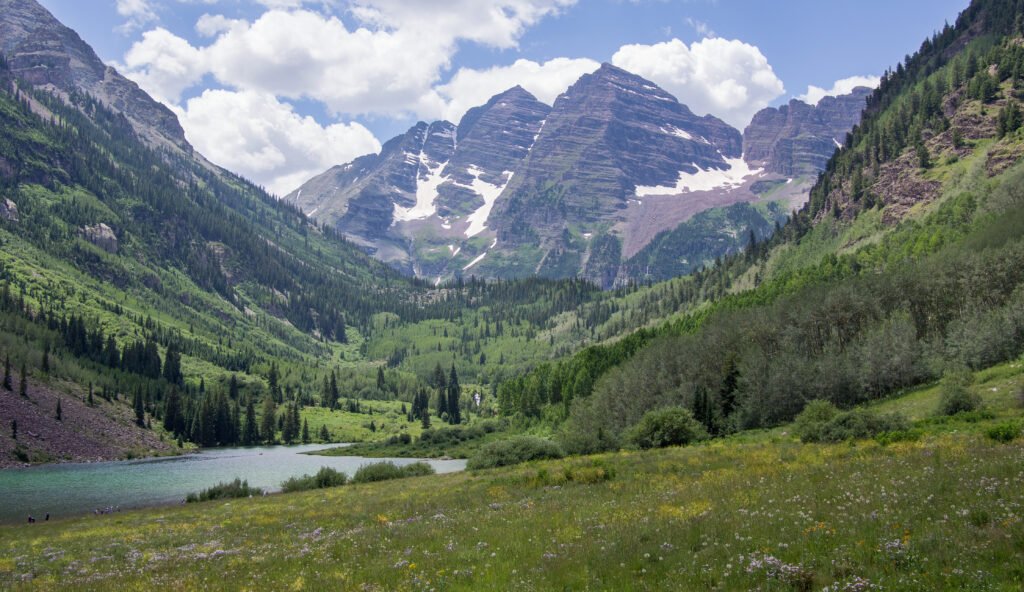
Twin 14,000-foot peaks near Aspen, their distinctive maroon-colored slopes composed of a soft, fractured mudstone that gives the Bells both their striking color and a genuinely dangerous reputation among climbers — a US Forest Service warning sign on the access trail cautions that the rock “kills without warning,” a reputation cemented after eight climbers died here in a single tragic stretch in 1965. Despite the climbing hazards, the view from Maroon Lake at the base remains one of the most photographed mountain scenes in North America, requiring no technical skill to enjoy.
Near Aspen. Entry fee; shuttle required during peak season, since Maroon Creek Road closes to private vehicles midday in summer and fall. Best at sunrise for the classic reflection shot in Maroon Lake.
Hanging Lake
A genuinely striking turquoise alpine lake suspended on a cliff shelf within Glenwood Canyon, its vivid color produced by dissolved travertine minerals depositing over millions of years — the lake’s popularity has grown so intense that a strict permit system now limits daily visitors to protect the fragile geological formation from erosion and damage, a genuine case study in balancing access against preservation at a small, easily loved natural site.
Glenwood Canyon, near Glenwood Springs. Permit required in advance. Best booking permits well ahead of a summer visit, given how quickly daily slots fill.
Glenwood Caverns Adventure Park
A genuinely unusual combination of a historic show cave and a modern amusement park, both accessible via the same gondola ride up from Glenwood Springs — visitors can tour dramatic underground cave formations and then ride roller coasters perched at the canyon’s edge within the same afternoon.
Glenwood Springs. Entry fee; cave tour and rides priced separately or combined. Best on a clear day for the gondola ride’s canyon views.
Rifle Falls State Park
A genuinely striking triple waterfall cascading over a limestone cliff face, with a network of small caves behind and beside the falls themselves that visitors can explore directly, a rare chance to walk behind a genuine waterfall and look back out through the falling water toward the canyon beyond.
Near Rifle, Western Slope. Park entry fee. Best in spring or early summer for maximum water flow.
Crystal Mill
One of the most photographed historic structures in Colorado, this wooden mill building perches dramatically on a rock outcropping directly above the Crystal River, built in 1893 to house an air compressor for nearby silver mines and remarkably still standing despite over a century of exposure to the elements.
Near Marble, Western Slope. Free to view; reached via a rough unpaved road requiring high-clearance or 4×4 vehicles. Best in fall for foliage color along the river.
Black Canyon of the Gunnison
A genuinely narrow, sheer-walled canyon carved by the Gunnison River, so steep and deep in places that sunlight reaches the canyon floor for only a brief window each day, giving the park its name — some sections of the canyon walls drop over 2,000 feet at a near-vertical pitch, among the most dramatic canyon profiles in North America, and the river’s continued erosion means the canyon is technically still deepening today.
Near Montrose, Western Slope. Park entry fee. Best combined with the South Rim Drive for the most accessible overlook views.
Colorado National Monument
A genuinely dramatic red rock canyon landscape carved into the edge of the Colorado Plateau, its scenic Rim Rock Drive offering sweeping views over sheer-walled canyons and freestanding sandstone monoliths without requiring extensive hiking to appreciate, making it a genuinely accessible way to experience Colorado Plateau canyon scenery without traveling all the way to Utah.
Near Grand Junction, Western Slope. Park entry fee. Best at sunset for the canyon walls’ warm red glow.
St. Elmo Ghost Town
One of Colorado’s best-preserved 19th-century mining ghost towns, its wooden storefronts and homes largely intact after the town’s rapid decline once the local railroad and mining operations shut down in the early 20th century — a small resident population still maintains a general store, giving the town a genuinely lived-in rather than purely museum-like atmosphere.
Near Buena Vista, Western Slope/Sawatch Range. Free to explore; rough access road. Best combined with a broader Chalk Creek Canyon scenic drive.
Leadville
The highest incorporated city in the United States at over 10,000 feet elevation, this former silver boomtown retains a genuinely well-preserved Victorian-era downtown, its history closely tied to some of the wealthiest and most dramatic mining fortunes and failures of the American West.
Central Colorado, Sawatch Range. Free to explore. Best combined with a broader Sawatch Range/Mount Elbert scenic drive given the region’s dramatic high-peak backdrop.
The San Juan Mountains
Southwestern Colorado’s San Juan range holds some of the state’s most dramatic alpine scenery, ancient Native American cliff dwellings, and genuinely remote hot springs.
Telluride
A genuinely stunning former mining town set within a box canyon ringed by 13,000-foot peaks, its historic downtown and free gondola (connecting the town to the adjacent Mountain Village) offering some of the most dramatic accessible mountain scenery in the entire state, a rare case of a genuinely free public transit system doubling as a scenic mountain experience in its own right.
San Juan Mountains. Free gondola; town exploration free. Best in fall for aspen foliage against the surrounding peaks.
San Juan Skyway
A 236-mile scenic byway looping through the heart of the San Juan Mountains, connecting Durango, Silverton, Ouray, and Telluride via genuinely dramatic high-mountain passes, considered one of the most scenic drives in the entire United States.
Southwestern Colorado. Free to drive. Best June-September, since high passes along the route close seasonally due to snow.
Mesa Verde National Park
Home to the best-preserved ancient cliff dwellings in North America, built by the Ancestral Puebloan people who inhabited this region for over 700 years before departing in the late 13th century, likely due to prolonged drought — the park’s Cliff Palace, the largest dwelling, contained roughly 150 rooms carved directly into a natural sandstone alcove, a genuinely staggering feat of construction using tools available nearly eight centuries ago.
Near Cortez, San Juan Mountains region. Park entry fee; some dwelling tours require separate tickets. Best booking ranger-led cliff dwelling tours well in advance during peak summer season.
Dunton Hot Springs
A genuinely remote and luxurious former mining ghost town, its historic log cabins restored into an upscale resort built around natural hot springs, offering a level of secluded comfort rare anywhere this deep into the San Juan backcountry.
Near Dolores, San Juan Mountains. Resort pricing (upscale); day-use options limited. Best for travelers seeking a genuine remote luxury escape rather than a budget day trip.
Pagosa Springs
Home to the deepest known geothermal hot spring in the world, its mineral-rich waters channeled into a series of soaking pools along the San Juan River, offering genuine geothermal relaxation in a dramatic mountain setting.
San Juan Mountains. Entry fee for developed spring pools. Best in winter, when soaking in steaming pools against a snowy mountain backdrop feels genuinely magical.
Crested Butte
A genuinely well-preserved Victorian mining town now designated Colorado’s official “Wildflower Capital,” its surrounding mountain meadows bursting into a spectacular multi-species wildflower bloom each summer that draws dedicated wildflower photographers from across the country.
Gunnison County, San Juan Mountains region. Free to explore town. Best mid-July for peak wildflower bloom.
The Eastern Plains
Colorado’s often-overlooked eastern plains hold genuinely surreal geological formations that most visitors never realize exist within the same state as the Rockies.
Paint Mines Interpretive Park
A genuinely surreal badlands landscape of striped clay formations in vivid shades of red, orange, and white, the same clay deposits Native American peoples mined for pottery and body paint for thousands of years before European settlement, giving the park its name.
Near Calhan, eastern plains. Free. Best at sunrise or sunset for the clay formations’ most vivid coloring.
South-Central Colorado
The San Luis Valley and surrounding mountains hold Colorado’s most genuinely bizarre natural landscape, along with a singular piece of hand-built folk art.
Great Sand Dunes National Park
Home to the tallest sand dunes in North America, reaching heights of over 750 feet, formed over thousands of years as wind carried sand from the San Luis Valley’s dry lakebed into the natural pocket created by the surrounding Sangre de Cristo Mountains. The dunes sit genuinely improbably against a backdrop of 14,000-foot snow-capped peaks, one of the most visually striking landscape juxtapositions in the entire national park system.
San Luis Valley, south-central Colorado. Park entry fee. Best in early morning or late afternoon, since the sand becomes genuinely scorching underfoot during midday summer heat.

Bishop Castle
A genuinely astonishing hand-built stone castle constructed single-handedly by one man, Jim Bishop, over more than five decades starting in the 1960s, using stone he personally gathered from the surrounding mountainside — the structure now includes a genuine iron dragon sculpture that breathes fire on special occasions, and remains entirely free to visit and climb, a remarkable feat of one person’s sustained obsession and, genuinely, one of the most singular pieces of self-taught architecture anywhere in the country.
Near Rye, south-central Colorado. Free (donations welcomed). Best on a clear day given the structure’s exposed, unenclosed upper stairways and walkways.
Mount Evans Scenic Byway
The highest paved road in North America, climbing to over 14,000 feet at the summit of Mount Evans, offering visitors the rare chance to drive to a genuine fourteener summit without hiking, alongside a resident population of mountain goats often seen directly alongside the roadway.
Near Idaho Springs, Front Range/South-Central border. Road entry fee. Best June-early September, the only season the summit road remains open and snow-free.
Steamboat Springs
A genuinely distinctive ranching-and-ski town, its natural hot springs having drawn Ute tribes and later settlers for centuries, with a walkable downtown along the Yampa River offering both genuine Western ranch culture and world-class winter recreation in the same compact, welcoming community.
Northwestern Colorado. Free to explore town; hot springs and ski resort fees vary. Best in winter for ski season, or summer for hot springs and river activities.
Colorado Road Trip & High-Altitude Basics
Colorado’s mountain roads genuinely require more careful planning than flatland driving — many high passes (Independence Pass near Aspen, Trail Ridge Road through Rocky Mountain National Park, portions of the San Juan Skyway) close entirely each winter and don’t reliably reopen until late May or June depending on snowpack, so checking seasonal road status before building an itinerary around them is essential. Mountain driving also genuinely demands more caution than most visitors expect — narrow, winding roads with steep drop-offs, sudden weather changes, and, in some areas, unpaved sections requiring higher-clearance vehicles (Crystal Mill and St. Elmo among the destinations in this guide requiring this kind of access). Afternoon thunderstorms are a genuine daily pattern across much of the Colorado high country in summer, which is exactly why experienced mountain hikers build in an early start and aim to be off any exposed summit or ridge well before early-to-mid afternoon.
Altitude sickness is a genuine concern for visitors arriving from low elevations and heading directly into Colorado’s high country — symptoms including headache, nausea, and shortness of breath can appear within hours of ascending above roughly 8,000 feet, and severe cases require descending to lower elevation. Staying well-hydrated, avoiding alcohol on the first day at altitude, and building in a day or two of acclimatization at a moderate elevation like Denver (already over 5,000 feet) before pushing into the high mountains all genuinely reduce the risk. Sun exposure is also more intense at altitude than most visitors expect, given the thinner atmosphere, making sunscreen and sun protection worth taking seriously even on cool mountain days.
Colorado Food & Craft Beer Worth Seeking Out
Colorado holds a genuinely outsized craft beer scene relative to its population, with Denver and the broader Front Range hosting one of the highest concentrations of craft breweries per capita in the entire country — the Great American Beer Festival, held annually in Denver, remains one of the most significant beer industry events in the United States, drawing thousands of entries from breweries nationwide. Colorado lamb, raised on the state’s high-altitude Western Slope pastures, is genuinely prized by chefs nationally for its distinct flavor, worth seeking out at a dedicated Colorado restaurant rather than assuming all lamb tastes the same.
Palisade, on the Western Slope near Grand Junction, produces genuinely excellent peaches thanks to a unique microclimate along the Colorado River, along with a growing and increasingly respected wine region that surprises many visitors unfamiliar with high-altitude viticulture. Green chile, a New Mexico-influenced staple that’s become genuinely central to Colorado’s own food identity (particularly Pueblo-grown chiles), shows up smothering everything from burritos to burgers across the southern half of the state, and Pueblo’s own annual Chile and Frijoles Festival celebrates the local variety with genuine civic pride.
Best Time to Visit Colorado
June through September offers the best access to high-altitude hiking, mountain passes, and most of this guide’s alpine hidden gems, since many roads and trails above 10,000 feet remain snow-covered or officially closed well into late spring in a typical year. December through March suits ski season across Colorado’s mountain resort towns, though many of the natural hidden gems in this guide become genuinely inaccessible or significantly more difficult to reach during winter months, and some, like Bishop Castle’s exposed upper walkways, are considerably less safe to explore in icy conditions.
Fall (September-early October) brings Colorado’s celebrated aspen foliage season, turning entire mountainsides gold, and is widely considered by repeat visitors to be the single best window for combining comfortable hiking weather with the state’s most dramatic seasonal color — the window is genuinely narrow, though, often lasting only two to three weeks in any given area depending on elevation and that year’s weather. Spring remains genuinely unpredictable at higher elevations, with mountain snow lingering well into May or even June in some years, making it the least reliable season for high-country travel despite pleasant weather at lower elevations like Denver and the Front Range.
I cover all of these hidden gems in the video above. If this guide helped you plan your Colorado trip, subscribe to Worldly Traveler on YouTube for more travel guides from around the world.
Frequently Asked Questions
What are the best hidden gems in Colorado?
Some of the best hidden gems in Colorado include Maroon Bells, Great Sand Dunes National Park, Hanging Lake, Garden of the Gods, and the ghost town of St. Elmo, all offering a side of the state beyond Denver and the major ski resorts.
How many days do you need to explore Colorado’s hidden gems?
10-14 days allows a well-paced loop covering the Front Range, a stretch of the Western Slope, and either the San Juan Mountains or South-Central Colorado. A shorter 5-7 day trip can focus on just one or two regions.
What is the best time of year to visit Colorado?
June-September offers the best access to high-altitude hiking and most mountain passes, while December-March suits ski season. Many alpine destinations remain snow-covered or inaccessible outside these windows.
Do you need to worry about altitude sickness in Colorado?
Genuinely, yes, especially for visitors arriving from low elevations and heading directly into the high mountains — staying hydrated, ascending gradually when possible, and knowing the symptoms of altitude sickness are all worth taking seriously.
Can you drive to Maroon Bells directly?
During peak summer and fall season, Maroon Creek Road is closed to private vehicles during the day, and visitors must take a shuttle bus from Aspen Highlands, though early morning and evening direct access is sometimes available outside shuttle operating hours.