
Albania spent most of the second half of the 20th century almost entirely sealed off from the outside world, and that isolation, once one of the strangest and most restrictive in Europe, has left behind something genuinely rare today: a Mediterranean coastline that still feels, in patches, undiscovered. This guide, checked against a real video tour, covers 25 hidden gems along the Albanian Riviera and beyond, organized by region so you can build a trip through whichever corner of the country calls to you.
Tirana & Saranda: Albania’s capital and its southern gateway city remain worth a stop on any first trip, and Tirana’s own transformation deserves its own dedicated guide, covered separately on this site.
What makes Albania genuinely different from its Balkan and Mediterranean neighbors is how recently it’s opened up at all. Under dictator Enver Hoxha, the country pursued one of the most extreme isolationist policies of the entire Cold War, closing its borders almost completely and scattering hundreds of thousands of concrete bunkers across the landscape in preparation for an invasion that never came. That history ended only in the early 1990s, which means the tourism infrastructure most Mediterranean countries built up over decades is, in Albania, still genuinely being built in real time. For travelers, that translates into beaches and villages that would carry the crowds and prices of Croatia or the Amalfi Coast anywhere else, but here still feel like something closer to a discovery.
The Albanian Riviera
The Accursed Mountains
Berat & Gjirokastër’s Old Towns
Lake Ohrid
Albania’s Communist-Era History
Comparing Albania’s Regions
Albanian Food Worth Seeking Out
Best Time to Visit Albania
FAQ
The Albanian Riviera
Stretching along the Ionian coast between Vlorë and Saranda, this is Albania’s most talked-about region, and genuinely earns the comparisons to Croatia’s Dalmatian coast a decade ago.
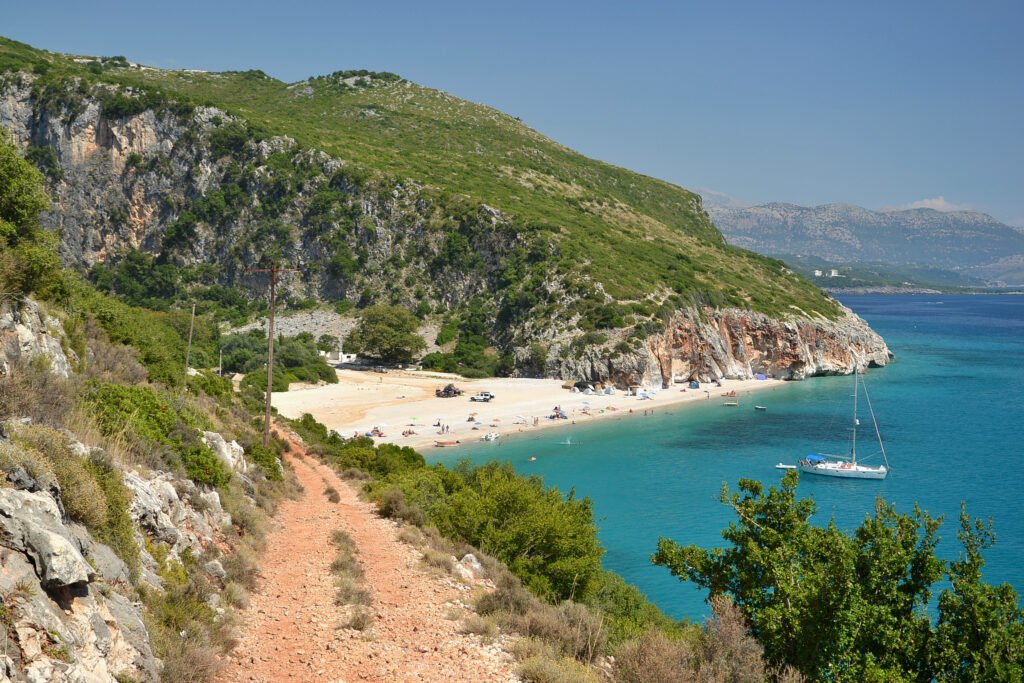
Gjipe Beach
A striking white-pebble beach hidden at the mouth of a limestone canyon, reachable only by a roughly hour-long hike down through the gorge or by boat, a genuine effort that keeps the crowds here noticeably thinner than more accessible beaches nearby.
Between Dhermi and Vuno, Vlorë County. Free. Best arriving early in the day, both for cooler hiking temperatures and to claim space on the small beach.
Porto Palermo Castle
A triangular Ottoman fortress built on its own small peninsula, originally constructed under Venetian rule before being rebuilt and fortified in the 19th century by Ali Pasha of Ioannina, a notorious and powerful regional ruler whose castles dot this entire stretch of coast.
Himarë, Vlorë County. Small entry fee. Best combined with a swim at the small beach directly beside the fortress.
%202.JPG)
Qeparo Old Village
A genuinely abandoned stone village climbing a hillside above the modern coastal settlement of the same name, its empty houses and narrow lanes left largely untouched since residents moved down to the coast decades ago, offering an eerie, atmospheric wander through a Riviera town frozen mid-transition.
Above Qeparo, Vlorë County. Free to explore. Best in the late afternoon, when the light picks out the texture of the weathered stone.
Dhermi Old Village
Set back in the hills above the busier beach resort of the same name, Dhermi’s old village retains a genuinely traditional Riviera character, stone houses and a historic church, largely bypassed by the beach crowds below.
Above Dhermi, Vlorë County. Free to explore. Best combined with a Dhermi beach day, given the short drive up into the hills.
Grama Bay
A genuinely remote, dramatic bay accessible only by boat, its cliffs covered in ancient Greek and Roman-era inscriptions carved by sailors sheltering here over roughly two thousand years, a quiet open-air record of maritime history along this coast.
Between Palasa and Himarë, Vlorë County. Boat access required. Best on a boat tour that allows time to actually land and see the inscriptions up close.
Llogara Pass
A dramatic mountain pass connecting the Riviera to the rest of southern Albania, its road climbing to over 1,000 meters through pine forest before descending sharply toward the coast, with sweeping views over the Ionian Sea from several roadside viewpoints along the way.
Vlorë County, Llogara National Park. Free to drive. Best in the early morning for the clearest visibility across the coast below.
Ali Pasha Bridge
A genuinely picturesque Ottoman-era stone bridge, another legacy of the powerful regional ruler whose castles and infrastructure projects still shape this part of southern Albania, its arched span offering a quieter historical counterpoint to the coast’s beach-focused attractions.
Southern Albania. Free to view. Best combined with a broader inland detour away from the coast road.
Karaburun Peninsula
A genuinely wild, largely uninhabited peninsula forming a marine national park, its rugged coastline and clear water drawing divers and boat tours to a stretch of Albania’s coast that remains almost entirely undeveloped.
Vlorë County. Boat tour access. Best for travelers specifically seeking Albania’s least developed coastal scenery.
Zvërnec Island
A small island connected to the mainland by a wooden footbridge through a lagoon, home to a medieval Orthodox monastery whose weathered stone walls and bell tower make it one of the more atmospheric religious sites along the coast.
Narta Lagoon, near Vlorë. Free to walk the footbridge; monastery donations welcome. Best at sunset, when the lagoon’s still water reflects the island and monastery.
The Accursed Mountains
In Albania’s far north, a genuinely dramatic range straddles the border with Montenegro and Kosovo, its ominous English name a rough translation of the local “Bjeshkët e Nemuna.”
Theth
A remote mountain village that remained largely cut off from the rest of Albania by poor roads until relatively recently, its traditional stone houses and dramatic surrounding peaks now drawing hikers from across Europe, particularly along the popular Theth-to-Valbona trekking route.
Shkodër County, Albanian Alps National Park. Free to explore village; guided trekking fees vary. Best in summer, when the high mountain trails are fully clear of snow.

Valbona Valley
A genuinely spectacular glacial valley, its steep, forested walls rising toward some of the highest peaks in the Accursed Mountains, connected to Theth by a demanding but rewarding day-long hike over the Valbona Pass.
Kukës County, Valbona Valley National Park. Free. Best combined with the Theth trek for the fullest experience of the range.
Berat & Gjirokastër’s Old Towns
Away from both the coast and the mountains, two UNESCO World Heritage towns hold Albania’s most significant Ottoman-era architecture.
Berat
Genuinely nicknamed the “Town of a Thousand Windows,” Berat’s old quarter climbs a hillside in tiers of white Ottoman houses, each stacked to preserve its neighbor’s view, crowned by a hilltop castle still home to several working churches and a small resident population.
Central Albania. Free to explore town; castle entry fee. Best at sunset, when the white houses catch the day’s last light.
Gjirokastër
Known as the “City of Stone” for its distinctive gray stone-roofed houses, Gjirokastër’s steep, cobbled old town and imposing hilltop castle reflect a genuinely different architectural character from Berat’s whitewashed hillside, and the town is also the birthplace of both Albania’s longtime dictator Enver Hoxha and the internationally acclaimed writer Ismail Kadare.
Southern Albania. Free to explore town; castle entry fee. Best combined with a visit to the castle’s small arms museum, which includes a preserved American fighter jet from the Cold War era.
Lake Ohrid
Straddling the border with North Macedonia, this ancient lake, among the oldest in the world, holds a quieter slice of shoreline on the Albanian side.
Lin Peninsula
A small, quiet peninsula jutting into Lake Ohrid, home to the archaeological remains of an early Christian basilica with mosaic floors, offering a genuinely peaceful, uncrowded alternative to the busier Macedonian side of the lake just across the water.
Pogradec area, eastern Albania. Free. Best at sunset, when the lake’s water turns a deep, still blue.
Albania’s Communist-Era History
Understanding Albania’s 20th-century isolation genuinely changes how a lot of the country’s landscape reads. Enver Hoxha’s regime, which ruled from the end of the Second World War until 1985, pursued an isolationist policy so extreme that Albania eventually severed ties even with its fellow communist allies, the Soviet Union and later China, leaving the country almost entirely cut off from outside contact by the 1970s. Fearing invasion that never materialized, the regime built an estimated 170,000 concrete bunkers across the country, many still visible today dotting hillsides, beaches, and farmland, a genuinely strange and ubiquitous physical legacy of that paranoia. Gjirokastër’s castle museum, with its preserved Cold War-era military hardware, and Tirana’s own communist-era landmarks (covered in more depth in this site’s dedicated Tirana guide) both offer a more direct way to engage with this history than the bunkers alone.
Comparing Albania’s Regions
| Region | Best For | Getting Around | Crowd Level |
|---|---|---|---|
| The Riviera | Beaches, coastal hiking, boat tours | Rental car along the coast road | Busy in July-August, quiet outside peak season |
| Accursed Mountains | Serious hiking and trekking | Rental car to trailheads, then on foot | Genuinely quiet even in summer |
| Berat & Gjirokastër | Ottoman architecture, history | Rental car or intercity bus | Moderate, growing but not overwhelmed |
| Lake Ohrid | Quiet lakeside scenery | Rental car | Genuinely uncrowded on the Albanian side |
Albanian Food Worth Seeking Out
Albanian cuisine draws on Ottoman, Italian, and Greek influences layered over centuries, and byrek, a flaky savory pastry filled with cheese, spinach, or meat, remains genuinely central to daily eating, sold fresh from small bakeries across the country. Along the Riviera, fresh grilled seafood, particularly at family-run restaurants in villages like Dhermi and Himarë, reflects the coast’s genuine fishing tradition, worth seeking out over more tourist-oriented options closer to the busiest beaches. Tavë kosi, baked lamb with yogurt and rice, is genuinely considered a national dish, and Berat and Gjirokastër’s old towns both hold traditional restaurants serving versions passed down through generations. Raki, a strong fruit brandy similar to varieties found across the Balkans, is worth trying in moderation, particularly the homemade versions still common in rural mountain villages like Theth.
Best Time to Visit Albania
May, June, and September offer warm, sunny weather with noticeably thinner crowds than July and August, which bring both the highest temperatures and the busiest, most expensive stretch of the year along the Riviera. Spring and early summer are genuinely the best window for the Accursed Mountains, since the Theth-Valbona trek and other high routes require trails clear of snow, typically achieved by June. Summer remains the most popular season for the coast despite the crowds, given the reliable swimming weather. Winter stays quiet across the entire country, and while the Riviera’s beach towns largely shut down for the season, Berat and Gjirokastër’s old towns remain genuinely worth visiting year-round, offering a peaceful, uncrowded alternative for travelers less focused on beach weather.
I cover all of these hidden gems in the video above. If this guide helped you plan your Albania trip, subscribe to Worldly Traveler on YouTube for more travel guides from around the world.
Frequently Asked Questions
What are the best hidden gems in Albania?
Some of the best hidden gems in Albania include Gjipe Beach (reachable only by a canyon hike or boat), Porto Palermo Castle, the old villages of Dhermi and Qeparo, the Llogara Pass, and Zvërnec Island’s monastery.
Is the Albanian Riviera crowded?
Less so than comparable Mediterranean coastlines, though that’s genuinely changing fast. Popular spots like Dhermi and Jale get busy in July and August, but many of the beaches covered in this guide still see a fraction of the crowds found on the Amalfi Coast or in Croatia.
How many days do you need to explore Albania’s hidden gems?
10-14 days allows a well-paced trip covering the Riviera coast, a stretch of the Accursed Mountains, and the old towns of Berat or Gjirokastër. A shorter 5-7 day trip works well focused on just the coast.
What is the best time of year to visit Albania?
May, June, and September offer warm, sunny weather with noticeably thinner crowds than July and August, which are the busiest and hottest months along the Riviera.
Do you need a car to explore Albania’s hidden gems?
Yes, genuinely, for most of this guide. The Riviera’s coast road connects many beaches, but reaching villages like Qeparo’s old town or the trailheads into the mountains realistically requires a rental car.