
Ultimate Ireland Travel Guide: 25 Hidden Gems + Everything You Need to Know
Everyone plans their Ireland trip around the same five stops: Dublin, the Cliffs of Moher, Killarney, maybe Galway. They’re worth seeing, but they’re also where every tour bus in the country ends up at the same time. The real hidden gems in Ireland — the monastic island that inspired a galaxy far, far away, a road that climbs into the clouds, a beech tunnel older than the tourists who now photograph it — sit just off that well-worn route. I cover all 25 of these in the video below, so start there if you want to see them in motion, then use this guide to actually plan the trip around them.
Wild Atlantic Way & the West
Ring of Kerry & the Southwest
Northern Ireland & the Causeway Coast
Dublin & the East
Islands
Best Time to Visit Ireland
How to Get Around Ireland
Suggested Road Trip Itinerary
Packing & Travel Essentials
FAQ
Wild Atlantic Way & the West
1. The Burren
A vast limestone plateau in County Clare that looks more like the surface of the moon than anywhere else in Ireland, the Burren’s cracked “pavement” rock hides rare Arctic and Mediterranean plants growing side by side in its fissures. Ancient tombs dot the landscape, some older than the Egyptian pyramids.
Region: County Clare. Free to explore. Best in spring when the wildflowers bloom in the rock crevices.
2. Doolin Cave
Home to the Great Stalactite, one of the largest free-hanging stalactites in the world at over 7 meters long, this cave sits just minutes from the Cliffs of Moher yet gets a fraction of the visitors. The guided walk through the cave system is genuinely dramatic.
Region: County Clare, near Doolin. Entry fee (~€16). Booking ahead recommended in summer.
3. Loop Head Peninsula
While everyone crowds the Cliffs of Moher viewing platform, Loop Head offers comparable cliff scenery, a working lighthouse, and almost total solitude at the very tip of County Clare, where the Shannon Estuary meets the open Atlantic.
Region: County Clare. Free; lighthouse tours have a small fee. Best at sunset.
4. The Céide Fields
Beneath a blanket of Atlantic bog lies the oldest known field system in the world, over 5,500 years old, preserved intact by the peat that grew over it. A visitor center explains how Stone Age farmers organized this landscape millennia before Stonehenge.
Region: County Mayo. Entry fee (~€5). Best on a clear day for the coastal views from the visitor center.
5. Gleniff Horseshoe
A dramatic glacial valley drive looping beneath the cliffs of the Dartry Mountains in County Sligo, Gleniff feels remote even by rural Ireland standards. It’s the kind of scenic drive locals know and tourists almost never find.
Region: County Sligo. Free, single-track scenic drive. Best in clear weather; narrow road not suited to large vehicles.
6. Slieve League Cliffs
Nearly three times the height of the Cliffs of Moher, Slieve League is one of the highest sea cliffs in Europe, yet stays remarkably uncrowded thanks to its remote County Donegal location. The Bunglass viewpoint delivers one of the most dramatic coastal views in the country.
Region: County Donegal. Free. Best in the morning before clouds roll in off the Atlantic.

7. Doe Castle
A 16th-century tower house on a spit of land nearly surrounded by water, Doe Castle looks like something out of a fairy tale and served as a stronghold for the MacSweeney clan for generations. It’s free to explore and almost always empty.
Region: County Donegal. Free. Best combined with a drive along the Donegal coast.
Ring of Kerry & the Southwest
8. Healy Pass
A winding mountain road connecting the Beara Peninsula’s two counties, Healy Pass climbs through hairpin turns with sweeping views over Glanmore Lake and the surrounding valleys. It’s one of Ireland’s great driving roads, and far less traveled than the Ring of Kerry.
Region: Cork/Kerry border. Free, narrow mountain road. Best driven early in the day.
9. Diamond Hill
The signature hike of Connemara National Park, Diamond Hill rewards a moderate 2-3 hour climb with panoramic views over the Twelve Bens mountain range and Ballynakill Harbour below.
Region: County Galway, Connemara. Free park entry. Best on a clear day; the summit view is weather-dependent.
10. Gougane Barra
A tiny stone chapel sits on an island in a lake ringed by forested mountains, marking the spot where Saint Finbarr founded a monastery in the 6th century. It’s one of the most peaceful, least-visited spots in West Cork.
Region: County Cork. Free. Best in autumn for the surrounding forest colors.
11. The Kingdom of Kerry
Beyond the famous Ring of Kerry loop, the wider Kerry countryside holds quiet lanes, unmarked viewpoints, and villages that see a fraction of the tour-bus traffic that clogs the main route in summer.
Region: County Kerry. Free to explore. Best explored by detouring off the main Ring of Kerry road.
12. Eyeries Village
A tiny Beara Peninsula village where every house is painted a different bright color, Eyeries looks almost unreal against the green hills and gray Atlantic behind it. It’s one of Ireland’s most photogenic and least-visited villages.
Region: County Cork, Beara Peninsula. Free. Best in good light for photos.
13. Carrauntoohil
Ireland’s highest peak at just over 1,000 meters, Carrauntoohil offers serious hikers a genuine mountain challenge with views stretching across the whole of Kerry on a clear day.
Region: County Kerry, MacGillycuddy’s Reeks. Free; guided hikes recommended for the Devil’s Ladder route. Best in summer for stable weather.
14. Charles Fort
A star-shaped 17th-century coastal fortress overlooking Kinsale Harbour, Charles Fort saw action in multiple conflicts over three centuries and remains remarkably intact, with sweeping harbor views from its ramparts.
Region: County Cork, near Kinsale. Entry fee (~€5). Best paired with a walk into Kinsale town.
15. Mizen Head
The most southwesterly point in Ireland, Mizen Head features a dramatic signal station connected to the mainland by a footbridge over crashing Atlantic waves. It’s a wilder, quieter alternative to the more famous cliff viewpoints further north.
Region: County Cork. Entry fee (~€8). Best on a clear, calm day for the coastal views.
16. Glengarriff
A sheltered village where the Gulf Stream keeps a subtropical woodland garden thriving on Garinish Island just offshore, Glengarriff feels almost Mediterranean compared to the rest of rugged West Cork.
Region: County Cork. Village free; Garinish Island ferry and garden entry fee (~€15 combined). Best in late spring for the garden blooms.
Northern Ireland & the Causeway Coast
17. The Dark Hedges
An avenue of beech trees planted in the 18th century now forms a natural tunnel over Bregagh Road, made famous as a filming location for a major fantasy series. Visit at dawn to see it without the crowds that gather later in the day.
Region: County Antrim. Free. Best at sunrise, before tour groups and traffic restrictions kick in.
.jpg)
18. Carrick-a-Rede Rope Bridge
A swaying rope bridge connects the mainland to a tiny island off the Antrim coast, originally built by salmon fishermen. The crossing is short but the drop and the views make it memorable.
Region: County Antrim. Entry fee (~£15). Booking ahead recommended in peak season.
19. Rock of Dunamase
The ruins of a medieval fortress sit atop a limestone outcrop rising dramatically from the flat Laois countryside, with a history stretching back to Viking raids and Norman conquest.
Region: County Laois. Free. Best at golden hour for photos of the ruins against the surrounding farmland.
20. Lough Tay (Guinness Lake)
A dark lake ringed by steep granite slopes and a white sand “beach” that gave it its nickname, Lough Tay sits on the historic Guinness family estate in the Wicklow Mountains and is one of the most photographed viewpoints in the county.
Region: County Wicklow. Viewpoint free (lake itself is private property). Best from the roadside viewpoint on the R759.
21. Sally Gap Drive
A high mountain pass through the Wicklow Mountains, Sally Gap crosses open blanket bog above the tree line, with views that feel closer to the Scottish Highlands than anywhere else near Dublin.
Region: County Wicklow. Free scenic drive. Best avoided in fog or heavy rain — visibility drops fast at altitude.
Dublin & the East
22. Powerscourt Gardens
One of the finest formal gardens in Ireland, Powerscourt combines Italian terraces, a Japanese garden, and a walled garden across 47 acres, with the Sugarloaf Mountain as a backdrop. It’s a short drive from Dublin yet feels worlds away.
Region: County Wicklow, near Enniskerry. Entry fee (~€12). Best in late spring for the rhododendrons.

Islands
23. Skellig Michael
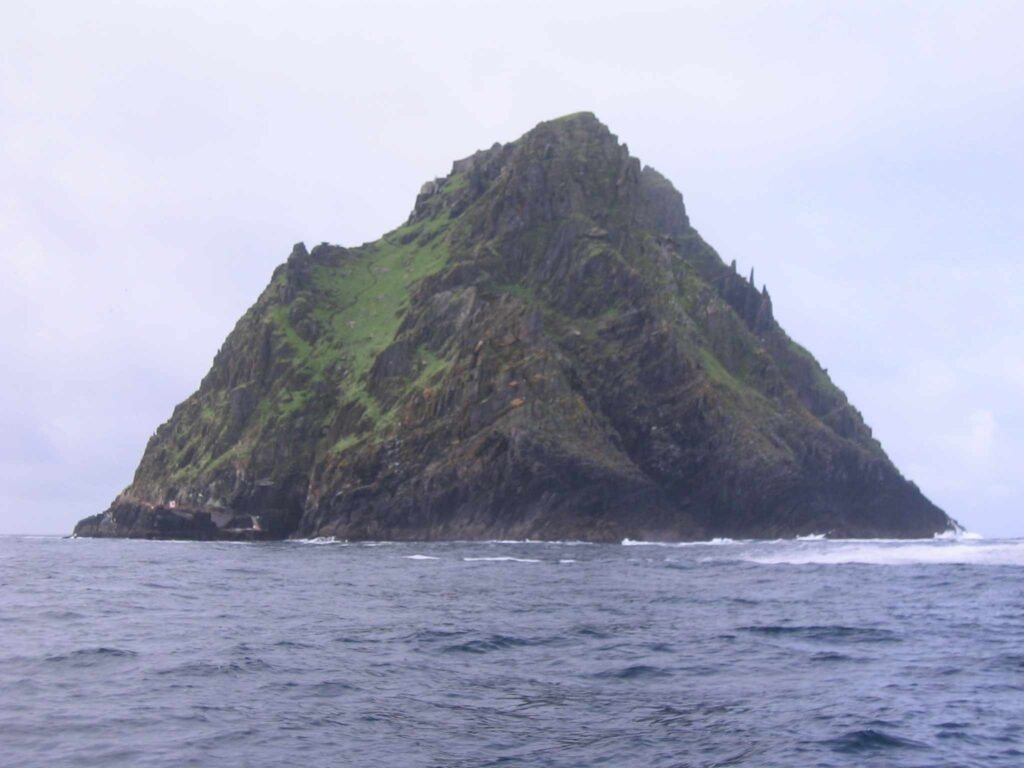
A jagged rock rising from the Atlantic 12 kilometers off the Kerry coast, Skellig Michael holds the remains of a 6th-century monastic settlement built into stone beehive huts near the summit — and gained a new wave of fame as a filming location for a galaxy far, far away.
Region: County Kerry, boat departs from Portmagee. Boat trip required (~€100), weather-dependent and books out weeks ahead in summer.
24. Inisheer (Inis Oírr)
The smallest of the three Aran Islands, Inisheer can be walked end to end in an afternoon, past stone walls, a shipwreck on the beach, and a ruined castle overlooking the harbor. It sees far fewer visitors than its larger neighbor, Inishmore.
Region: County Galway, ferry from Doolin or Ros a Mhíl. Ferry fee (~€25 return). Best as a full-day trip.
25. Innisfree
A tiny, uninhabited island on Lough Gill made famous by W.B. Yeats’s poem “The Lake Isle of Innisfree,” this spot rewards the literary-minded traveler with the same quiet the poet described over a century ago.
Region: County Sligo, Lough Gill. Viewable from the shore or by boat tour. Best on a still morning for lake reflections.
Best Time to Visit Ireland
Summer (June-August): The mildest weather and longest daylight — up to 17 hours of light in June — but also the busiest and most expensive season, especially around the Ring of Kerry and Cliffs of Moher.
Shoulder season (April-May, September-October): The best balance for most travelers. Fewer crowds, lower accommodation prices, and still-reasonable weather, though rain is more likely than in summer.
Winter (November-March): Quiet and atmospheric, especially in coastal areas, but many rural attractions reduce hours or close, and days are short — as little as 8 hours of daylight in December.
Rain reality check: Ireland gets rain year-round. Packing for it matters more than picking the “driest” month.
How to Get Around Ireland
Renting a car: Essential for reaching the vast majority of the hidden gems on this list. Most car rental companies require drivers to be at least 21-23 with a valid license held for a minimum period — check requirements before booking.
Driving on the left: Ireland drives on the left. Roundabouts and narrow rural roads (especially routes like Healy Pass, Sally Gap, and Gleniff Horseshoe) take some adjustment — go slow on unfamiliar single-track roads with passing bays.
Public transport: Trains and buses connect major cities and towns well, but rural hidden gems are largely inaccessible without a car or a guided tour.
Road conditions: Main routes (N-roads and motorways) are excellent. Regional and local roads (R-roads and L-roads) can be narrow, winding, and occasionally single-track — budget more time than GPS estimates suggest, especially in Kerry, Donegal, and Wicklow.
Suggested Ireland Road Trip Itinerary
A realistic 7-10 day loop that hits a meaningful cross-section of the gems above without over-packing the days:
Days 1-2: Dublin & Wicklow. Arrive in Dublin, then head south into the Wicklow Mountains for Sally Gap, Lough Tay, and Powerscourt Gardens.
Days 3-4: Southwest & Kerry. Drive to Kinsale (Charles Fort), continue along the Beara Peninsula (Healy Pass, Eyeries Village, Glengarriff), then into Kerry for a Skellig Michael boat trip if weather allows.
Days 5-6: Clare & the Wild Atlantic Way. Head north through the Burren, Doolin Cave, and Loop Head Peninsula, with a possible detour to Inisheer.
Days 7-8: Donegal & the Northwest. Continue up the coast to Slieve League Cliffs, Gleniff Horseshoe, and the Céide Fields, with a stop at Lough Gill for Innisfree.
Days 9-10: Antrim & the North. Finish with the Dark Hedges, Carrick-a-Rede Rope Bridge, and the Causeway Coast before returning to Dublin or Belfast.
Ireland Packing & Travel Essentials
Layers: Temperatures rarely swing to extremes, but weather changes fast — pack a waterproof jacket, a warm mid-layer, and sturdy waterproof shoes regardless of season.
Driving essentials: An international driving permit if required by your home country, a phone mount for GPS, and a portable charger for long rural stretches with limited services.
Connectivity: Coverage is generally good, but drops out in remote areas like the Beara Peninsula and parts of Donegal — download offline maps before heading into rural regions.
Cash: Most places take cards, but small rural shops and parking machines in remote areas sometimes cash-only — keep some euros (or pounds sterling in Northern Ireland) on hand.
I cover all 25 of these spots in the video above, with footage from Skellig Michael, the Dark Hedges, Slieve League, and more. If this guide helped you plan, subscribe to Worldly Traveler on YouTube for more hidden gems guides from around the world.
Frequently Asked Questions
What are the best hidden gems in Ireland?
Some of the best hidden gems in Ireland include Skellig Michael, the Dark Hedges, Slieve League Cliffs, Healy Pass, and the Burren. These places deliver Ireland’s dramatic scenery and history without the crowds found at the Cliffs of Moher or central Dublin.
How many days do you need for an Ireland road trip?
7 to 10 days is enough to comfortably drive a loop covering the Wild Atlantic Way, the southwest peninsulas, and a stop in Dublin or Wicklow, with time to actually stop at the hidden gems along the way rather than just driving past them.
What is the best time of year to visit Ireland?
Late May through early September offers the mildest weather and longest daylight hours, though it’s also the busiest season. Shoulder months like April, May, September, and October offer thinner crowds and lower prices, with a higher chance of rain.
Do you need a car to see Ireland’s hidden gems?
Yes, for almost all of them. Public transport covers cities and larger towns well, but most hidden gems — scenic drives, remote coastlines, and rural mountain passes — are only practically reachable by car.
Is it expensive to visit Ireland’s hidden gems?
Most hidden gems are free to visit, including the Dark Hedges, Healy Pass, the Burren, and Slieve League. A handful charge entry, such as Powerscourt Gardens and Doolin Cave, generally in the €10-20 range, and Skellig Michael requires a paid boat trip.