
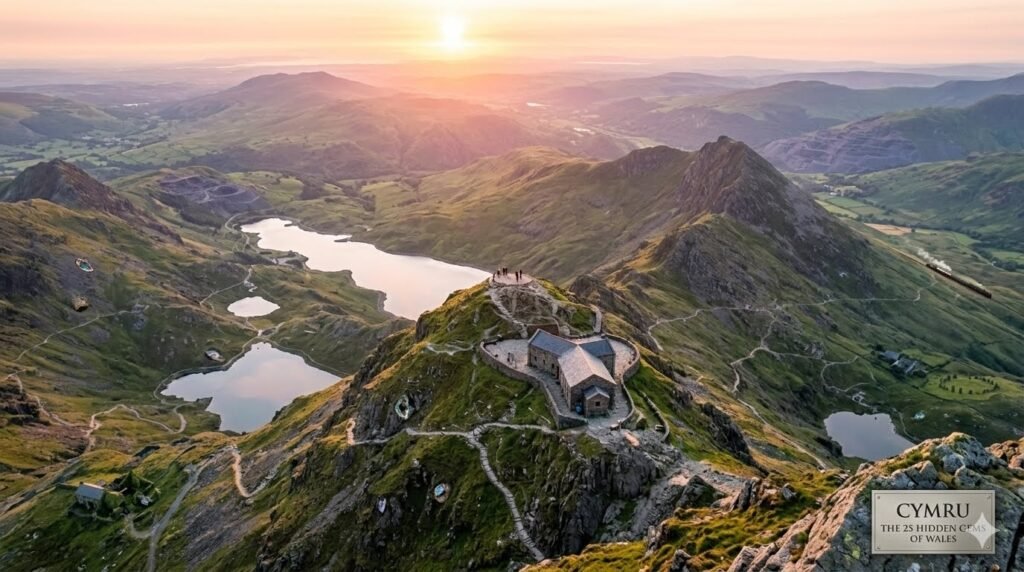
Snowdon and Cardiff draw the bulk of Wales’s visitors, but the country packs a striking amount of scenery and history into a relatively small footprint — waterfalls you can walk behind, ruined abbeys wrapped in ivy, and coastal islands connected only at low tide. This guide covers more than 25 hidden gems in Wales, verified against independent sources, organized by region. I cover the core list in the video below, with additional verified spots included here to round things out.
Wales’s compact size — smaller than most US states — belies how varied its landscape actually is. Snowdonia’s mountains in the north give way to the rolling, sparsely populated hills of Mid Wales, then to the dramatic sea cliffs of the Pembrokeshire Coast in the southwest, before ending in the more industrial, castle-dense southeast around Cardiff. Welsh culture and language remain genuinely present throughout, not a tourist affectation — road signs are bilingual nationwide, and many of the villages and natural features in this guide carry Welsh names centuries older than their English equivalents.
Snowdonia & North Wales
Mid Wales & the Brecon Beacons
Pembrokeshire & the Southwest
Cardiff & Southeast Wales
Getting Around Wales
FAQ
Snowdonia & North Wales
North Wales holds the country’s most dramatic mountain scenery, along with a scattering of genuinely unusual man-made attractions.
1. Portmeirion Village
An Italianate fantasy village built by architect Clough Williams-Ellis over five decades starting in 1925, most famous as the filming location for the 1960s TV series “The Prisoner,” with pastel buildings overlooking the Dwyryd estuary.
Gwynedd, near Porthmadog. Entry fee. Best on a sunny day for the full color palette.
2. Porth Wen Brickworks
The atmospheric ruins of a Victorian-era brickworks on the Anglesey coast, its chimneys and kilns slowly being reclaimed by the sea, reached by a coastal footpath.
Anglesey. Free; reached by a moderate coastal walk. Best combined with a wider Anglesey coast path walk.
3. Aber Falls
A dramatic 37-meter waterfall in the Carneddau mountains, reached by a gentle riverside walk through ancient woodland, one of the most accessible substantial waterfalls in Snowdonia.
Near Abergwyngregyn, Gwynedd. Free. Best after rainfall for the fullest flow.
4. Llanddwyn Island
A tidal island off Anglesey associated with Dwynwen, the Welsh patron saint of lovers, with a ruined chapel, two lighthouses, and sweeping views across to the Llŷn Peninsula and Snowdonia’s mountains.
Newborough, Anglesey. Free (car park fee at Newborough Beach). Best at low tide and sunset.

5. The Blue Lake, Fairbourne
A striking turquoise flooded former slate quarry near Fairbourne, its unusual mineral-tinted water color drawing photographers, though swimming is officially discouraged due to underwater hazards.
Near Fairbourne, Gwynedd. Free to view. Best for photography rather than swimming.
6. The Smallest House in Great Britain
A genuinely tiny red-fronted cottage on the Conwy quayside, measuring just over three meters by less than two, occupied until 1900 and now a small museum piece.
Conwy. Small entry fee. Best combined with a Conwy Castle visit.
7. Dolaucothi Gold Mines
The only known Roman gold mine in Britain, with underground tunnels open for guided tours revealing nearly 2,000 years of mining history layered from Roman times through the 20th century.
Carmarthenshire. Entry fee for underground tours. Best combined with a National Trust membership visit.
8. The Fairy Glen, Betws-y-Coed
A narrow, moss-covered gorge with a rushing river, considered one of the most atmospheric short walks in Snowdonia, tucked just outside the popular village of Betws-y-Coed.
Near Betws-y-Coed. Small entry fee. Best after rain for a fuller river.
Mid Wales & the Brecon Beacons
Wales’s central region holds some of its best waterfalls and least-visited mountain scenery, largely bypassed by travelers racing between North and South Wales.
9. Sgwd yr Eira Waterfall
One of the most distinctive waterfalls in Britain, where the path actually passes behind the falling water through a rock overhang, part of the Four Waterfalls Walk in the Brecon Beacons.
Near Ystradfellte, Brecon Beacons. Free. Best after rainfall; footing can be slippery behind the falls.
10. Llyn y Fan Fach
A glacial lake beneath the dramatic escarpment of the Black Mountain, tied to Welsh folklore about a “Lady of the Lake,” reached by a moderate hike from the nearest car park.
Carmarthenshire, Brecon Beacons. Free. Best on a clear day for the escarpment views.
11. The Skirrid Mountain Inn
Reputedly one of the oldest pubs in Wales, with a history stretching back roughly 900 years and a notorious past as a site of hangings, now a popular stop for its atmosphere as much as its food.
Llanvihangel Crucorney, Monmouthshire. Standard pub pricing. Best for an evening meal with genuine history attached.
12. The Witches’ Cauldron (Pwll y Wrach)
A dramatic waterfall and nature reserve near Talgarth, its name derived from local folklore, with a short woodland trail leading to the falls.
Near Talgarth, Powys. Free. Best after rain for the fullest water flow.
13. The Red Kite Feeding Station, Rhayader
A wildlife center offering close-up views of red kites, a bird of prey brought back from the brink of British extinction through a dedicated conservation program centered on this region.
Gigrin Farm, Rhayader. Entry fee. Best at the scheduled daily feeding time (afternoon).
14. The Lonely Tree, Llanfyllin
A solitary, widely photographed tree standing on an open hillside near Llanfyllin, a genuinely simple but striking landscape photography subject well known among Welsh photography circles.
Near Llanfyllin, Powys. Free. Best at sunrise or sunset.
15. Devil’s Bridge Falls
A series of dramatic waterfalls near Aberystwyth, where three bridges from three different eras (medieval, 18th-century, and modern) are stacked directly atop one another over the gorge.
Near Aberystwyth, Ceredigion. Small entry fee for the falls trail. Best after rainfall.
Pembrokeshire & the Southwest
Wales’s southwestern coast holds some of the country’s most dramatic clifftop scenery and least-crowded beaches.
16. St. Govan’s Chapel
A tiny medieval chapel wedged into a cliff crevice on the Pembrokeshire coast, reached by a steep set of stone steps, tied to local legend about a hermit who hid from pirates in the rock.
Pembrokeshire coast, near Bosherston. Free; note the site sometimes closes for military range activity — check before visiting. Best at low tide.
17. Mwnt Beach
A small, sheltered cove beneath a distinctive conical hill topped by a whitewashed 14th-century chapel, considered one of the prettiest and least-developed beaches on the Cardigan Bay coast.
Ceredigion coast. Free; National Trust parking fee. Best on a clear day for whale and dolphin spotting offshore.
18. Skomer Island
A protected island off the Pembrokeshire coast, home to one of the largest Manx shearwater colonies in the world and a substantial puffin population, reachable by a short boat trip.
Off Marloes, Pembrokeshire. Boat fare plus landing fee. Best April-July for puffins.
19. Strumble Head Lighthouse
A remote lighthouse on a rugged headland near Fishguard, considered one of the best whale and dolphin watching points on the Welsh coast, with far fewer visitors than more famous Pembrokeshire spots.
Near Fishguard, Pembrokeshire. Free. Best for wildlife watching in late summer.
20. The Hidden Waterfall at Nantcol
A little-known waterfall in the Nantcol Valley below the Rhinogydd mountains, reached by a quiet farmland walk well off the main Snowdonia tourist trail.
Nantcol Valley, near Llanbedr, Gwynedd. Free. Best after rainfall.
Cardiff & Southeast Wales
21. Castell Coch
A fairy-tale Victorian Gothic revival castle built atop medieval ruins just outside Cardiff, with an extraordinarily ornate interior that feels more like a stage set than a historic residence.
Near Cardiff (Tongwynlais). Entry fee (Cadw). Best combined with a Cardiff day trip.
22. Tintern Abbey
A ruined 12th-century Cistercian abbey in the Wye Valley, its roofless Gothic arches inspiring both Wordsworth’s poetry and Turner’s paintings, remaining one of the best-preserved medieval ruins in Britain.
Wye Valley, Monmouthshire. Entry fee (Cadw). Best from the Devil’s Pulpit viewpoint across the valley for the classic photo.

23. Penarth Pier
A restored Victorian seaside pier near Cardiff, with an art deco pavilion and views across the Bristol Channel, offering a genteel counterpoint to Cardiff’s busier city-center attractions.
Penarth, near Cardiff. Free to walk the pier. Best at sunset.
24. The Secret Garden at Dyffryn Gardens
A restored Edwardian estate garden near Cardiff, with formal terraces, themed garden “rooms,” and a large arboretum, considerably less visited than Wales’s more famous castle gardens.
Near St Nicholas, Vale of Glamorgan. Entry fee (National Trust). Best in late spring for peak bloom.
25. The Roman Amphitheatre, Caerleon
The best-preserved Roman amphitheater in Britain, part of a larger legionary fortress complex, once seating up to 6,000 spectators and now a quiet, grassy ruin most visitors to South Wales never make time for.
Caerleon, near Newport. Free. Best combined with the adjacent Roman baths and barracks ruins.
Getting Around Wales
Rail network: Wales’s coastal rail lines connect major towns reasonably well, particularly along the North Wales coast and the South Wales main line, making places like Conwy and Cardiff-area sites accessible by train.
Rural car necessity: Most of the natural hidden gems in this guide — waterfalls, mountain lakes, remote coastal spots like St. Govan’s Chapel and Strumble Head — require a car, since Wales’s rural bus network has been significantly reduced in recent years.
Cadw and National Trust: Many historic sites (Castell Coch, Tintern Abbey, Dolaucothi) are managed by Cadw (the Welsh government’s historic environment service) or the National Trust, and membership passes can offer real savings for a multi-site trip.
Driving notes: Wales drives on the left, and rural roads in Snowdonia and Pembrokeshire can be narrow single-track lanes with passing places, similar to rural England and Scotland — budget extra time accordingly.
Welsh Food Worth Seeking Out
Welsh cakes — small, griddle-cooked fruited cakes similar to a scone — are sold across the country from bakeries and market stalls, best eaten warm. Cawl, a hearty lamb and vegetable stew, is considered Wales’s national dish and varies by region and household. Bara brith, a spiced fruit loaf traditionally made with tea-soaked dried fruit, pairs well with a stop at any of the country’s traditional tearooms.
I cover the core hidden gems from Snowdonia to Pembrokeshire in the video above. If this guide helped you plan your Wales trip, subscribe to Worldly Traveler on YouTube for more hidden gems guides from around the world.
Frequently Asked Questions
What are the best hidden gems in Wales?
Some of the best hidden gems in Wales include Portmeirion village, Tintern Abbey, Llanddwyn Island, Sgwd yr Eira waterfall (which you can walk behind), and Castell Coch, all offering dramatic scenery and history beyond Cardiff and Snowdon.
How do you get around Wales to see hidden gems?
Wales’s rail network connects major towns along the coast reasonably well, but most hidden gems in this guide, especially waterfalls, mountain lakes, and rural castles, require a car for the final stretch.
What is the best time of year to visit Wales’s hidden gems?
May-June and September offer the most reliable weather with fewer crowds than peak summer. Waterfalls run fullest in spring after winter rain and snowmelt.
How many days do you need to see hidden gems across Wales?
7-10 days allows a loop covering North Wales (Snowdonia), Mid Wales, and the Pembrokeshire Coast. A shorter 4-5 day trip works well focused on just North Wales or just the south.
Are Wales’s hidden gems free to visit?
Many natural sites, including waterfalls, beaches, and mountain lakes, are free. Historic sites like Portmeirion, Tintern Abbey, and Castell Coch charge entry fees.