
Switzerland is small enough to drive across in a single day, and yet it somehow holds four national languages, three genuinely distinct cultural regions, and some of the most dramatic mountain scenery on Earth, all packed into a country roughly the size of Vermont. Zurich and Geneva get most of the international attention, but this guide, built on independent research and organized by region, looks at what’s worth seeing once you leave the two big cities behind.
Zurich, Geneva & Lucerne: Switzerland’s biggest cities remain genuinely worth building a first trip around, this guide picks up from there, heading into the mountains and lake regions most city-focused visitors never reach.
What’s easy to miss about Switzerland from the outside is how different its regions actually feel from each other. The German-speaking majority shapes most of what people picture when they think “Swiss,” but head south into Ticino and you’re suddenly surrounded by Italian architecture, Italian food, and Italian being spoken on the street. Head west toward Lake Geneva and French takes over, along with a genuinely different, more Mediterranean-leaning food and wine culture. That regional variety is a big part of why Switzerland rewards slower, more deliberate travel rather than a quick city-to-city dash.
The Bernese Oberland
The Lake Geneva Region
Ticino
The Grisons
Swiss Trains & Mountain Passes
Swiss Food Worth Seeking Out
Best Time to Visit Switzerland
FAQ
The Bernese Oberland
This is the Switzerland of postcards, dramatic peaks, green valleys, and cowbells, and it genuinely earns the reputation.
Lauterbrunnen Valley
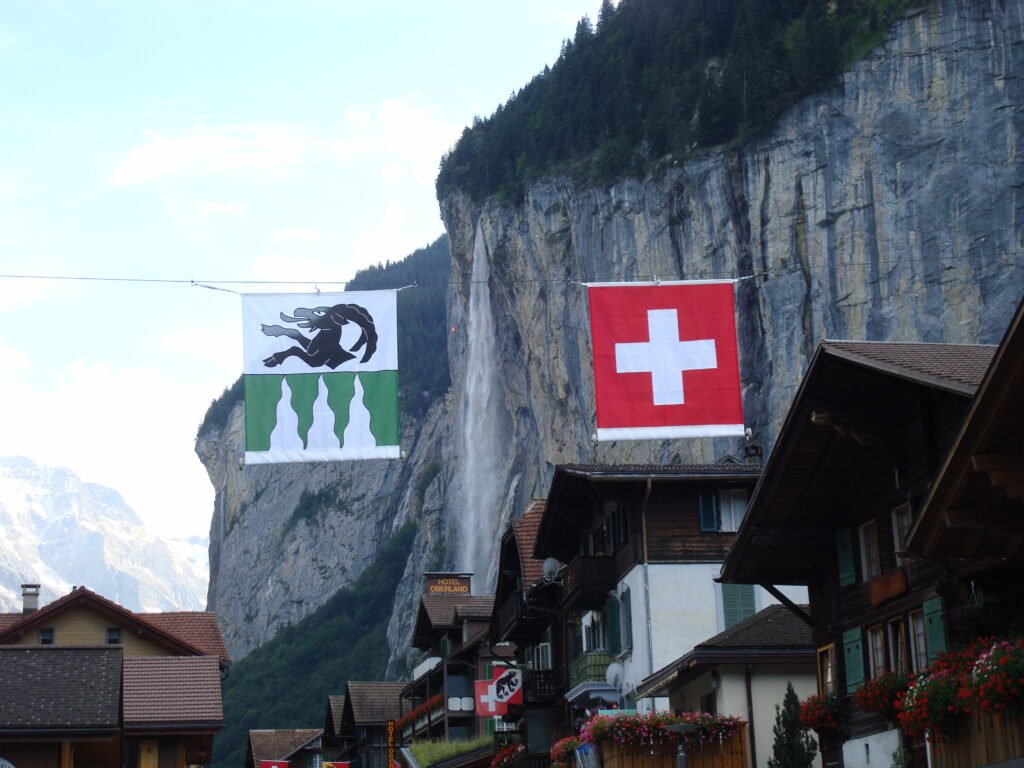
A steep-walled glacial valley holding 72 waterfalls, the most famous being Staubbach Falls, which drops nearly 300 meters directly from a hanging cliff above the valley floor. J.R.R. Tolkien is widely believed to have drawn inspiration from Lauterbrunnen for the elven city of Rivendell, and standing at the valley floor looking up, it’s genuinely easy to see why.
Bernese Oberland. Free to explore; individual waterfall attractions (like the Trümmelbach Falls, inside the mountain) charge entry. Best in early summer, when snowmelt keeps the waterfalls running at full force.
Wengen
A car-free village perched on a shelf above the Lauterbrunnen Valley, reachable only by cable car or a cogwheel train, which keeps the whole place genuinely quiet in a way few other alpine resort towns manage. The views across to the Eiger, Mönch, and Jungfrau peaks are some of the best in the entire region.
Above Lauterbrunnen Valley, Bernese Oberland. Free to explore; cogwheel train fare required. Best in winter for skiing, or summer for hiking with genuinely fewer crowds than nearby Grindelwald.

Aletsch Glacier
The largest glacier in the Alps, stretching over 20 kilometers and holding enough ice to genuinely reshape how you think about scale in the mountains. A UNESCO World Heritage Site, it’s viewable from several accessible viewpoints without requiring technical mountaineering experience.
Near Fiesch, Valais. Cable car fare to reach viewpoints. Best in late summer for the most stable weather and clearest glacier views.
Gorner Gorge
A narrow gorge near Zermatt, carved by glacial meltwater into smooth, sculpted rock, with wooden walkways letting visitors walk directly through the gorge at water level, close enough to feel the spray on a hot day.
Near Zermatt, Valais. Small entry fee. Best in summer, when the gorge is fully accessible and the meltwater is running strong.
The Lake Geneva Region
West of the Bernese Oberland, the shores of Lake Geneva hold vineyard terraces and medieval towns that feel genuinely different from the mountain villages further east.
Lavaux Vineyard Terraces
A UNESCO World Heritage wine region, its terraced vineyards climbing steeply from the shore of Lake Geneva, cultivated in roughly this same form since the 11th century. Walking the paths between the terraces, with the lake and the French Alps visible across the water, is one of the more underrated scenic walks in the entire country.
Between Lausanne and Montreux, Vaud. Free to walk; wine tasting fees vary. Best in September or October, during the grape harvest.
Château de Chillon
A genuinely striking medieval castle built on a small rock island right at the edge of Lake Geneva, its foundations rising directly out of the water. Lord Byron’s poem “The Prisoner of Chillon” drew on the castle’s history as a political prison, and the poet reportedly carved his own name into one of the dungeon pillars.
Near Montreux, Vaud. Entry fee. Best in the early morning for photos before the castle’s significant midday crowds.

Gruyères
A tiny, remarkably well-preserved medieval village that gave its name to Gruyère cheese, still produced in a working dairy right at the base of the hill the town sits on. The cobblestone streets and hilltop castle make it a genuinely easy, worthwhile stop despite the crowds it draws.
Fribourg canton. Free to explore town; castle and cheese dairy entry fees separate. Best on a weekday morning, since the village’s small size means it fills up fast on weekends.

Ticino
Switzerland’s Italian-speaking south feels like a genuinely different country, all palm trees, lakeside piazzas, and Italian architecture.
Lugano
Set on the shores of Lake Lugano and ringed by mountains, this town’s Italianate architecture, mild climate, and palm-lined promenade make it feel far more like northern Italy than the rest of Switzerland. It’s a genuinely good reminder that “Swiss” doesn’t mean just one thing.
Ticino. Free to explore. Best in the early evening, when the lakeside promenade fills with locals out for a passeggiata.

Verzasca Valley
Home to the Verzasca River, its water so clear and vividly turquoise-green that it’s genuinely hard to believe in photos, flowing beneath a striking Roman-style stone bridge, the Ponte dei Salti, in the village of Lavertezzo. The valley also holds the Verzasca Dam, made famous as the location of the bungee jump opening scene in the James Bond film “GoldenEye.”
Ticino, north of Locarno. Free. Best in summer for swimming in the river’s genuinely clear, cold pools.
The Grisons
Switzerland’s largest and least densely populated canton holds some of its most dramatic, least-visited alpine scenery.
St. Moritz
A genuinely storied resort town, credited with helping launch winter tourism in the Alps back in the 1860s, and still one of the most prestigious ski and lake resort destinations in Switzerland today, with the Engadin Valley’s dry, sunny climate setting it apart from cloudier alpine regions elsewhere.
Engadin Valley, Grisons. Free to explore town; ski and activity fees vary. Best in winter for skiing, or summer for hiking around the surrounding lakes.

Swiss National Park
Switzerland’s only national park, and a genuinely strict one, hiking is permitted only on marked trails, and picking flowers or disturbing wildlife is prohibited, preserving a level of untouched alpine wilderness that’s genuinely rare in a country this developed.
Engadin Valley, Grisons. Free. Best in July or August, when high mountain trails are fully clear of snow.
Swiss Trains & Mountain Passes
Switzerland’s train network is genuinely one of the best in the world, and a Swiss Travel Pass can make sense for a trip built around this itinerary, covering trains, buses, and even some cable cars and mountain railways. Several of this guide’s destinations, including Wengen and the Jungfrau region, are actually easier to reach by train and cable car than by car, since some villages are entirely car-free. Mountain passes like the Furka and Grimsel, connecting different valleys across dramatic high-altitude routes, close seasonally due to snow, typically from October through May or June, so a driving trip built around these routes needs to account for that seasonal window. Postal buses (PostAuto), Switzerland’s iconic yellow buses, reach many smaller villages that trains don’t, and they’re worth knowing about for reaching some of this guide’s more remote stops.
Swiss Food Worth Seeking Out
Fondue and raclette, both built around melted cheese, are genuinely regional specialties worth trying in the actual region they come from, fondue in French-speaking Switzerland, raclette (traditionally melted directly off a wheel of cheese by an open fire) in the mountain valleys. Gruyère and Emmental cheeses, both named after the specific valleys where they originated, are worth tasting fresh at a working dairy rather than assuming all “Swiss cheese” is interchangeable. Ticino’s food culture leans genuinely Italian, risotto, polenta, and local wine replacing the cheese-and-potato-heavy cooking found further north. And Swiss chocolate, while genuinely excellent nationwide, is worth seeking out from a small regional chocolatier rather than only the big international brands, since Switzerland’s chocolate-making tradition runs deep at the local level too.
Best Time to Visit Switzerland
June through September offers the best hiking conditions and full access to mountain trails, cable cars, and high passes, with July and August representing peak season, the most reliable weather, but also the busiest and most expensive stretch of the year. Spring brings wildflowers to the alpine meadows and keeps the Lake Geneva region especially pleasant, though higher mountain trails may still be snow-covered into June. December through March suits skiing across the country’s major resort regions, including the Bernese Oberland and the Grisons, though many of this guide’s hiking-focused destinations become genuinely inaccessible during winter months. Shoulder seasons (April-May and October-November) see reduced cable car and mountain railway schedules, worth checking before planning a trip specifically around this window.
If this guide helped you plan your Switzerland trip, subscribe to Worldly Traveler on YouTube for more travel guides from around the world.
Frequently Asked Questions
What are the best hidden gems in Switzerland?
Some of the best hidden gems in Switzerland include Lauterbrunnen Valley (with its 72 waterfalls), the car-free village of Wengen, Lake Lugano in the Italian-speaking Ticino region, the Lavaux vineyard terraces above Lake Geneva, and the Aletsch Glacier.
Why does part of Switzerland feel Italian?
Ticino, Switzerland’s southernmost canton, is officially Italian-speaking, and its architecture, food, and lakeside towns genuinely reflect that heritage, giving it a distinctly different feel from the rest of the country.
How many days do you need to explore Switzerland’s hidden gems?
10-14 days allows a well-paced trip covering the Bernese Oberland, the Lake Geneva region, and a stretch of Ticino or the Grisons. A shorter 5-7 day trip works well focused on just the Bernese Oberland.
What is the best time of year to visit Switzerland?
June through September offers the best hiking conditions and full access to mountain trails and cable cars, while December through March suits skiing across the country’s major resort regions.
Do you need a car to explore Switzerland?
Not necessarily. Switzerland’s train network is genuinely one of the best in the world, and many of the country’s most scenic spots, including several in this guide, are reachable by train, cable car, or postal bus alone.