
Sydney’s Opera House and the Great Barrier Reef anchor most first-time trips to Australia, and both genuinely earn their reputation. But Australia is a continent-sized country, roughly the same size as the contiguous United States, and reducing it to two headline attractions leaves out dramatic coastlines, ancient deserts, and an entire island state most visitors never reach. This guide walks through Australia’s best hidden gems, checked against real research into each location, with a look at how the country genuinely compares to its closer neighbor across the Tasman Sea, New Zealand.
Sydney & the Great Barrier Reef: The Opera House, Sydney Harbour, and the world’s largest coral reef system remain genuinely essential for any first visit, this guide picks up from there and heads toward the regions most short trips never quite reach.
What’s easy to underestimate about Australia, treating it as a single manageable destination, is just how vast and varied the country genuinely is. A flight from Sydney to Perth takes roughly as long as one from London to Moscow, and the landscape shifts dramatically along the way, temperate coastline, ancient red desert, and, in Tasmania specifically, a genuinely wild, cool-climate wilderness that surprises visitors expecting only sunburnt outback. That scale is exactly why a two-week trip focused on a specific region, rather than an attempt to see the whole country, genuinely rewards deeper exploration.
Australia’s Aboriginal history also runs far deeper than most visitors realize going in, Aboriginal Australians represent one of the oldest continuous cultures on Earth, with a documented presence on the continent stretching back at least 65,000 years. That deep history shows up throughout the landscape covered in this guide, in the Dreamtime stories tied to formations like the Blue Mountains’ Three Sisters, and in the profound spiritual significance of Uluru to the Anangu people. Approaching Australia’s natural landmarks with that context in mind genuinely changes the experience of visiting them, from simply admiring dramatic scenery to engaging, even briefly, with tens of thousands of years of continuous human relationship to this specific land.
New South Wales Beyond Sydney
The Great Ocean Road
Tasmania
The Red Centre
Australia’s Aboriginal Heritage
Australia vs. New Zealand
Australian Wildlife Worth Seeking Out
FAQ
New South Wales Beyond Sydney
Australia’s most populous state holds genuinely dramatic scenery within easy reach of Sydney itself, much of it accessible as a day trip rather than requiring a major detour from a standard itinerary.
The Blue Mountains
Named for the distinctive blue haze created by oil released from the region’s dense eucalyptus forests, the Blue Mountains rise just under two hours from central Sydney, offering genuinely dramatic sandstone cliffs, waterfalls, and the Three Sisters rock formation, a trio of sandstone pillars tied to Aboriginal Dreamtime legend, each with its own version passed down through different local traditions. The region’s cool climate and dense forest made it a genuinely popular escape from Sydney’s summer heat as far back as the 19th century, and the network of walking trails through the surrounding national park now ranges from gentle lookout strolls to genuinely serious multi-day hikes for more experienced walkers.
Blue Mountains National Park, west of Sydney. Free park access; individual attraction fees vary. Best on a clear day, when the eucalyptus haze that gives the mountains their name is most visible.
,%20Three%20Sisters%20--%202019%20--%201987-9.jpg)


Hunter Valley
New South Wales’s premier wine region, genuinely one of the oldest in Australia, with commercial winemaking dating back to the 1820s, offers rolling vineyards and cellar door tastings within a two-hour drive of Sydney, a genuinely relaxed counterpoint to the city’s faster pace. The region’s Semillon, a grape variety that ages remarkably well in this specific climate, has become a genuine point of pride among Australian winemakers, worth seeking out at a smaller, family-run cellar door rather than only the larger commercial producers.
Hunter Valley, north of Sydney. Free to explore; wine tasting fees vary. Best on a weekday to avoid the region’s busier weekend tour bus traffic.
The Great Ocean Road
One of the most celebrated coastal drives in the world, built as a genuine memorial to Australian soldiers, and one of the few roads anywhere that doubles as an actual war monument.
The Twelve Apostles
A collection of limestone sea stacks rising from the Southern Ocean off Victoria’s coast, these formations were originally named the “Sow and Piglets” by an English explorer in 1798, before being rebranded the “Twelve Apostles” in the 1920s, likely a marketing decision timed to the newly built Great Ocean Road, since the more evocative name flowed better for drawing tourists. Despite the name, there were probably never twelve stacks standing at once, and today only about eight remain, the ocean’s continuous erosion having claimed several others over the decades, including one that collapsed as recently as 2005. Construction on the Great Ocean Road itself began in 1919, built partly to create jobs for returning World War I soldiers, and the road remains formally dedicated to Australians who died in that war, its Memorial Arch at the eastern end of the route standing as a direct tribute to that sacrifice. The limestone stacks themselves formed over millions of years, the softer rock gradually eroded by relentless Southern Ocean waves and wind into caves, then arches, and finally the isolated sea stacks visible today.
Port Campbell National Park, Victoria, roughly 275 km west of Melbourne. Free. Best at sunrise or sunset, when the limestone stacks shift dramatically in color from golden yellow to deep shadow.
,%20Port%20Campbell%20National%20Park,%20Twelve%20Apostles%20--%202019%20--%200969.jpg)


Loch Ard Gorge
Named for the Loch Ard, one of Victoria’s most famous shipwrecks, which ran aground here in 1878 with only two survivors, this dramatic gorge, backed by 70-meter limestone cliffs, offers a genuinely more intimate, walkable counterpart to the Twelve Apostles’ more famous lookout points nearby. The story of the two young survivors, Eva Carmichael and Tom Pearce, both just teenagers who managed to reach shore after the wreck, remains a genuinely significant piece of local maritime lore, and the gorge’s small beach, accessible via a set of stairs down from the clifftop, marks the exact spot where Pearce reportedly pulled Carmichael from the water.
Port Campbell National Park, Victoria. Free. Best combined with a Twelve Apostles visit, given the short distance between the two.

Tasmania
Australia’s island state offers a genuinely different, cooler, wilder version of the country, one most mainland-focused itineraries skip entirely.
Tasmania’s Wilderness
Home to genuinely vast tracts of temperate wilderness, including Cradle Mountain and the Franklin-Gordon Wild Rivers, both part of a broader UNESCO World Heritage Wilderness Area covering roughly a fifth of the entire island, Tasmania offers hiking, wildlife encounters, and a noticeably cooler climate than mainland Australia, along with the genuine chance to spot a Tasmanian devil in the wild, a marsupial found nowhere else on Earth outside this specific island. The island’s isolation from the mainland, separated by the often rough waters of the Bass Strait, has genuinely preserved species and ecosystems that disappeared from continental Australia centuries ago, making Tasmania a real living laboratory for conservation efforts today.
Central and western Tasmania. Free park access at most sites; some track fees apply. Best in Tasmania’s summer (December-February), when hiking trails are most reliably accessible.

.jpg)
The Red Centre
Australia’s vast desert interior holds the country’s most spiritually significant natural landmark, a place that genuinely rewards understanding its cultural weight before arriving.
Uluru
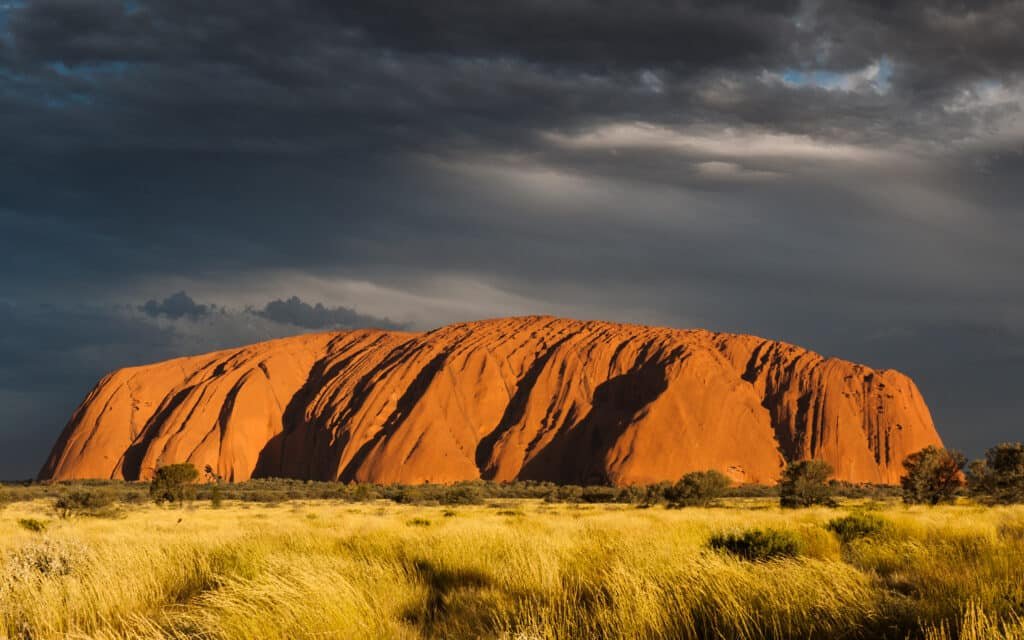
A massive sandstone monolith rising dramatically from the surrounding flat desert, Uluru holds genuinely deep spiritual significance to the Anangu people, its traditional custodians, who have lived in this region for tens of thousands of years and consider the rock a sacred site tied directly to their creation stories, known as Tjukurpa. Climbing Uluru was permanently banned in October 2019, following decades of the Anangu requesting that visitors respect the site by not climbing, and the rock’s genuinely dramatic color shift at sunrise and sunset, from deep ochre to fiery red, remains one of the most photographed natural phenomena in the entire country. Guided walks led by Anangu guides, offering direct cultural context and Dreamtime stories tied to specific formations around the rock’s base, provide a genuinely richer way to experience the site than simply viewing it from a distance.
Uluru-Kata Tjuta National Park, Northern Territory. Park entry fee. Best at sunrise or sunset for the most dramatic color changes across the rock’s surface.
.jpg)
.jpg)

Australia’s Aboriginal Heritage
Understanding the depth of Aboriginal history genuinely changes how a visit to Australia’s natural landmarks feels. Aboriginal Australians represent one of the oldest continuous living cultures on Earth, with archaeological evidence placing their presence on the continent at a minimum of 65,000 years, predating agriculture, written language, and most of what’s typically considered “ancient history” elsewhere in the world. Prior to European colonization in 1788, hundreds of distinct Aboriginal nations existed across the continent, each with its own language, customs, and deep, specific relationship to their particular country, a term Aboriginal Australians use to describe the profound, reciprocal connection between a people and their traditional land, one that goes well beyond simple ownership or residence.
That history is genuinely inseparable from many of the landmarks covered in this guide. Uluru’s significance to the Anangu, the Three Sisters’ place in Blue Mountains Dreamtime stories, and countless other sites across the country carry layers of meaning that predate European arrival by tens of thousands of years. Seeking out Aboriginal-led tours and cultural centers, increasingly available at many of Australia’s major natural attractions, offers a genuinely richer way to engage with these places than viewing them purely as scenic backdrops.
Australia vs. New Zealand
| Category | Australia | New Zealand |
|---|---|---|
| Scale | Vast, continent-sized | Compact, easier to cover fully |
| Landscape | Diverse: desert, reef, rainforest, coast | Concentrated: fjords, mountains, glaciers |
| Wildlife | Iconic and unique (kangaroos, koalas) | Fewer native mammals, strong bird life |
| Best for | Longer trips, varied landscapes and cities | Shorter trips, concentrated natural drama |
The choice between Australia and New Zealand genuinely comes down to how much time you have and what kind of landscape variety you want. Australia’s sheer size means a trip here can deliver genuinely different experiences within a single country, tropical reef, red desert, temperate wilderness, and major cosmopolitan cities, but that same size means covering multiple regions requires real time and often internal flights, a genuinely different logistical reality than a country you can drive across in a day. New Zealand, by contrast, concentrates dramatic natural scenery, fjords, glaciers, and mountains, into a country small enough to drive across in a way that makes a shorter trip feel genuinely complete rather than just a sampling of a much larger whole.
Cost and safety also factor into the comparison genuinely. Both countries carry a reputation as relatively expensive, English-speaking destinations with high standards of infrastructure and safety, though specific costs can shift depending on region and season within each. Wildlife draws travelers to Australia in a way New Zealand genuinely can’t match, kangaroos, koalas, and a wide range of unique marsupials found nowhere else on Earth, while New Zealand’s own wildlife appeal leans more toward birdlife, including flightless species like the kiwi that evolved in the absence of the ground-based predators found on larger continents.
Australian Wildlife Worth Seeking Out
Kangaroos and wallabies, genuinely wild and commonly spotted in national parks and even some regional golf courses, remain among the most sought-after wildlife sightings for first-time visitors, and dawn or dusk offers the best chance of spotting them actively grazing. Koalas, increasingly threatened by habitat loss and, in recent years, devastating bushfires, are best observed at a genuine wildlife sanctuary or in eucalyptus forest with a knowledgeable guide, rather than assumed to be easily spotted in the wild, since sightings are genuinely less common than many visitors expect, koalas sleep up to 20 hours a day, making a daytime spotting in the wild a matter of real luck as much as effort.
The platypus, one of only two egg-laying mammal species on Earth, remains genuinely elusive, most active at dawn and dusk near quiet freshwater streams in eastern Australia and Tasmania, and spotting one in the wild is considered a genuine highlight even among experienced Australian wildlife watchers. And Tasmania’s devils, now found in the wild only on that island after disappearing from the mainland centuries ago, are worth seeking out at a dedicated sanctuary, both for the genuine thrill of seeing this unique marsupial and to support ongoing conservation efforts against the facial tumor disease that has significantly reduced wild populations in recent decades, a genuine conservation crisis that several Tasmanian sanctuaries are actively working to address through breeding and disease research programs.
I reference this New Zealand vs. Australia comparison in the video above. If this guide helped you plan your Australia trip, check out more travel videos from Worldly Traveler.
Whichever regions make it onto your itinerary, Australia genuinely rewards travelers willing to pick a focus rather than attempt everything in a single trip. The country’s scale means that trying to cover Sydney, the Great Ocean Road, Tasmania, and the Red Centre all in ten days will leave every stop feeling rushed, while narrowing the scope to one or two of these regions allows for the kind of slower, more attentive travel that actually reveals what makes each of them worth visiting in the first place, ancient rock formations, unique wildlife found nowhere else on the planet, and a continent-sized landscape that genuinely rewards patience over a checklist mentality.
Frequently Asked Questions
What are the best hidden gems in Australia?
Some of the best hidden gems in Australia include the Twelve Apostles along the Great Ocean Road, Uluru in the Red Centre, Tasmania’s wilderness, and the Blue Mountains just outside Sydney, each offering a genuinely different slice of the country’s landscape.
How many of the Twelve Apostles are still standing?
Only about eight of the original limestone stacks remain today. The formation was originally named the Sow and Piglets in 1798 before being renamed the Twelve Apostles in the 1920s, likely as a marketing decision to draw tourists.
Should I visit Australia or New Zealand?
It genuinely depends on your priorities. Australia offers vast, diverse landscapes, iconic wildlife, and major cities, while New Zealand delivers dramatically concentrated natural scenery, fjords, and mountains within a much smaller, easier-to-cover area.
How many days do you need to explore Australia’s hidden gems?
2-3 weeks allows a well-paced trip covering the Great Ocean Road, a stretch of the Red Centre, and either Tasmania or the Blue Mountains. A shorter 10-day trip works well focused on just Victoria and New South Wales.
Is Uluru sacred to Aboriginal people?
Yes, genuinely. Uluru holds deep spiritual significance to the Anangu people, its traditional custodians, and climbing the rock was permanently banned in 2019 out of respect for that significance, following decades of the Anangu requesting visitors not climb.