
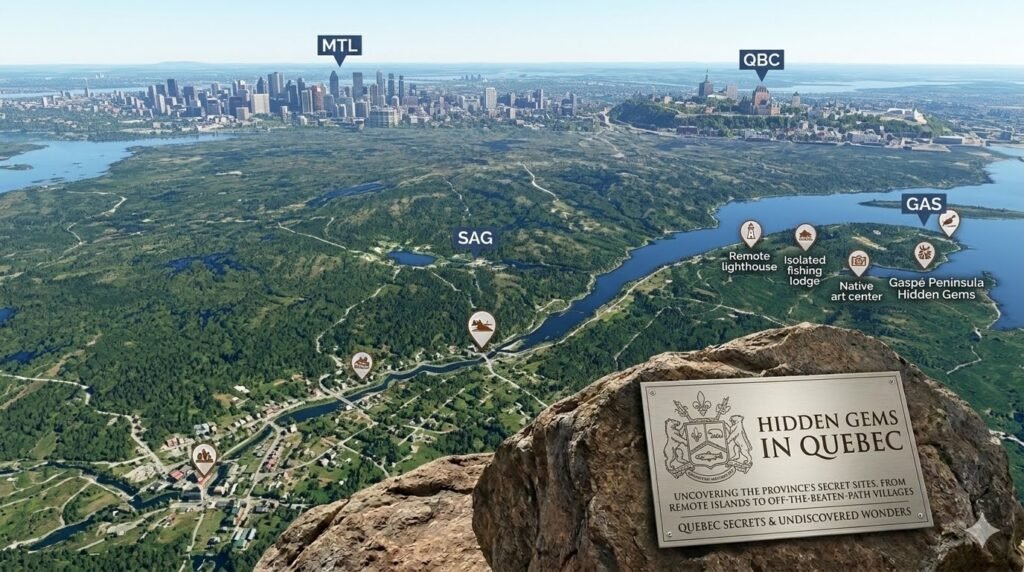
Quebec City’s old town and Montreal’s cosmopolitan energy anchor most first-time visits to the province, but Quebec’s real scale reveals itself once you head into the Gaspé Peninsula, the Saguenay Fjord, or the islands scattered along the St. Lawrence. This guide covers more than 25 hidden gems in Quebec, organized by region. The source video for this guide runs shorter than most in this series and names about 20 distinct locations rather than a full 25 — the additional locations below were independently researched and verified to bring the list to a genuinely comprehensive total.
Quebec City & Charlevoix
Saguenay-Lac-Saint-Jean
The Gaspé Peninsula
The Laurentians & Eastern Townships
Lower St. Lawrence & Islands
Getting Around Quebec
Language Notes
FAQ
Quebec City & Charlevoix
Just beyond Quebec City’s fortified old town, the Charlevoix region offers dramatic river and mountain scenery within a short drive.
1. Montmorency Falls
Standing nearly 30 meters taller than Niagara Falls, this dramatic waterfall sits just 12 kilometers from Quebec City’s old town, with a suspension bridge crossing directly over its crest and a cable car for easy access.
Beauport, near Quebec City. Free to view; cable car and via ferrata activities priced separately. Best in spring for peak water flow.
2. Île d’Orléans
An agricultural island in the St. Lawrence River just outside Quebec City, known as the birthplace of French settlement in the Americas, now dotted with heritage farmhouses, vineyards, and roadside stands selling strawberries and cider.
Near Quebec City. Free to drive the island loop; individual farms and wineries charge for tastings. Best in July-August for strawberry season.

3. Canyon Sainte-Anne
A dramatic gorge with waterfalls and suspension bridges crossing high above the rushing Sainte-Anne-du-Nord River, offering a genuinely thrilling perspective for a relatively short, accessible walk.
Near Beaupré, Charlevoix region. Entry fee. Best after rainfall for the fullest water flow.
4. Baie-Saint-Paul
Considered the artistic heart of Charlevoix, this small town’s galleries and studios have drawn painters for over a century, set against a striking backdrop of the St. Lawrence River meeting the Laurentian foothills.
Charlevoix region. Free to explore. Best combined with a wider Charlevoix scenic drive.
5. Isle-aux-Coudres
A small island in the St. Lawrence reached by a short, free ferry, offering a quiet cycling loop past traditional windmills, artisan bakeries, and river views toward the Charlevoix coastline.
Charlevoix region, ferry from Saint-Joseph-de-la-Rive. Free ferry. Best by rented bicycle for the full island loop.
6. Parc national de la Jacques-Cartier
A dramatic glacial valley just north of Quebec City, with steep forested walls rising above the Jacques-Cartier River, offering some of the best accessible wilderness hiking near any major Canadian city.
North of Quebec City. Park entry fee. Best in September-October for fall foliage viewed from the valley floor.
Saguenay-Lac-Saint-Jean
This northern region holds Quebec’s most dramatic fjord scenery and a genuinely strange abandoned company town.
7. Saguenay Fjord
One of the southernmost fjords in the world, carved by glaciers and now home to beluga whales at its mouth, with cliffs rising up to 500 meters directly from the water.
Saguenay-Lac-Saint-Jean region. Free to view from park trails; boat tours priced separately. Best by boat or kayak for the closest views of the cliffs.

8. Village de Val-Jalbert
A remarkably preserved ghost town, abandoned in 1927 when its pulp mill closed, with original company-town buildings still standing and a dramatic waterfall (Ouiatchouan Falls) at its edge.
Chambord, Lac-Saint-Jean. Entry fee. Best with a full day allotted to explore the site and cable car to the falls’ viewpoint.
9. Tadoussac
Located where the Saguenay Fjord meets the St. Lawrence River, this small village is one of the best whale-watching bases in eastern Canada, drawing several species of whale to the nutrient-rich confluence of waters.
Mouth of the Saguenay Fjord. Whale-watching tour fees vary. Best June-October for peak whale activity.
The Gaspé Peninsula
Quebec’s easternmost region offers dramatic coastal scenery that rivals anywhere in eastern Canada, with a fraction of the visitors.
10. Parc national de la Gaspésie
Home to Quebec’s highest peaks outside the Arctic and one of the southernmost caribou herds in North America, this remote wilderness park offers genuinely rugged hiking rarely crowded even in peak season.
Gaspé Peninsula. Park entry fee. Best July-September for full trail access.
11. Percé Rock
A massive limestone formation rising from the sea near the town of Percé, pierced by a natural arch, considered one of the most recognizable natural landmarks in Quebec and reachable on foot at low tide.
Percé, Gaspé Peninsula. Free to view; boat tours around the rock priced separately. Best at low tide for beach access.
12. Forillon National Park
Occupying the very tip of the Gaspé Peninsula, this park combines dramatic sea cliffs, forested hills, and a genuine chance of spotting whales, seals, and a wide range of bird species along its coastal trails.
Gaspé Peninsula tip. Park entry fee. Best for a multi-day visit given the park’s size and remote location.
13. Parc régional des Appalaches
A network of hiking trails through the Appalachian foothills in southern Quebec, including a notable via ferrata route, offering serious outdoor recreation well off the main Gaspé tourist circuit.
Southern Quebec, Chaudière-Appalaches region. Trail and activity fees vary. Best in summer and early fall.
The Laurentians & Eastern Townships
South and north of Montreal, these two regions hold Quebec’s best mountain scenery and quirky small-town character.
14. Mont Sutton
A mountain in the Eastern Townships known for exceptionally varied ski terrain in winter and equally rewarding hiking trails through hardwood forest in warmer months.
Eastern Townships. Trail/lift fees vary by season. Best in October for peak fall foliage.
15. Saint-Élie-de-Caxton
A small village in the Mauricie region whose eccentric local storytelling tradition, tied to celebrated Quebec storyteller Fred Pellerin, has turned an otherwise ordinary town into a genuinely unique cultural stop.
Mauricie region. Free to explore; guided storytelling tours priced separately. Best when a local storytelling event coincides with your visit.
16. Parc du Poisson Blanc
A reservoir dotted with dozens of small islands in the Outaouais region, with several available for camping, offering a genuinely secluded wilderness experience within a few hours of Montreal or Ottawa.
Outaouais region. Park entry and camping fees apply. Best for a multi-day canoe-camping trip.
17. Coaticook Gorge
Home to one of the longest suspension footbridges in the world, this gorge park in the Eastern Townships also hosts an evening light show (“Foresta Lumina”) that transforms the forest after dark.
Coaticook, Eastern Townships. Entry fee. Best in the evening for the light show, seasonal — check current dates.
18. Waber Falls, La Mauricie
A waterfall within La Mauricie National Park, reached via a moderate hiking trail through the park’s characteristic Canadian Shield forest and lake landscape.
La Mauricie National Park. Park entry fee. Best in spring for fuller water flow.
19. Parc national de la Yamaska
A reservoir-centered park in the Eastern Townships offering swimming, kayaking, and mountain biking trails, popular with locals but rarely mentioned in general Quebec travel guides.
Eastern Townships. Park entry fee. Best in summer for water activities.
Lower St. Lawrence & Islands
The stretch of the St. Lawrence River east of Quebec City holds some of the province’s least-visited islands and coastal towns.
20. Mingan Archipelago National Park Reserve
A chain of limestone islands sculpted by erosion into distinctive monolith formations, some resembling human or animal shapes, along Quebec’s remote North Shore.
North Shore, Côte-Nord region. Park entry fee; boat access required. Best in summer given the remote northern location.
21. Île aux Basques
A small island in the St. Lawrence estuary, historically used by 16th-century Basque whalers as a summer whaling station, with archaeological remains still visible and now protected as a nature reserve.
Lower St. Lawrence, near Trois-Pistoles. Guided tour required for access. Best on a clear day for the boat crossing.
22. Parc national du Bic
A compact coastal park combining rocky coves, forested hills, and a genuine seal colony, offering some of the most varied scenery packed into one relatively small park.
Near Rimouski, Lower St. Lawrence. Park entry fee. Best at low tide for tidal pool exploration.
23. Kamouraska
A historic village along the St. Lawrence known for some of the best sunset views in the province, its wide river vistas and colorful heritage houses drawing painters and photographers for generations.
Lower St. Lawrence. Free to explore. Best at sunset, as the name suggests.
24. Îles de Sorel
A maze of over 100 small islands and channels where the Richelieu River meets the St. Lawrence, offering quiet kayaking and birdwatching within a couple hours of Montreal.
Near Sorel-Tracy, between Montreal and Quebec City. Free to explore by kayak or boat rental. Best in summer for calm water conditions.
25. Jardins de Métis (Reford Gardens)
An internationally recognized garden combining formal English-style plantings with the surrounding boreal forest, notable for successfully growing Himalayan blue poppies far south of their native range.
Grand-Métis, Lower St. Lawrence. Entry fee. Best in July for peak bloom, including the blue poppies.
Getting Around Quebec
Driving distances: Quebec is enormous — the Gaspé Peninsula alone is roughly a 6-7 hour drive from Quebec City, and Saguenay-Lac-Saint-Jean adds significant distance beyond Charlevoix. Plan regional trips rather than trying to cover the whole province at once.
Seasonal considerations: Quebec winters are long and genuinely cold, with many rural parks and attractions closing or reducing hours from November through April. Confirm seasonal opening dates before planning a visit to remote sites.
Ferries: Several hidden gems in this guide (Isle-aux-Coudres, parts of the Mingan Archipelago) require ferry or boat access — check schedules in advance, especially outside peak summer season.
Language Notes
Quebec is predominantly French-speaking, and while Quebec City and Montreal have strong English-language tourism infrastructure, rural regions like the Gaspé Peninsula and Saguenay-Lac-Saint-Jean are more consistently French-first. Basic French phrases are genuinely useful outside the main cities, and road signage throughout the province is in French.
I cover the core hidden gems from the video above, with additional researched locations added to round out the list. If this guide helped you plan your Quebec trip, subscribe to Worldly Traveler on YouTube for more hidden gems guides from around the world.
Frequently Asked Questions
What are the best hidden gems in Quebec?
Some of the best hidden gems in Quebec include the Saguenay Fjord, Montmorency Falls, the Mingan Archipelago’s monolith formations, Percé Rock, and the ghost town of Val-Jalbert, all offering dramatic scenery beyond Quebec City and Montreal.
Do you need to speak French to travel in Quebec?
English is widely understood in Quebec City and Montreal, but rural areas, especially the Gaspé Peninsula and Saguenay-Lac-Saint-Jean, are predominantly French-speaking, and basic French phrases go a long way.
How do you get around Quebec?
A car is essential for most of the hidden gems in this guide, given the large distances between regions like the Gaspé Peninsula and Saguenay-Lac-Saint-Jean and limited public transit outside major cities.
What is the best time of year to visit Quebec’s hidden gems?
June-September offers the best access to outdoor sites and mildest weather. September-October brings spectacular fall foliage, while winter (December-March) suits a different set of activities given Quebec’s cold, snowy climate.
How many days do you need to see hidden gems across Quebec?
10-14 days allows a loop covering Quebec City, Charlevoix, Saguenay-Lac-Saint-Jean, and a portion of the Gaspé Peninsula. A shorter 5-7 day trip can focus on just the Quebec City and Charlevoix region.