
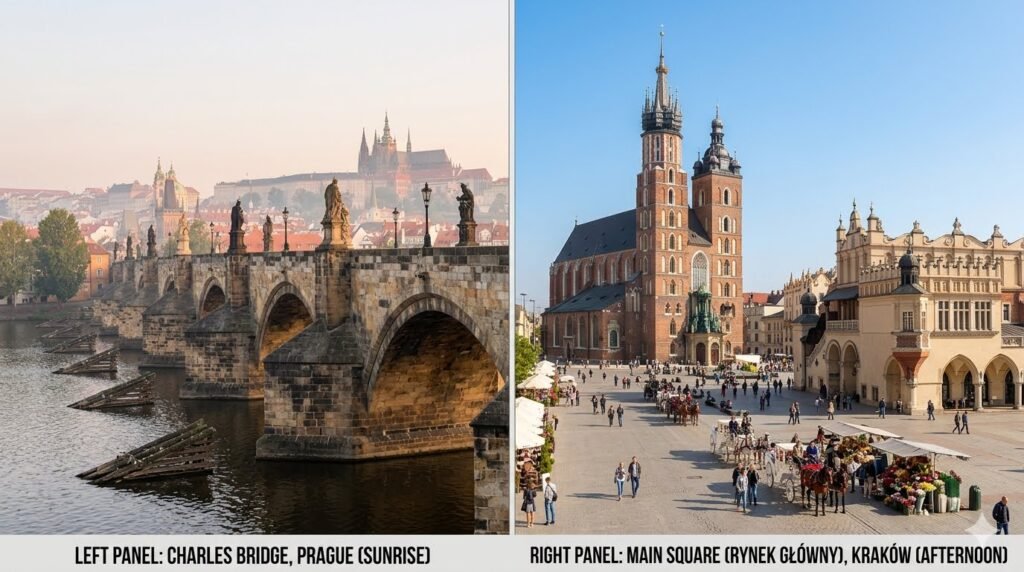
A storybook capital with a thousand-year-old castle, or a compact medieval city with the largest square in Europe and one of the world’s strangest UNESCO sites underground. This guide compares Prague and Krakow on cost, sights, food, nightlife, safety, and the best time to visit. I walk through both cities in the video below.
Both cities are UNESCO-listed historic centers with roughly similar footprints for a first-time visitor: compact old towns, a hilltop castle complex, and a defining central square. Where they diverge is price and pace — Prague pulls more international visitors and prices itself accordingly, while Krakow has stayed noticeably more affordable despite an equally rich historic core.
Cost of Travel
Things to See in Prague
Things to See in Krakow
Food, Nightlife & Safety
Planning Your Visit
FAQ
Cost of Travel
Prague runs consistently more expensive than Krakow across nearly every category. A mid-range restaurant meal costs $12-$20 in Prague versus $8-$15 in Krakow. Attraction entry fees are also lower in Krakow: Wawel Castle or St. Mary’s Basilica typically cost $5-$10 versus $10-$20 for Prague Castle or the Astronomical Clock tower. Accommodation follows the same pattern — a mid-range Prague hotel runs $80-$150 a night versus $40-$70 for comparable comfort in Krakow.
| Prague | Krakow | |
|---|---|---|
| Daily budget (mid-range) | $70-$100 | $50-$80 |
| Hostel bed | From ~$30 | From ~$10-$15 |
| Signature landmark | Charles Bridge & Prague Castle | Main Market Square & Wawel Castle |
| Unique attraction | Astronomical Clock (oldest working, 1410) | Wieliczka Salt Mine (UNESCO) |
Things to See in Prague
1. Charles Bridge
Built in the 14th century under King Charles IV, this stone bridge across the Vltava River is lined with 30 Baroque statues. Early morning is the best time to visit before crowds arrive.
Prague. Free. Best at sunrise.

2. Prague Castle
The seat of Czech rulers for over a thousand years, this sprawling complex includes St. Vitus Cathedral, the Old Royal Palace, and Golden Lane. The changing of the guard takes place daily at noon.
Prague. Entry fee for interiors; courtyards free. Allow a half day.
3. St. Vitus Cathedral
The Gothic cathedral inside Prague Castle’s walls, and the largest and most important church in the country.
Prague Castle grounds. Included with castle ticket for full interior access.
4. Astronomical Clock (Orloj)
Installed in 1410, this is the world’s third-oldest astronomical clock and the oldest one still operating. Crowds gather hourly in Old Town Square to watch its moving apostle figures.
Old Town Square. Free to watch; tower climb has a fee.
5. Old Town Square
The historic heart of Prague, home to the Astronomical Clock and the Old Town Hall Tower, which can be climbed for panoramic views.
Prague. Free.
6. Petřín Hill
A green hill overlooking the city, popular for its own miniature Eiffel Tower-style lookout and among the best spots for a wide view over Prague’s red rooftops.
Prague. Free; funicular or tower climb has a small fee.
7. St. Nicholas Church
A Baroque church in the Lesser Town, another recommended vantage point for skyline views, particularly at sunset.
Lesser Town, Prague. Entry fee; tower climb extra.
Things to See in Krakow
1. Main Market Square (Rynek Główny)
One of the largest medieval squares in Europe, ringed by colorful townhouses and the Cloth Hall, with street performers and flower stalls keeping it lively day and night.
Krakow. Free.

2. St. Mary’s Basilica
Overlooking the Main Square, famous for a carved wooden altarpiece and an hourly trumpet call (hejnał) played live from its taller tower.
Krakow. Entry fee; tower climb extra.
3. Wawel Castle & Cathedral
The former residence of Polish kings, including Wawel Cathedral, the Royal Chambers, and the legendary Dragon’s Den, with views over the Vistula River.
Krakow. Entry fee, separate tickets for different sections.

4. Kazimierz (Jewish Quarter)
Once the center of Jewish life in Krakow, today a neighborhood of cobblestone streets, galleries, synagogues, and cafes, including the historic Remuh Synagogue.
Krakow. Free to walk; guided tours recommended.
5. Wieliczka Salt Mine
A UNESCO World Heritage site just outside Krakow, with tunnels stretching over 287 kilometers and descending to around 327 meters. The highlight is the Chapel of St. Kinga, carved entirely from salt.
Just outside Krakow. Entry fee, guided tour required.

6. Planty Park
A green ring encircling Krakow’s Old Town on the site of the city’s former medieval walls, popular for a relaxed walk between attractions.
Krakow. Free.
7. Collegium Maius
The oldest building of Jagiellonian University, where Copernicus once studied — a compact but historically rich stop with a small museum of astronomical instruments.
Krakow. Entry fee for the museum.
8. Nowa Huta
A planned communist-era district on Krakow’s outskirts, built in the 1950s around a massive steelworks, best explored on a guided tour focused on its Soviet-era architecture, including a Cold War-era nuclear bunker open to visitors.
Krakow outskirts. Guided tour recommended.
9. Tatra Mountains (day trip)
A popular day trip from Krakow for hiking and mountain scenery, typically based out of the resort town of Zakopane, roughly two hours away.
About 2 hours from Krakow. Transport fee.
Food, Nightlife & Safety
Food: Prague’s food is hearty Czech comfort fare: svíčková (beef in cream sauce), goulash, and roast pork with dumplings, paired with world-class Czech pilsner. Krakow’s kitchen leans toward pierogi, zapiekanka (street-food pizza), and sernik (cheesecake), with kiełbasa a common night-market grab.
Nightlife: Prague has more variety, including large clubs and historic beer halls like U Fleków. Krakow’s scene is cozier, built around atmospheric cellar bars and jazz clubs, concentrated in Kazimierz.
Safety: Both cities are considered very safe, with low rates of violent crime. The main concern in both is pickpocketing in crowded tourist areas and on public transport.
Planning Your Visit
Best time to visit: May through September offers the best combination of daylight and manageable weather. Winter brings snow and Christmas markets to both — Prague’s winters run slightly milder.
Getting around: Neither city requires a rental car — both historic centers are highly walkable, and trams/buses cover the rest.
How many days to allow: Three to four days covers either city’s highlights comfortably, including a day trip.
Combining both: Prague and Krakow are connected by train in roughly 7-8 hours direct, making a combined trip realistic with two weeks or more.
I walk through both cities side by side in the video above, including the Astronomical Clock and the Wieliczka Salt Mine. If this guide helped you plan your trip, subscribe to Worldly Traveler on YouTube for more travel comparisons from around the world.
Frequently Asked Questions
Is Prague or Krakow cheaper to visit?
Krakow is noticeably cheaper across food, accommodation, and attractions, roughly $20-30 lower per day than Prague.
How many days do you need in each city?
Three to four days covers the highlights of either city comfortably, including a day trip.
Is the Prague Astronomical Clock worth seeing?
Yes, it’s the world’s oldest astronomical clock still in operation, dating to 1410.
Can you visit both Prague and Krakow in one trip?
Yes, they’re connected by train in roughly 7-8 hours direct.
What is the Wieliczka Salt Mine?
A UNESCO World Heritage salt mine near Krakow with over 287 kilometers of tunnels, famous for its salt-carved chapel.