
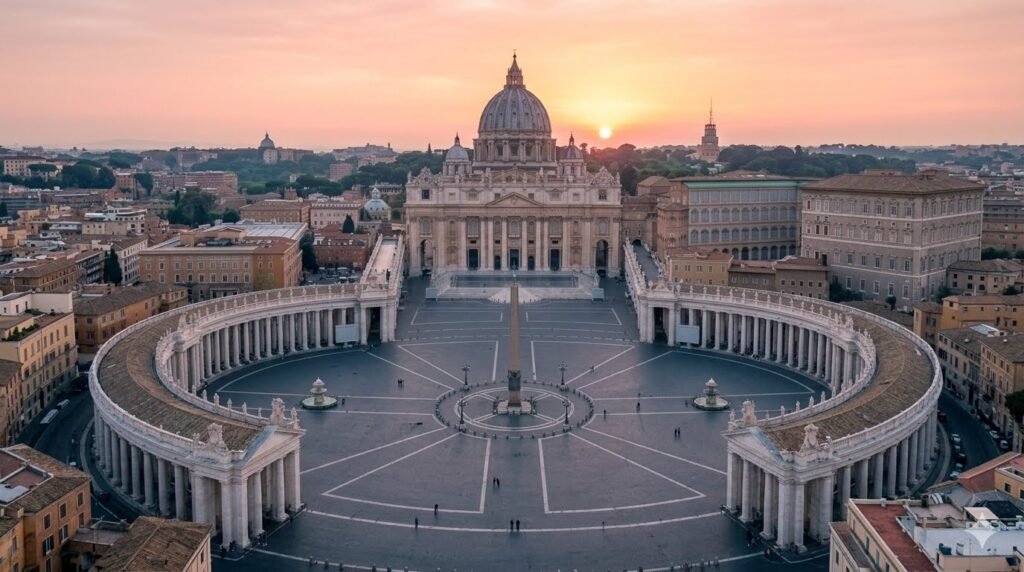
The Vatican packs one of the densest concentrations of art and history anywhere on Earth into the world’s smallest sovereign state — just 0.2 square miles, more than half of which is actually garden. This guide covers everything you need for a genuine Vatican City tour: the museum rooms most visitors rush past, the basilica’s essential sights, the Sistine Chapel, and the practical details (dress code, timing, tickets) that make or break a visit. I cover this across three videos, all embedded below.
Vatican Museums Highlights
Vatican City Beyond the Museums
St. Peter’s Basilica
The Sistine Chapel
How to Skip the Lines
Vatican Dress Code & Rules
How Many Hours to Allow
FAQ
Vatican Museums Highlights
The Vatican Museums hold one of the largest art collections in the world, spread across a maze of galleries that most visitors only partially see. Beyond the headline stops, a handful of rooms reward those who slow down.
Gallery of Maps
A 120-meter-long corridor lined with 40 topographical maps of Italy, painted in the 1580s by Ignazio Danti, with an elaborately frescoed ceiling depicting historical and religious scenes above.
Included with Vatican Museums admission. Best combined with the adjacent Gallery of Tapestries.
%20(48759327626).jpg)
Bramante Staircase
Technically two staircases: the original 1505 double-helix ramp designed by Donato Bramante, built so pack animals could ascend and descend without crossing paths, and the more famous 1932 spiral staircase by Giuseppe Momo, now the museums’ main exit and one of the most photographed spots in Rome.
Included with admission; the 1932 staircase is on the standard visitor route. Best photographed from directly above, looking down the spiral.

Niccoline Chapel
A small private chapel decorated with frescoes by Fra Angelico depicting the lives of St. Stephen and St. Lawrence, tucked away from the main visitor flow and often nearly empty even when the main galleries are packed.
Included with admission; access can be limited, check current visitor route.
Gregorian Egyptian Museum
A dedicated collection of Egyptian antiquities, including sarcophagi, mummies, and statuary, reflecting the Vatican’s own history of archaeological collecting rather than a colonial-era import from elsewhere.
Included with admission. Best for travelers with a specific interest in ancient Egypt.
Room of the Aldobrandini Wedding
Named for an ancient Roman fresco depicting a wedding ceremony, discovered in the 1600s and now displayed in a room most visitors walk straight through en route to more famous galleries.
Included with admission.
Etruscan Museum
A dedicated collection of artifacts from the Etruscan civilization that predated Rome itself, including jewelry, bronzework, and pottery recovered from tombs across central Italy.
Included with admission. Best for travelers with a specific interest in pre-Roman Italy.
Borgia Apartments
The private living quarters of the notorious Borgia pope, Alexander VI, decorated with elaborate frescoes and now doubling as a space for contemporary art exhibitions.
Included with admission.
Vatican City Beyond the Museums
Vatican City is a functioning sovereign state, not just a museum complex — a handful of sites reflect that everyday functioning side most tourists never think to look for.
Vatican Gardens
Covering more than half of Vatican City’s total area, these formal and wooded gardens are open only via guided tour, offering a genuinely peaceful contrast to the crowded museum galleries just beyond their walls.
Separate guided tour booking required. Best booked well in advance, tours run limited daily slots.
Vatican Necropolis (Scavi)
An excavated ancient Roman burial ground beneath St. Peter’s Basilica, including what’s believed to be the tomb of St. Peter himself, accessible only through a separate, limited-capacity guided tour booked directly through the Vatican’s excavations office.
Separate booking required (the “Scavi Office”), months of advance notice often needed. Best for travelers planning well ahead.
Vatican Library
One of the oldest libraries in the world, holding manuscripts dating back centuries, largely closed to casual visitors but occasionally opening select manuscripts for public exhibition.
Reading rooms restricted to qualified researchers; exhibition areas occasionally open to the public.
Vatican Observatory
A genuine, still-functioning astronomical observatory operated by the Catholic Church, reflecting a centuries-long Vatican tradition of scientific research that surprises many visitors.
Not generally open to public tours; primarily of interest as a fact about the Vatican’s institutional history.
Vatican Post Office
Vatican City issues its own stamps and postmarks, and mailing a postcard from here is a small but genuine novelty for philatelists and casual visitors alike.
Located in St. Peter’s Square. Free to visit; postage priced normally.
Swiss Guard
The Vatican’s colorfully uniformed military corps, responsible for the Pope’s personal security since 1506, stationed at various checkpoints around Vatican City and a genuinely photogenic (though not to-be-mocked) tradition.
Visible at Vatican entrances and St. Peter’s Square. Free to observe; photograph respectfully.
St. Peter’s Basilica
The largest church in the world by interior volume, St. Peter’s Basilica is free to enter but rewards knowing what to prioritize inside.
Michelangelo’s Pietà
Michelangelo’s sculpture depicting Mary holding the body of Christ, completed when the artist was only in his early twenties, now displayed behind protective glass following a 1972 vandalism incident.
Free with basilica entry, located near the entrance. Best viewed early to avoid the crowd that gathers later.
St. Peter’s Square
Gian Lorenzo Bernini’s sweeping elliptical colonnade frames the square in front of the basilica, designed to symbolically embrace visitors arriving from around the world, with 284 columns arranged in four rows.
Free, open-air, accessible anytime the square isn’t closed for a papal event.
The Dome (Cupola)
Designed principally by Michelangelo and completed after his death, the dome can be climbed (partly by elevator, partly by a narrowing spiral staircase) for one of the best panoramic views over Rome.
Separate ticket required (elevator or stairs-only pricing). Best booked for early morning to avoid both crowds and midday heat on the climb.
St. Peter’s Tomb & Scavi Necropolis
Beneath the main basilica floor, the Vatican Grottoes hold the tombs of numerous popes, while the deeper Scavi excavation (described above) reaches what’s believed to be St. Peter’s actual burial site.
Grottoes free with basilica entry; Scavi requires separate advance booking.
The Sistine Chapel
The final stop on the standard Vatican Museums route, the Sistine Chapel holds Michelangelo’s ceiling frescoes and his “Last Judgment” on the altar wall — arguably the single most famous room of art in the world. Photography and talking are both prohibited inside, strictly enforced by chapel staff, so plan to simply look rather than document. Given the volume of visitors passing through daily, expect a crowded, relatively brief viewing experience rather than a leisurely one; arriving with an early-entry ticket meaningfully improves this.
How to Skip the Lines
Book timed entry in advance: The Vatican Museums’ official website sells timed-entry tickets that let you skip the general admission line entirely — book as far ahead as your schedule allows, especially for peak season.
Consider early-morning or evening tours: Some guided tours offer entry before the museums open to the general public or after standard hours close, both of which come with separate, faster-moving lines.
Go early regardless: Even with a timed ticket, arriving at opening time means fewer visitors ahead of you inside the galleries themselves.
St. Peter’s Basilica has its own line: A Vatican Museums ticket does not include basilica entry — budget separate time for the basilica’s security line, which moves quickly but can still take 20-30 minutes at peak times.
Vatican Dress Code & Rules
Cover shoulders and knees: This applies to everyone, regardless of gender, for both St. Peter’s Basilica and the Vatican Museums. Enforcement at the basilica entrance can be strict — visitors in shorts or sleeveless tops are sometimes turned away or asked to cover up.
Remove hats inside the basilica: A standard sign of respect expected of all visitors.
No photography in the Sistine Chapel: Strictly enforced, including phone cameras.
Keep voices low: Both the basilica and the Sistine Chapel are active religious spaces, and loud conversation is discouraged throughout.
How Many Hours to Allow
Minimum (half day): 4-5 hours covers the Vatican Museums’ highlights, the Sistine Chapel, and St. Peter’s Basilica at a reasonably brisk pace.
Comfortable (full day): A full day allows time to also climb the dome, linger in specific galleries like the Gallery of Maps, and take a slower walk through St. Peter’s Square.
Extended (multi-visit): Travelers with a genuine interest in art history sometimes split the museums and basilica across two separate visits, since the combined complex is large enough to fatigue even dedicated visitors in a single pass.
I cover the Vatican Museums, St. Peter’s Basilica, and Vatican City’s lesser-known corners across the three videos above. If this guide helped you plan your visit, subscribe to Worldly Traveler on YouTube for more travel guides from around the world.
Frequently Asked Questions
How much time should you allow for a Vatican City tour?
Allow at least half a day (4-5 hours) to see the Vatican Museums, Sistine Chapel, and St. Peter’s Basilica without rushing. A full day allows time to also climb the dome and explore the Vatican Gardens.
What is the dress code for the Vatican?
Shoulders and knees must be covered for both St. Peter’s Basilica and the Vatican Museums, for all visitors regardless of gender. Hats should be removed inside the basilica, and enforcement can be strict, so plan your outfit accordingly.
How do you skip the line at the Vatican Museums?
Book timed-entry tickets online in advance directly through the Vatican Museums website, or book an early-morning or evening guided tour, which typically includes separate, faster entry lines than general admission.
Do you need a guide for the Vatican Museums?
A guide isn’t required, but the museums are large and can be disorienting without one — a guided tour or a good audio guide makes it much easier to prioritize the highlights given limited time.
Is the Vatican Museums the same as St. Peter’s Basilica?
No — they are separate sites with separate entrances and often separate lines. St. Peter’s Basilica is free to enter, while the Vatican Museums (which include the Sistine Chapel) require a paid ticket.
What is the best time of year to visit the Vatican?
Late fall through early spring (excluding major religious holidays) sees smaller crowds than the busy June-August period. Early morning entry, regardless of season, is consistently the best way to beat the crowds.