
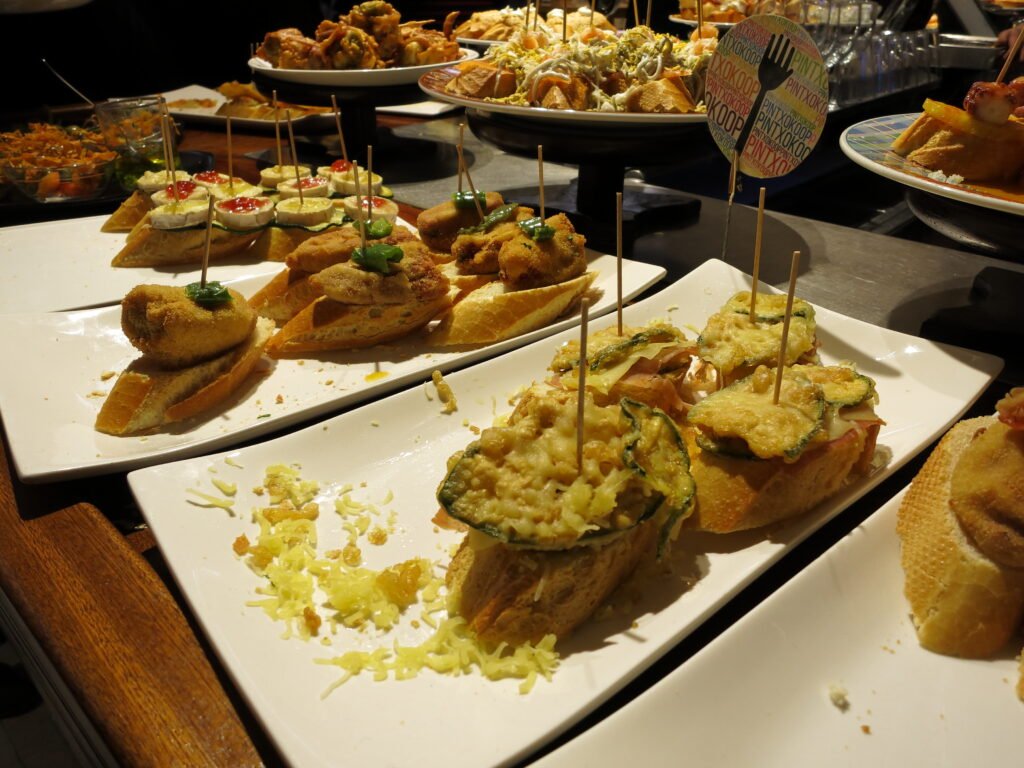
Pintxos are the Basque Country’s answer to tapas, but the culture around them is genuinely its own: small, often elaborate bites eaten standing at a bar, one dish and one drink at a time, before moving to the next spot. San Sebastián pintxos culture is often ranked among the best food experiences in Europe, and Bilbao’s scene, while less internationally famous, is every bit as good and noticeably less touristy. This guide covers where to go, what to order, and how the whole bar-hopping ritual actually works in both cities. For the fuller regional picture — including the French side of the border — see our Ultimate Guide to the Basque Country.
Both cities take pintxos seriously enough that the food scene has become a genuine tourist draw in its own right, separate from any single landmark. San Sebastián in particular holds one of the highest concentrations of Michelin stars per capita anywhere in the world, and that same obsessive attention to craft trickles down into even the most casual bar counter. Bilbao’s version of the culture skews a bit heartier and less internationally polished, shaped by the city’s working port history rather than its resort-town reputation — which, depending on what you’re after, might make it the more interesting stop of the two.
How Pintxos Bar-Hopping Works
Walk into most traditional pintxos bars and you’ll see the day’s cold offerings laid out along the counter — help yourself, and the bartender keeps a running count (or you keep your used napkins and toothpicks on the bar, which staff tally up to calculate your bill). Hot pintxos are made to order and usually announced on a chalkboard; ask for these by name rather than pointing at the counter. The custom is to have one or two pintxos and one drink — a glass of txakoli (the region’s slightly sparkling white wine), a caña (small beer), or a glass of red — before moving to the next bar. A full pintxos crawl typically covers 4-6 bars over an evening, starting around 8pm.
The origins of this custom trace back to a simpler tradition of placing a small snack — often just a slice of bread with something on top — over a glass to keep flies out, which is where the word “pincho” (meaning “spike,” referring to the toothpick) comes from. Over the decades, especially from the 1990s onward, Basque chefs turned that humble habit into something closer to a competitive art form, with bars regularly rotating their offerings and competing in citywide pintxos contests. That history is part of why the format still works the way it does: it was never designed as a sit-down meal, and treating it that way misses the point of the crawl.
How Pintxos Bar-Hopping Works
Pintxos in San Sebastián
Pintxos in Bilbao
What to Order: A Pintxos Glossary
FAQ
Pintxos in San Sebastián
San Sebastián’s pintxos scene is dense enough that you could spend a week in the Parte Vieja alone and not repeat a bar.
Parte Vieja Pintxos Crawl
San Sebastián’s old town holds the highest concentration of pintxos bars in the entire Basque Country, with multiple award-winning spots within a few blocks of each other. This is the classic crawl — start early to beat the crowds at the most popular counters. Streets like Calle 31 de Agosto and Calle Fermín Calbetón are the backbone of the neighborhood’s reputation, each block holding several genuinely competitive kitchens.
Parte Vieja. €3-6 per pintxo. Best from 8pm onward, or earlier (7pm) to beat the rush at the most famous bars.
Bretxa Market Pintxos Bars
The bars surrounding La Bretxa market skew more local and less crowded than the busiest old town streets, offering the same quality with noticeably shorter waits at the counter.
Near La Bretxa Market. €2-5 per pintxo. Best around lunchtime or early evening.
Gros Neighborhood
Across the river from the old town, Gros has developed its own strong, more residential pintxos scene, popular with surfers and locals rather than tour groups, with a handful of genuinely innovative kitchens.
Gros district. €3-6 per pintxo. Best for a quieter, more local evening.
A Secret Old Town Bar
Tucked away from the main pintxos strip, a handful of small bars on Parte Vieja’s quieter side streets serve some of the city’s best food without the tourist markup — worth asking a local bartender for their current favorite, since word-of-mouth spots shift over time.
Parte Vieja side streets. Cost varies. Best discovered by asking locals rather than searching online.
A Sample San Sebastián Crawl
If you only have one evening, a workable route is: start in the Bretxa Market area for a quieter first stop and a glass of txakoli, move into the heart of the Parte Vieja for two of the neighborhood’s most talked-about counters, and finish in a smaller side-street bar for a slower final course and coffee. Budget roughly 30-45 minutes per stop rather than rushing — the point is the pacing as much as the food.
Pintxos in Bilbao
Bilbao’s pintxos culture centers on its Casco Viejo (Old Town), with a genuinely different character than San Sebastián’s — heartier, less internationally famous, and often better value.
Plaza Nueva
A neoclassical arcaded square in the heart of the old town, Plaza Nueva is Bilbao’s single best pintxos-hopping destination, with dozens of bars tucked under its columned walkways serving both classic and modern pintxos.
Casco Viejo. €2-5 per pintxo. Best in the early evening for the full crawl atmosphere.

Mercado de la Ribera Pintxos Bars
One of Europe’s largest covered markets sits directly on the Nervión River, and its ground floor holds a genuine pintxos bar scene that locals treat as a legitimate lunch destination rather than a tourist stop.
Casco Viejo, riverside. €2-5 per pintxo. Best around midday when the market’s stalls are also open.

Calle Somera & the Seven Streets
Bilbao’s seven original medieval streets (Las Siete Calles) hold a dense cluster of traditional pintxos bars, less polished than Plaza Nueva but arguably more authentic, especially for classic, unfussy Basque cooking.
Casco Viejo. €2-5 per pintxo. Best on a slow evening wander without a fixed plan.
El Ensanche Modern Pintxos Scene
Bilbao’s 19th-century expansion district has developed its own, more contemporary pintxos scene in recent years, with a handful of bars pushing more experimental combinations than the traditional old town spots.
El Ensanche district. €3-6 per pintxo. Best for travelers who’ve already done a classic Casco Viejo crawl and want something different.
A Sample Bilbao Crawl
Start at Mercado de la Ribera for a market-adjacent first stop, move into Plaza Nueva for the classic arcaded-square experience, and finish along Calle Somera in the Seven Streets for a more traditional, unpolished last round. Bilbao’s crawl tends to run slightly later than San Sebastián’s, with many locals not starting until closer to 9pm.
A Few Practical Tips
Cash helps: Many smaller, more traditional pintxos bars still prefer cash, especially for quick counter transactions — carry small bills.
Standing is normal: Don’t expect a table at most classic pintxos bars — standing at the counter or at a shared high-top is the default, and pulling up a chair mid-crawl isn’t really how the culture works.
Weekends get busy: Friday and Saturday evenings see the heaviest crowds at the most famous bars — weeknights, especially Tuesday through Thursday, offer a noticeably calmer experience at the same counters.
Pace yourself: It’s easy to eat and drink more than planned across a long crawl — pacing one drink per stop, rather than doubling up, keeps the evening sustainable across 5-6 bars.
What to Order: A Pintxos Glossary
Gilda
Considered the original pintxo, a simple skewer of pickled guindilla pepper, olive, and anchovy — sharp, briny, and the classic way to start a crawl. It’s named after the 1946 film “Gilda,” reportedly because the combination was considered as spicy and provocative as the movie’s title character.
Tortilla de Patata
A thick Spanish potato and egg omelet, usually served in a small wedge on bread, a reliable, comforting staple found at nearly every bar. Debates over whether it should include onion are taken surprisingly seriously by locals.
Jamón Ibérico
Thinly sliced cured ham from acorn-fed Iberian pigs, often served simply on bread to let the meat’s quality speak for itself. The best versions come from pigs graded “de bellota,” reflecting an acorn-heavy diet in their final months.
Txipirones
Baby squid, usually grilled or fried, sometimes served in their own ink — a Basque coastal classic reflecting the region’s deep fishing traditions.
Foie a la Plancha
Seared foie gras, typically one of the pricier hot pintxos on any menu, often paired with a sweet element like caramelized apple or fig to balance the richness.
Bacalao
Salted cod, prepared in various ways across different bars — a historically significant Basque ingredient dating back to the region’s cod-fishing trade routes, which once stretched as far as Newfoundland.
Txangurro
Spider crab, usually served baked or in a small tart, prized for its sweet, delicate meat and considered one of the more refined seafood pintxos available.
Croquetas
Small fried croquettes, typically filled with ham or mushroom, a comfort-food staple you’ll find at virtually every bar in some form, with quality varying significantly by kitchen.
I cover the food scenes in both cities across two videos, embedded above. If this guide helped you plan your Basque Country food crawl, subscribe to Worldly Traveler on YouTube for more travel guides from around the world.
Frequently Asked Questions
What is the difference between pintxos and tapas?
Pintxos are the Basque Country’s version of small bar snacks, typically served on a slice of bread and secured with a toothpick, and eaten while bar-hopping. Tapas, common in the rest of Spain, are more variable in format and are often ordered rather than picked up from a counter.
How much do pintxos cost?
Cold, counter-served pintxos typically cost around 2 euros each, while hot pintxos made to order run closer to 4-6 euros depending on ingredients like foie gras or seafood.
What is the best area for pintxos in San Sebastián?
The Parte Vieja (Old Town) has the highest concentration of pintxos bars in San Sebastián, though the Gros neighborhood across the river also has a strong, less touristy scene.
What is the best area for pintxos in Bilbao?
Plaza Nueva and the surrounding Casco Viejo (Old Town) hold Bilbao’s densest concentration of pintxos bars, while the area around Mercado de la Ribera offers a more market-adjacent option.
Do you tip at pintxos bars?
Tipping isn’t customary the way it is in the US — rounding up or leaving small change is appreciated but not expected at most pintxos bars.