
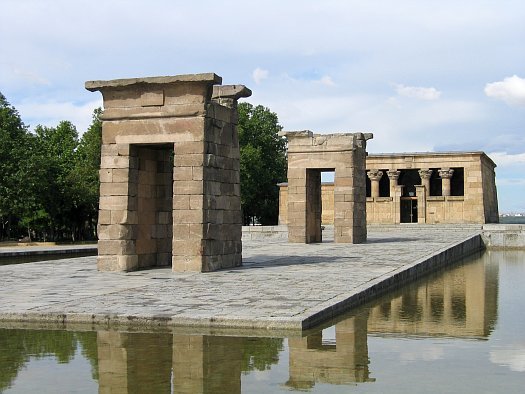
 Featured: Temple of Debod, Madrid. Source: Wikimedia Commons
Everyone hits the Prado and the Royal Palace, but Madrid’s most memorable moments tend to happen somewhere nobody told you to look — an abandoned metro station frozen since the 1960s, a duchess’s secret garden on the city’s edge, a wine cellar beneath the world’s oldest restaurant. This guide covers 25 hidden gems in Madrid that most first-time visitors walk right past, organized by category so you can build a real route through them. I cover all of these in the video below.
Madrid rewards this kind of digging more than most European capitals, partly because its biggest sights — the Prado, the Royal Palace, Puerta del Sol — sit so close together that visitors rarely have a reason to wander further. But some of the city’s best stories live just outside that core: a painter’s sun-filled studio in Chamberí, a Civil War-era bunker beneath a royal garden, a factory-turned-cultural-center on the site of a former slaughterhouse. Together, these 25 spots trace Madrid’s history from Habsburg royalty through the Spanish Civil War to its present-day art scene, in a way the standard tourist loop never quite manages.
Royal & Historic Secrets
Museums & Art
Markets & Food
Parks & Gardens
Underground & Unusual Madrid
FAQ
Royal & Historic Secrets
1. Campo del Moro (The King’s Secret Garden)
The Royal Palace’s expansive rear gardens are far less visited than the palace’s interior rooms, offering fountains, sweeping lawns, and one of the best views of the palace facade from below.
Príncipe Pío district. Free entry. Best in spring for the gardens in bloom.
2. Monasterio de las Descalzas Reales (The Convent of Royal Secrets)
Founded by a Habsburg princess, this still-active royal convent holds an extraordinary collection of art and treasures donated by generations of noblewomen who entered as nuns, largely hidden from public view until relatively recently.
Centro district. Entry fee (~€6), guided tours only. Best booked in advance; photography restricted.
3. Museo Cerralbo (A Marquis’s Treasure Trove)
The former mansion of the Marquis of Cerralbo, preserved exactly as he left it, crammed floor to ceiling with paintings, armor, and antiques collected over a lifetime.
Argüelles district. Entry fee (~€3, free on Sundays and certain hours). Best on a weekday morning.
4. Almudena Cathedral Crypt (A Cathedral of Gems)
Beneath Madrid’s main cathedral, a Neo-Romanesque crypt holds dozens of small chapels donated by Madrid families, each individually decorated, forming a quiet counterpoint to the cathedral’s grander upper nave.
Centro district. Small entry fee. Best combined with a Royal Palace visit next door.
Match confidence: low — verify against video.
5. Torre de los Lujanes (A Medieval Hangout)
One of Madrid’s oldest surviving civil buildings, this 15th-century Gothic tower on Plaza de la Villa predates most of the city’s other architecture by centuries, standing quietly amid later buildings most tourists don’t look twice at.
Centro district. Exterior viewing free. Best combined with a Plaza de la Villa walk.
Match confidence: medium — verify against video.
Museums & Art
6. Museo Sorolla (The House of Light)
The former home and studio of painter Joaquín Sorolla, known as the “master of light,” preserves his sun-drenched Mediterranean-scene paintings alongside a genuinely beautiful Andalusian-style garden courtyard.
Chamberí district. Entry fee (~€3, free certain hours). Best on a quiet weekday.
Match confidence: medium — verify against video.
7. Museo del Romanticismo (A Trip to the Romantic Era)
A house museum recreating the domestic life of Madrid’s 19th-century Romantic-era elite, room by room, with period furniture, art, and even a small garden café.
Chueca district. Entry fee (~€3, free certain hours). Best paired with a Chueca neighborhood walk.
8. Museo de América (A Different World of Treasures)
A dedicated museum of pre-Columbian and colonial-era art and artifacts from the Americas, offering a different historical lens than Madrid’s more famous European-focused museums.
Moncloa district. Entry fee (~€3, free certain hours). Best combined with a Temple of Debod visit nearby.
9. Ermita de San Antonio de la Florida (Goya’s Secret Masterpiece)
A small hermitage chapel where Francisco Goya painted the entire ceiling in fresco — and where he’s also buried, minus his skull, which was stolen sometime after his death and never recovered.
Moncloa district. Free entry. Best in the morning when it’s quietest.
10. La Tabacalera (Art in a Tobacco Factory)
A former royal tobacco factory turned self-managed social and cultural center, La Tabacalera hosts rotating exhibitions, street art, and community events in a raw industrial space unlike anywhere else in the city.
Lavapiés district. Free entry. Best combined with a Lavapiés neighborhood walk.
Match confidence: medium — verify against video.
Markets & Food
11. Mercado de la Cebada (A Market for the People)
A working-class neighborhood market far less polished than the tourist-favorite Mercado de San Miguel, offering genuinely local prices and produce rather than a curated tapas experience.
La Latina district. Free to browse. Best in the morning.
Match confidence: medium — verify against video.
12. Sobrino de Botín (Cellar of the World’s Oldest Restaurant)
Recognized by Guinness World Records as the oldest continuously operating restaurant in the world (opened 1725), Botín’s wood-fired oven and centuries-old wine cellar are as much a historical site as a place to eat.
Centro district. Restaurant pricing (mid-to-high range). Best to book ahead.
13. Chocolatería San Ginés (A Sip of Old Spain)
Open since 1894 and serving chocolate con churros around the clock, San Ginés is a genuine Madrid institution, tucked into an alley most visitors need a map to find.
Centro district. Café pricing. Best late at night, when it’s a local tradition after a night out.
Match confidence: low — verify against video.
14. El Rastro (Secrets of the Flea Market)
Madrid’s oldest and largest open-air flea market, running since the 15th century, fills the streets around Plaza de Cascorro with antiques, vintage goods, and local color every Sunday.
La Latina district. Free to browse. Sundays and public holidays only, mornings.

Parks & Gardens
15. El Capricho (The Secret Garden of a Duchess)
Built between 1787 and 1839 by the Duchess of Osuna, El Capricho is one of Madrid’s most beautiful and least-visited parks, complete with a maze, a lake, and a Spanish Civil War bunker hidden beneath the grounds.
Barajas district. Free entry, but limited opening days — check current hours before visiting.

16. Rosaleda del Parque del Oeste (A Garden of a Thousand Roses)
A dedicated rose garden within the larger Parque del Oeste, home to thousands of rose bushes and an annual rose competition, in full bloom for a few unforgettable weeks each spring.
Moncloa district. Free entry. Best in May during peak bloom.
17. Huerto de las Comendadoras (The Nuns’ Secret Orchard)
A quiet convent orchard tucked behind Plaza de las Comendadoras, offering a rare patch of cultivated green space in the middle of the Malasaña neighborhood.
Malasaña district. Access varies. Best combined with a Malasaña walk.
Match confidence: low — verify against video.
18. Matadero Madrid (From Slaughterhouse to Art House)
A former municipal slaughterhouse converted into one of Madrid’s leading contemporary art and culture centers, hosting exhibitions, film screenings, and design events in raw industrial-era buildings.
Arganzuela district. Free entry to the grounds; individual events vary. Best combined with a Río Manzanares riverside walk.

Underground & Unusual Madrid
19. Chamberí Ghost Station (A Station Frozen in Time)
An original 1919 Madrid Metro station, closed since 1966 when platform lengthening made it obsolete, preserved with its original tiling and vintage advertisements intact and now open as a small museum called Andén 0.
Chamberí district. Free entry, limited hours (weekends), advance booking recommended.
20. Temple of Debod (Egypt in the Heart of Spain)
An authentic 2,200-year-old Egyptian temple, gifted to Spain by Egypt in 1968 as thanks for Spanish help preserving monuments threatened by the Aswan Dam, now reassembled in a Madrid park.
Príncipe Pío district. Free entry (interior visits require booking). Best at sunset for the reflecting pool views.
21. Callejón del Gato (The Alley of Funhouse Mirrors)
A narrow alley near Puerta del Sol lined with distorting mirrors, famously referenced in Spanish literature as a symbol of grotesque, exaggerated reality — a strange, easy-to-miss corner of the city center.
Centro district. Free. Best combined with a Puerta del Sol walk.
22. Teleférico de Madrid (Flying Over the City)
A cable car connecting Parque del Oeste to Casa de Campo, offering an unusual bird’s-eye perspective on the city that most first-time visitors never think to seek out.
Moncloa district. Ticket fee (~€6 one-way). Best on a clear day for the views.
Match confidence: medium — verify against video.
23. Real Fábrica de Tapices (A Pink and White Dream)
A still-operating royal tapestry factory dating to 1721, where artisans continue weaving using traditional techniques, with guided tours through its ornate red-brick, Neo-Mudéjar building.
Retiro district. Entry fee (~€4), guided tours only. Best booked in advance.
Match confidence: low — verify against video.
24. Basílica de San Francisco el Grande (The Third Largest Dome in the World)
This neoclassical basilica holds one of the largest domes in Europe — surpassed only by St. Peter’s Basilica and the Pantheon in Rome — decorated with paintings by Goya and other Spanish masters, yet rarely appears on a typical Madrid itinerary.
La Latina district. Entry fee (~€5). Best in the morning for good light through the dome’s windows.
25. Andén 0 (Platform 0, The Original Metro)
The formal name for the preserved original platform and station house at Chamberí, Andén 0 offers a second angle on the same ghost-station complex — its vintage ticket booths and entrance pavilion are worth seeing alongside the platform itself.
Chamberí district. Free entry, same visit as Chamberí Ghost Station above.
Note: this may be the same site as entry #19 rather than a separate location — confirm against the video before publishing.
Tips for Exploring Madrid’s Hidden Gems
Book ahead for the ghost station: Chamberí Ghost Station (Andén 0) has limited opening days and requires advance booking through the Madrid Metro’s official site — it’s not a walk-up visit.
Time El Rastro right: Since it only runs Sunday mornings and public holidays, build your itinerary around it rather than assuming you can fit it in whenever convenient.
Check free-entry hours: Many of Madrid’s smaller museums, including Cerralbo, Sorolla, and Romanticismo, offer free entry during specific hours or on Sundays — worth timing your visit around if budget matters.
Beat the heat: Madrid summers regularly exceed 35°C (95°F) — save outdoor spots like El Capricho and El Rastro for the morning, and save indoor museums for the hottest part of the afternoon.
I cover all 25 of these spots in the video above, including El Capricho, the Temple of Debod, and the Chamberí Ghost Station. If this guide helped you plan your trip, subscribe to Worldly Traveler on YouTube for more hidden gems guides from around the world.
Frequently Asked Questions
What are the best hidden gems in Madrid?
Some of the best hidden gems in Madrid include El Capricho park, the Chamberí Ghost Station, the Temple of Debod, Matadero Madrid, and El Rastro flea market, all of which sit beyond the well-known Prado and Royal Palace.
Are Madrid’s hidden gems free to visit?
Many are free, including El Capricho, the Temple of Debod, Callejón del Gato, and El Rastro. A number of museums and historic sites charge modest entry fees, typically under 10 euros.
What is the best time of year to explore Madrid’s hidden gems?
Spring (April-May) and fall (September-October) offer the most comfortable weather for walking between sites. Madrid summers run very hot, so outdoor gems like El Capricho and El Rastro are best visited in the morning during July and August.
How many days do you need to see Madrid’s hidden gems?
2-3 extra days beyond the standard Prado and Royal Palace itinerary covers most of these hidden gems comfortably, especially when grouped by neighborhood.
Is El Rastro open every day?
No — El Rastro flea market operates only on Sundays and public holidays, so plan around that if it’s on your list.