
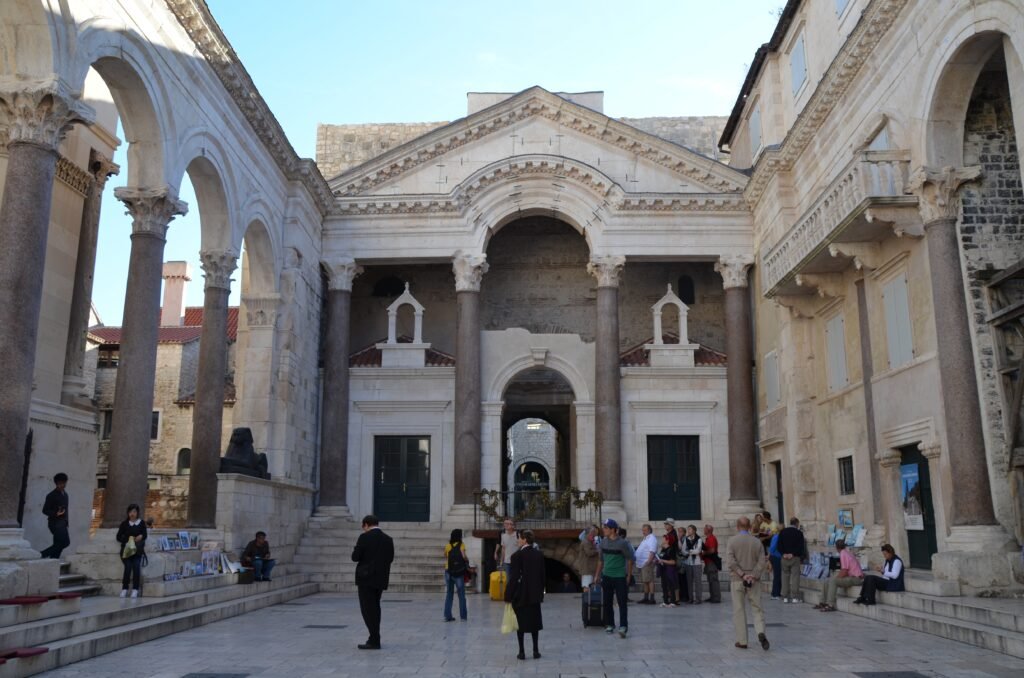
Split has a strange claim to fame among European cities: its old town is also, quite literally, a Roman emperor’s retirement home. Diocletian built his palace here around the year 300, and instead of falling into ruin, the whole thing just kept getting lived in, century after century, until an entire city grew up inside its walls. This guide, checked against a real video tour of the city, covers 25 hidden gems in Split, organized so you can explore well beyond the postcard shots of the Peristyle.
Diocletian’s Palace & the Riva: The Peristyle, the Cathedral of St. Domnius, and the seafront Riva promenade remain genuinely essential for any first visit, this guide picks up from there.
What makes Split different from a lot of Europe’s old towns is that its “historic monument” and its actual downtown are the exact same physical space. People live in apartments carved into the palace’s ancient walls, run cafés out of what used to be imperial chambers, and cut through Roman corridors on their way to work. That layering is really the whole point of visiting Split slowly rather than rushing through on a cruise-ship stopover, since so much of what makes the city interesting is easy to miss if you’re only looking for the obvious landmarks.
Inside Diocletian’s Palace
Marjan Hill & the Beaches
Art, History & Local Life
Day Trips from Split
Split Food Worth Seeking Out
Best Time to Visit Split
FAQ
Inside Diocletian’s Palace
The palace complex is a genuine maze, and most visitors only ever see the main square before moving on. There’s a lot more underneath and around it.
The Substructures
Beneath the palace’s ground floor, a vast network of Roman-era halls and chambers survives almost entirely intact, largely because they were used for storage over the centuries rather than demolished or built over. Walking through these underground spaces gives you a genuinely rare sense of the palace’s original scale, since the layout down here mirrors the imperial apartments that once stood directly above.
Diocletian’s Palace, entrance near the Bronze Gate. Entry fee. Best combined with a Peristyle visit, since the entrance sits just below the main square.
The Vestibule
A circular, domed entrance hall that once led directly into Diocletian’s private residence, its bare stone walls creating a genuinely striking natural echo. Visitors and street performers alike have discovered that a single sustained note sung here reverberates in a way that feels almost otherworldly.
Diocletian’s Palace, near the Peristyle. Free to enter. Best when it’s quiet enough to actually hear the acoustics, early morning is a good bet.
The Golden Gate
The grandest of the palace’s four original entrances, once reserved for the emperor himself, its arched form still framing the approach from the north. A striking statue of Gregory of Nin stands just outside it today, one of the most photographed spots in the entire city.
North side of Diocletian’s Palace. Free. Best in the early morning for photos before the crowds gather around the statue.
A Toe for Good Luck
That statue outside the Golden Gate depicts Gregory of Nin, a 10th-century bishop who fought for the right to hold Mass in the Croatian language rather than Latin. Local tradition says rubbing his oversized big toe brings good luck, and possibly guarantees a return trip to Split, and decades of visitors doing exactly that have polished the bronze toe to a bright gold shine.
Outside the Golden Gate, Diocletian’s Palace. Free. Best combined with a Golden Gate visit, since the statue stands right beside it.
St. Martin’s Church
Tucked into a narrow passageway within the palace walls, this is one of the smallest churches in the world, built directly into what was once a Roman guard corridor. Its tiny, easy-to-miss entrance is part of the charm, most visitors walk right past it without realizing what’s inside.
Within the palace walls, near the northern gate. Small entry fee. Best asking a local for directions, since the entrance is genuinely easy to miss.
Cathedral of St. Domnius
Originally built as Diocletian’s own mausoleum, this octagonal structure was later converted into a Christian cathedral, an ironic twist given that Diocletian was one of history’s most notorious persecutors of Christians. It’s considered the oldest cathedral in the world still using its original building.
Peristyle, Diocletian’s Palace. Entry fee, additional fee to climb the bell tower. Best climbing the bell tower for sweeping views over the palace’s terracotta rooftops.
Hidden Alleys of the Palace
Away from the main Peristyle-to-Golden-Gate route, the palace holds a genuine maze of narrow side streets, some barely wide enough for two people to pass. Getting a little lost here is honestly the best way to see it, small courtyards, hidden doorways, and quiet corners turn up constantly.
Throughout Diocletian’s Palace. Free. Best in the late afternoon, when the light angles low through the narrow passageways.
Marjan Hill & the Beaches
Locals call Marjan “the lungs of the city,” and once you’ve climbed it, you’ll understand why.
Marjan Hill
A forested peninsula rising just behind the old town, roughly the same size as New York’s Central Park, criss-crossed with pine-shaded trails leading up to sweeping viewpoints over Split and the surrounding islands. It’s been used as a public park since as early as the 3rd century, making it almost as old as the palace itself.
West of the old town, accessible on foot from the Riva. Free. Best in the late afternoon, hiking up in time to catch the sunset from the higher viewpoints.

Kašjuni Beach
Tucked along Marjan’s southern shoreline, this pebble beach sits far enough from the old town that it stays genuinely quieter than the more central city beaches, while still being a comfortable walk or short bus ride from downtown.
Southern side of Marjan Hill. Free. Best in the early morning or late afternoon, avoiding the midday sun with limited natural shade.
Bačvice Beach
Split’s most popular city beach, known locally as much for picigin, a splashy, acrobatic local ball game played in the shallow water, as for the beach itself. It’s genuinely one of the best places to see Split residents actually relaxing rather than working around tourists.
East of the old town, a short walk from the harbor. Free. Best late afternoon, when locals gather for a game of picigin in the shallows.
Relax Like a Local
Beyond the named beaches, much of Split’s coastline is lined with small, informal swimming spots, concrete platforms, rocky outcrops, quiet coves, that locals use just as often as the official beaches. Following the coastal path around Marjan turns up several of these without any signage at all.
Along the Marjan coastal path. Free. Best on a weekday morning, when even the well-known local spots stay uncrowded.
Art, History & Local Life
Split’s identity runs deeper than its Roman core, and its museums and markets show a different, more everyday side of the city.
Meštrović Gallery
Built as the personal home and studio of Ivan Meštrović, widely considered Croatia’s greatest sculptor, this gallery holds a substantial collection of his work displayed exactly as he intended, in the light-filled rooms and gardens he designed himself.
Marjan peninsula, western Split. Entry fee. Best combined with a Marjan Hill walk, given the gallery’s location right along the peninsula.
Archaeological Museum of Split
Croatia’s oldest museum, holding an extensive collection of artifacts from Salona, the Roman provincial capital that once stood just outside modern Split, before the city as we know it existed at all.
Northern Split, near the old town. Entry fee. Best combined with a visit to the Salona ruins themselves, a short drive away.
Pazar Green Market
Split’s open-air market, spilling out along the eastern wall of Diocletian’s Palace, where locals still do their daily shopping for produce, cheese, and cured meats. It’s a genuinely good place to see the palace used the way an ordinary Roman market square once might have been.
Eastern edge of Diocletian’s Palace. Free to browse. Best in the morning, when the stalls are fully stocked and the market is at its liveliest.
Narodni Trg (People’s Square)
The city’s main square outside the palace walls, genuinely functioning as Split’s living room, ringed by cafés where locals linger over coffee for hours. It’s a good spot to just sit and watch the city move around you.
Just west of Diocletian’s Palace. Free. Best in the early evening, when the square fills with both locals and visitors alike.
The Riva Promenade
Split’s palm-lined waterfront walkway, running directly along the harbor in front of the old town. It’s the genuine social center of the city, especially in the evening, when the whole promenade fills with people out for a walk.
Along the harbor, in front of Diocletian’s Palace. Free. Best at sunset, when the light over the harbor turns gold.
Day Trips from Split
Split’s ferry terminal makes it a genuinely convenient base for exploring the islands and coastline nearby. Hvar and Brač are both reachable within an hour or so by fast ferry, offering beaches, lavender fields, and hilltop villages well outside the city itself. Krka National Park, with its own set of dramatic waterfalls, sits within easy day-trip range by car or organized tour. And the ancient ruins of Salona, once the capital of Roman Dalmatia, are close enough for a half-day visit, a good pairing with a morning at the Archaeological Museum.
Split Food Worth Seeking Out
Peka, meat or seafood slow-cooked under a metal dome buried in hot coals, is a genuine Dalmatian specialty worth ordering ahead at a proper local restaurant, since it typically takes hours to prepare. Fresh seafood, unsurprisingly, is everywhere along the Riva, though wandering a few streets back from the water usually turns up better prices and equally fresh fish. Soparnik, a savory Swiss chard pie from the surrounding Poljica region, is a genuinely distinctive local specialty worth seeking out specifically in Split rather than assuming it’s available everywhere in Croatia. And no visit is complete without a coffee on Narodni Trg or the Riva, sitting for an hour with a single espresso is a genuine local pastime, not something to rush.
Best Time to Visit Split
May, June, and September offer warm, sunny weather with noticeably thinner crowds than July and August, which bring the busiest, most expensive stretch of the year to both the old town and the ferry terminal. Spring is a genuinely good season for Marjan Hill’s hiking trails, before the summer heat sets in. Summer remains the most popular time to visit, especially for beach access and island day trips, though booking ferries and accommodation ahead becomes genuinely necessary during peak weeks. Winter stays quiet, and while some restaurants and shops reduce their hours, it’s a genuinely peaceful time to explore the palace and its substructures without the crowds.
I cover all of these hidden gems in the video above. If this guide helped you plan your Split trip, subscribe to Worldly Traveler on YouTube for more travel guides from around the world.
Frequently Asked Questions
What are the best hidden gems in Split, Croatia?
Some of the best hidden gems in Split include the substructures beneath Diocletian’s Palace, Marjan Hill’s forest trails and viewpoints, the statue of Grgur Ninski (rub the toe for good luck), Bačvice Beach, and the Meštrović Gallery.
Why do people rub the toe of the Grgur Ninski statue?
Local tradition holds that rubbing the statue’s big toe brings good luck and, according to some versions of the story, ensures you’ll return to Split one day. The toe has been polished bright gold by generations of visitors doing exactly that.
How many days do you need in Split?
2-3 days gives you enough time to explore Diocletian’s Palace, Marjan Hill, and the city’s beaches at a relaxed pace, with room for a day trip to a nearby island.
Is Split walkable?
Yes, genuinely so. The old town and Diocletian’s Palace are entirely pedestrian, and Marjan Hill, the Riva promenade, and most of the city’s beaches are within easy walking distance of the historic center.
What is the best time of year to visit Split?
May, June, and September offer warm weather with noticeably thinner crowds than July and August, which are the busiest and most expensive months in the city.