
25 Things to Do in Lisbon: The Ultimate Lisbon Travel Guide
Lisbon has quietly become one of Europe’s most talked-about capitals, and for good reason. It’s built across seven hills above the Tagus River, with pastel buildings, black-and-white cobblestone patterns, and a genuine sense of history that survived a devastating 1755 earthquake and rebuilt itself into something new. This guide, checked against a real video tour of the city, covers 25 things to do in Lisbon, organized by neighborhood so you can plan a route that actually makes sense on foot.
What makes Lisbon different from most European capitals is how much of its identity comes from the sea. This was the city that funded Vasco da Gama’s voyage to India and helped launch Portugal’s Age of Discovery, and that maritime history shows up everywhere, from the monastery built to thank God for da Gama’s safe return to the tower that once guarded ships entering the harbor. Layer in the mournful sound of fado music, the taste of a fresh pastel de nata, and the way the light hits the river at sunset, and you start to understand why Lisbon has such a strong pull on people who visit.
Belém
The Alfama & Baixa
Chiado & Bairro Alto
Parque das Nações & the Modern City
Lisbon Food Worth Seeking Out
Best Time to Visit Lisbon
FAQ
Belém
This riverside district, a few miles west of the city center, is where Portugal’s Age of Discovery is most visible today.
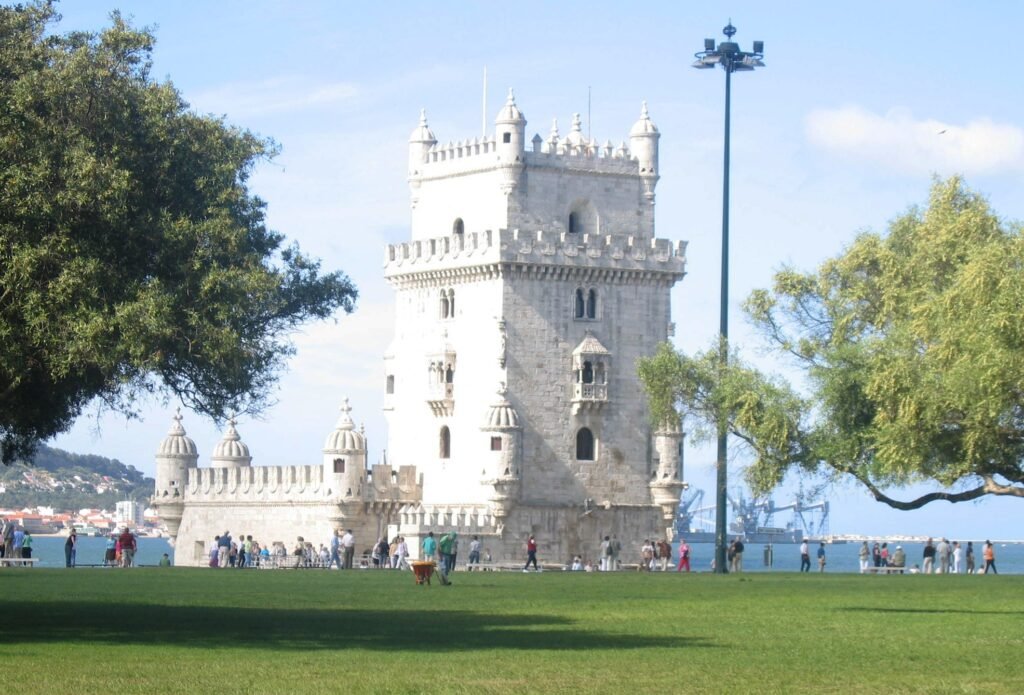
Belém Tower
Built in the early 16th century to defend the entrance to Lisbon’s harbor, this fortified tower is one of the most photographed landmarks in Portugal, and one of the last remaining examples of the ornate Manueline architectural style, named after King Manuel I and blending Gothic, Moorish, and maritime motifs into carved stonework you won’t see anywhere else.
Belém, western Lisbon. Entry fee. Best in the early morning, since lines can stretch long by midday.
Jerónimos Monastery
Commissioned by King Manuel I to give thanks for Vasco da Gama’s successful voyage to India, this monastery is a masterpiece of the same Manueline style as the Belém Tower, its cloisters covered in carved ropes, coral, and sea creatures that reference Portugal’s maritime ambitions. Vasco da Gama himself is buried inside.
Belém, western Lisbon. Entry fee. Best combined with a Belém Tower visit, since both sit within easy walking distance of each other.

Padrão dos Descobrimentos (Monument to the Discoveries)
A towering monument shaped like the prow of a ship, built along the riverbank to honor Portugal’s explorers, with Prince Henry the Navigator leading a procession of carved figures down the vessel’s side. A viewing platform near the top offers sweeping views back over Belém and the river.
Belém, along the Tagus riverfront. Entry fee for the viewing platform. Best at sunset for river views and the monument’s warm-lit silhouette.
The Alfama & Baixa
Lisbon’s oldest neighborhood, and the flat, rebuilt district beside it, hold the city’s medieval past and its 18th-century reinvention side by side.
Alfama District
The Alfama survived the 1755 earthquake that flattened most of the city, which is why its narrow, winding streets still follow a street plan that predates the disaster by centuries. Wander without a map here. Getting a little lost is genuinely part of the experience, and you’ll pass laundry hanging between balconies, small tiled churches, and the occasional burst of fado drifting out from a doorway.
Alfama, eastern Lisbon. Free to explore. Best in the late afternoon, when the neighborhood’s light and shadow are at their most striking.

Castelo de São Jorge
This hilltop castle has watched over Lisbon since at least the 11th century, though the site itself was fortified even earlier by the Romans and Moors. Beyond the ramparts, which offer some of the best panoramic views in the city, peacocks wander the castle grounds, a detail that surprises most first-time visitors.
Alfama, hilltop above the old town. Entry fee. Best in the late afternoon for golden light over the city and river.
Sé de Lisboa (Lisbon Cathedral)
Lisbon’s oldest church, built in 1147 shortly after the city was reconquered from Moorish rule, with a fortress-like Romanesque façade that reflects the turbulent period of its construction. It’s still an active cathedral today, and its cloister holds Roman and Moorish-era ruins uncovered during archaeological digs.
Alfama, near the waterfront. Free to enter; small fee for the cloister and treasury. Best combined with an Alfama walk, since it sits right at the district’s edge.
The Fado Museum
Fado, Lisbon’s soulful, melancholic musical tradition, is recognized by UNESCO as part of humanity’s intangible cultural heritage, and this museum traces its roots from 19th-century Alfama taverns to the concert halls it fills today. It’s a genuinely good primer before catching a live performance, since it explains the emotional concept of saudade, a kind of longing, that sits at the heart of every fado song.
Alfama, near the river. Entry fee. Best combined with an evening fado performance at one of the neighborhood’s traditional venues.
Praça do Comércio
One of the largest public squares in Europe, opening directly onto the Tagus River, this square was rebuilt after the 1755 earthquake as the grand new entrance to the city, and its yellow arcaded buildings and triumphal arch still give it a genuinely regal feel.
Baixa, riverfront. Free. Best in the early evening, when the square empties out and the light over the river turns golden.

Santa Justa Lift
A cast-iron elevator built in 1902, connecting the lower Baixa district to the hilltop Chiado neighborhood above. It was designed by an apprentice of Gustave Eiffel, and the neo-Gothic ironwork shows it. The viewing platform at the top offers one of the best rooftop panoramas in central Lisbon.
Baixa/Chiado border. Fee for the elevator; the connecting walkway is free. Best early in the day to avoid long lines for the platform.
Rossio Square
The heart of downtown Lisbon since the Middle Ages, paved with a dizzying wave-pattern mosaic of black and white cobblestones, a Portuguese design style, calçada portuguesa, that you’ll see echoed in sidewalks across the city and, thanks to Portuguese colonial history, in cities as far away as Rio de Janeiro and Macau.
Baixa. Free. Best combined with a broader Baixa walking route, given its central location.
Time Out Market (Mercado da Ribeira)
A historic 19th-century market hall reimagined by Time Out magazine as a curated food hall, bringing together some of Lisbon’s best chefs and restaurants under one roof. It’s touristy, sure, but it’s also a genuinely efficient way to sample a wide range of Portuguese cooking in a single visit.
Cais do Sodré, near the river. Free to enter; food priced individually. Best on a weekday to avoid weekend crowds.
Carmo Convent
A Gothic convent left roofless since the 1755 earthquake, its exposed stone arches now open to the sky in a way that makes the ruin feel almost intentional. Rather than rebuild it, the city chose to preserve the ruins as a quiet, sobering monument to the disaster, and they remain one of the most photogenic spots in Lisbon.
Chiado, near Santa Justa Lift. Small entry fee, which includes access to the archaeological museum inside. Best combined with a Santa Justa Lift visit given the shared location.
Chiado & Bairro Alto
These adjoining hilltop neighborhoods hold Lisbon’s literary cafés by day and its liveliest nightlife by night.
Bairro Alto
By day, this neighborhood is quiet, residential, and easy to overlook. By night, it transforms into Lisbon’s nightlife district, its narrow streets lined with small bars that spill out onto the sidewalks. It’s also worth a daytime wander for its independent shops and street art, which get lost in the after-dark crowds.
Central Lisbon, above Chiado. Free. Best in the evening for nightlife, or in the late morning for a quieter, shop-focused visit.
Miradouro da Senhora do Monte
Widely considered the best viewpoint in Lisbon, this hilltop lookout sits above and beyond the Alfama, with a sweep that takes in the castle, the river, and the rooftops in between. It draws far fewer tourists than the more famous viewpoints closer to the castle, which is exactly the appeal.
Graça, above the Alfama. Free. Best at sunset, when locals gather with drinks to watch the light change over the city.
Parque das Nações & the Modern City
Lisbon isn’t only tile-roofed history. The city’s eastern riverfront and central parks show a different, more contemporary side.
Parque das Nações
Built for the 1998 World Expo, this riverside district on Lisbon’s eastern edge is a genuinely different Lisbon from the historic center, all clean modern architecture, a cable car running along the river, and Vasco da Gama Bridge, one of the longest bridges in Europe, visible in the distance.
Eastern Lisbon, along the river. Free to explore; individual attractions charge entry. Best combined with a visit to the Lisbon Oceanarium.
Lisbon Oceanarium
One of the largest aquariums in Europe, built for the same 1998 Expo, organized around a massive central tank that represents the world’s oceans, with four surrounding habitats showing off the distinct marine life of different coastlines around the globe.
Parque das Nações. Entry fee. Best booking tickets in advance during school holidays, when it draws significant local family crowds.
MAAT (Museum of Art, Architecture and Technology)
A striking, wave-shaped riverside building whose curved white roof doubles as a public walkway, offering river views without ever needing to buy a ticket. The museum inside hosts rotating contemporary art and architecture exhibitions.
Belém, riverfront. Entry fee for exhibitions; roof walkway free. Best at sunset for the building’s reflective exterior against the water.
Eduardo VII Park
Lisbon’s largest central park, its sloped lawn offering a straight sightline down to the river, with a geometric hedge garden near the top and a large greenhouse, the Estufa Fria, tucked into one corner.
Central Lisbon. Free. Best at the top of the sloped lawn for the classic view down toward the river.
Estufa Fria (Cold Greenhouse)
A genuinely unusual greenhouse built into an old basalt quarry, its wooden slat roof creating dappled, filtered light for a dense collection of tropical and subtropical plants. Despite the name, it isn’t refrigerated. The “cold” simply refers to the lack of artificial heating, which the plants don’t seem to mind.
Eduardo VII Park, central Lisbon. Small entry fee. Best on a hot day, when the shaded, humid interior offers genuine relief.
Gulbenkian Museum
Built around the private art collection of oil magnate Calouste Gulbenkian, this museum holds an unusually broad range of work, from Egyptian antiquities to Islamic art to French Impressionist paintings, all set within a quiet, garden-wrapped modernist building that feels worlds away from the busier historic center.
Central Lisbon, near Eduardo VII Park. Entry fee. Best allotting several hours given the genuine range of the collection.
LX Factory
A former industrial complex turned creative hub, its old warehouse buildings now home to independent shops, restaurants, and a genuinely beautiful bookstore, Ler Devagar, built inside a former printing press. It sits directly beneath the 25 de Abril Bridge, which adds a dramatic backdrop to the whole complex.
Alcântara, western Lisbon. Free to browse; individual shop and restaurant prices vary. Best on a weekend, when the complex hosts its liveliest markets and events.
25 de Abril Bridge
Lisbon’s answer to the Golden Gate Bridge, and it genuinely looks the part, right down to the same shade of red-orange paint. Built in 1966, it spans the Tagus River to connect Lisbon with the city of Almada, where the Cristo Rei statue, modeled after Rio de Janeiro’s Christ the Redeemer, watches over the crossing from the opposite bank.
Spanning the Tagus River. Free to view; Cristo Rei viewing platform on the Almada side charges a small fee. Best viewed from Almada or a river cruise for the fullest perspective on its scale.

Lisbon Zoo
One of the oldest zoos in Europe, home to a genuinely well-regarded cable car that carries visitors above the enclosures, offering an aerial view of the grounds that most zoos simply can’t match.
Sete Rios, northern Lisbon. Entry fee. Best for families with children, given the zoo’s genuinely family-oriented programming.
Lisbon Food Worth Seeking Out
The pastel de nata, a small custard tart with a flaky, caramelized top, is Lisbon’s most famous export, and while you’ll find it in bakeries across the city, the original recipe comes from Belém, where the Pastéis de Belém bakery has guarded its exact formula since 1837. Bacalhau, salt cod, holds a nearly mythical place in Portuguese cooking. Locals often claim there are 365 ways to prepare it, one for every day of the year, and trying even a handful of different versions gives you a real sense of how central it is to the national diet. Ginjinha, a sweet cherry liqueur served in small shot glasses, often with a cherry dropped into the bottom, is worth trying at one of the tiny, standing-room-only bars in the Baixa where it’s been served since the 19th century. And a proper fado dinner, eaten at a small tavern in the Alfama while a singer performs just a few feet away, is less a meal than an experience. Reservations are worth making in advance at the more established venues.
Best Time to Visit Lisbon
April through June and September through October offer the most comfortable temperatures and noticeably thinner crowds than the height of summer, when both heat and tourist numbers climb across the city. Spring brings the jacaranda trees into bloom along several of Lisbon’s grand avenues, a genuinely lovely sight worth timing a visit around if you can. Summer stays popular despite the heat, thanks to the city’s beach access and lively outdoor festival season, though the combination of sun and steep, cobblestone streets makes it the more physically demanding time to explore on foot. Winter remains mild by northern European standards, and while it’s the quietest season for tourism, it’s also a genuinely good time to catch fado indoors, away from the summer crowds that fill the Alfama’s outdoor tables. If a European city break isn’t the only kind of trip on your radar, our guide to Washington State’s hidden gems beyond Seattle covers a very different kind of destination, from temperate rainforest to high desert wine country.
I cover all of these spots in the video above. If this guide helped you plan your Lisbon trip, subscribe to Worldly Traveler on YouTube for more travel guides from around the world.
Frequently Asked Questions
What are the best things to do in Lisbon?
Some of the best things to do in Lisbon include visiting the Belém Tower and Jerónimos Monastery, wandering the Alfama district, riding the Santa Justa Lift, listening to fado at a traditional venue, and taking in the views from Miradouro da Senhora do Monte.
What is fado music?
Fado is a traditional Portuguese style of melancholic, soulful singing that developed in Lisbon in the early 19th century, often centered on themes of longing, or saudade. It’s recognized by UNESCO as an Intangible Cultural Heritage of Humanity.
How many days do you need in Lisbon?
3-4 days gives you enough time to see Belém, the Alfama, and the city center at a comfortable pace, with room for a day trip to Sintra. A shorter 2-day visit can still cover the highlights.
Is Lisbon a walkable city?
Yes, though it’s a genuinely hilly one. Comfortable shoes matter more in Lisbon than in most European capitals, and the city’s old trams and funiculars exist specifically to help residents deal with the steep terrain.
What is the best time of year to visit Lisbon?
April through June and September through October offer the most comfortable temperatures and thinner crowds than the peak of summer, when the city gets both hot and busy.