
Puglia, Italy: The Ultimate Guide to Italy’s Hidden Heel
Forming the heel of Italy’s boot, Puglia has spent years as the country’s most talked-about “next big thing,” a region genuinely on the verge of the kind of international fame that transformed Tuscany and the Amalfi Coast decades ago, but still, for now, considerably less crowded and less expensive than either. This guide walks through Puglia’s best towns and landscapes, checked against real research into each location, with a direct look at how the region genuinely stacks up against its more famous coastal rival.
What makes Puglia genuinely distinct from Italy’s more famous regions is its landscape and history. Unlike the dramatic vertical cliffs of the Amalfi Coast or the rolling hills of Tuscany, Puglia is largely flat, its horizon dominated by olive groves, some containing trees estimated to be over a thousand years old, and its architecture shaped by a genuinely unusual mix of influences, Byzantine, Norman, and Aragonese rule all left visible marks across the region’s towns. That flat terrain and relative remoteness from Italy’s more heavily trafficked northern tourist circuit helped keep Puglia genuinely under-the-radar for far longer than most of the country.
Puglia’s position as the heel of Italy’s boot also gave it a genuinely unique strategic role throughout history, a stopover point for pilgrims, traders, and armies moving between Western Europe and the Byzantine and Ottoman worlds further east. That crossroads history shows up clearly in the region’s architecture, Norman castles built to defend against Saracen raids sit alongside Baroque churches funded by wealthy landowning families, and coastal watchtowers, once part of a defensive network scanning the Adriatic for approaching threats, still dot the shoreline today. Understanding that layered past genuinely deepens a visit here beyond simply admiring the whitewashed towns and dramatic coastline.
Alberobello & the Trulli
Ostuni, the White City
Polignano a Mare
The Salento Peninsula
Puglia’s Layered History
Puglia vs. Amalfi Coast: The Trade-Offs
Puglia Food Worth Seeking Out
FAQ
Alberobello & the Trulli
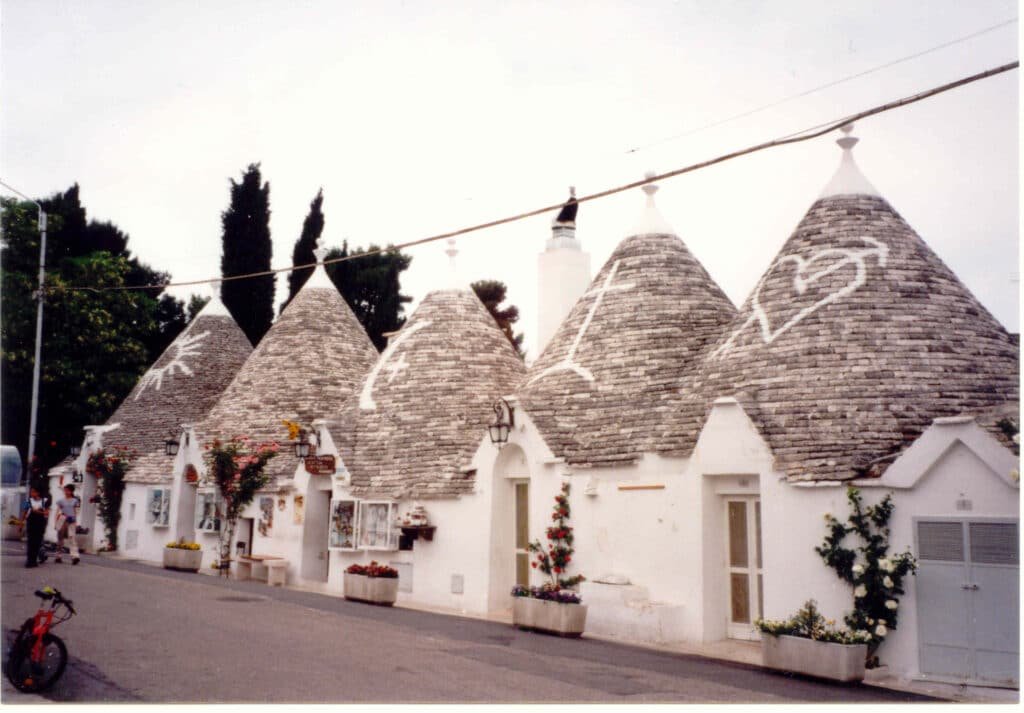
The single most distinctive architectural sight in all of Puglia, and genuinely worth the trip on its own, Alberobello’s cluster of conical stone roofs looks unlike anywhere else in Italy, or arguably anywhere else in Europe.
Alberobello
Home to over 1,500 trulli, traditional whitewashed stone dwellings with distinctive conical roofs, concentrated most densely in the Rione Monti district, Alberobello has been a UNESCO World Heritage Site since 1996. The trulli’s unusual construction, built without mortar using a traditional dry-stone technique, is widely believed to have originated partly as a practical response to a historical tax on permanent buildings, since these structures could reportedly be dismantled quickly if tax inspectors were spotted approaching, though the full historical accuracy of that specific story remains debated among historians. Some roofs are painted with symbols, astrological, religious, or simply decorative, added during restoration work in the 1980s and 1990s. The Trullo Sovrano, an 18th-century two-story trullo, one of the few built with an upper floor, offers a genuinely worthwhile interior visit for travelers wanting to see how these structures actually functioned as homes rather than just admiring their exteriors.
Rione Monti district, Alberobello, Bari province. Free to explore the streets; some trulli interiors charge entry as house museums. Best in the early morning, before tour buses arrive and while the whitewashed walls catch the day’s first light.
The Itria Valley
Beyond Alberobello itself, the surrounding Itria Valley holds a scattering of equally charming towns, including Locorotondo, its name literally meaning “round place” for its distinctive circular medieval layout, and Cisternino, both built in similarly tight, whitewashed configurations and worth a slower drive between stops rather than a single rushed day trip. The valley’s landscape between towns, dotted with individual trulli used as rural farm structures rather than clustered urban dwellings, gives a genuinely different sense of how these buildings functioned across the wider countryside, not just within Alberobello’s dense historic core. Martina Franca, another valley town worth including, adds a genuinely different Baroque architectural layer to the mix, its historic center built during a period of prosperity under Habsburg rule that left behind grander, more elaborate buildings than found in the surrounding smaller villages.
Itria Valley, between Bari and Brindisi provinces. Free to explore towns. Best allotting at least two full days to properly cover the valley’s several worthwhile towns.
Ostuni, the White City
Visible from miles away thanks to its uniformly whitewashed buildings, Ostuni offers one of Puglia’s most striking hilltop panoramas, a genuine landmark visible long before you actually arrive.
Ostuni
Ostuni’s entire historic center is coated in lime whitewash, a tradition originally intended to reflect heat and, according to some local accounts, help curb the spread of disease during past epidemics, and the effect is genuinely dramatic, the town appears to glow from a distance, set on a hill roughly 218 meters above the surrounding countryside, with the Adriatic Sea visible from its upper streets on a clear day. At the center of the historic core, Piazza della Libertà holds the 21-meter Column of Sant’Oronzo, built in 1771 as a votive offering following relief from famine and disease, a genuine piece of the town’s layered religious history. Ostuni’s cathedral, a striking example of Apulian Romanesque-Gothic architecture with a distinctive rose window, anchors the highest point of the old town and rewards the climb up through the maze of narrow whitewashed lanes leading toward it.
Historic center, Ostuni, Brindisi province. Free to explore. Best at sunset, when the white buildings take on a warm golden glow.

Polignano a Mare
A genuinely dramatic coastal town, its old center perched directly on limestone cliffs above the Adriatic Sea, offering a completely different visual character from the flat, whitewashed towns further inland.
Polignano a Mare
Built on a network of cliffside caves carved by the sea over millennia, Polignano a Mare’s historic center offers views straight down onto Lama Monachile, a small, dramatically framed beach wedged between the cliffs and a Roman-era bridge, genuinely one of the most photographed beach scenes in southern Italy. The town is also the birthplace of Domenico Modugno, the singer behind “Volare,” one of the most internationally recognized Italian songs ever recorded, a detail the town commemorates with a statue along its cliffside promenade. The Red Bull Cliff Diving World Series has held events here in recent years, divers launching from the cliffs directly above Lama Monachile, a genuinely fitting use of the town’s dramatic natural setting.
Polignano a Mare, Bari province. Free to explore town; beach access free, though crowded in summer. Best in the early morning for the clearest views down onto Lama Monachile before crowds arrive.
The Salento Peninsula
Puglia’s southernmost stretch, where the region narrows to a genuine peninsula between two seas, holds its best beaches and a distinctly Baroque architectural tradition found nowhere else in the region.
Lecce
Genuinely nicknamed the “Florence of the South,” Lecce’s historic center is built almost entirely from a soft local limestone, pietra leccese, that allowed for extraordinarily ornate carving, giving rise to a distinct regional style known as Lecce Baroque, its churches and palazzi covered in elaborate stone decoration found nowhere else in quite the same density. The Basilica di Santa Croce, its facade an almost overwhelming display of carved figures, columns, and decorative flourishes, stands as the single best example of this local style, and the city’s well-preserved Roman amphitheater, discovered beneath the main square during 20th-century construction work, adds a genuinely older layer of history beneath the Baroque splendor, a reminder that Lecce’s story extends back well over two thousand years before its Baroque golden age.
Historic center, Lecce, Lecce province. Free to explore; individual church and museum fees vary. Best allotting a full day, given the genuine density of significant Baroque architecture throughout the old town.
The Salento Coastline
Where the peninsula narrows between the Adriatic and Ionian Seas, Salento’s coastline holds some of Puglia’s best beaches, genuinely rivaling the Caribbean in water clarity at spots like Torre dell’Orso and the beaches near Otranto, Italy’s easternmost town. Otranto itself holds a genuinely significant cathedral, its floor covered by a massive 12th-century mosaic depicting the tree of life, along with a martyrs’ chapel commemorating townspeople killed during an Ottoman siege in 1480, a sobering piece of history worth knowing before admiring the town’s otherwise idyllic coastal setting.
Salento peninsula, southern Puglia. Free beach access at most spots. Best in June or September for warm water without peak-August crowds.
Puglia’s Layered History
Understanding why Puglia’s towns look so different from one another genuinely comes down to the sheer number of powers that controlled this stretch of coastline over the centuries. Greek colonists settled parts of the region in antiquity, followed by Roman rule, then a long Byzantine period that left behind genuine Orthodox-influenced religious architecture in places like the crypt churches scattered through the region. Norman conquerors arrived in the 11th century, building the castles and cathedrals that still anchor many Puglian towns today, before the region passed through Swabian, Angevin, and Aragonese hands, each leaving its own architectural fingerprint. That accumulated layering is part of why a single day trip through the Itria Valley or Salento can pass through towns with genuinely distinct visual character, despite sitting only a short drive apart, each one shaped by whichever power happened to be building and investing there at a given moment in the region’s long, contested history.
Puglia vs. Amalfi Coast: The Trade-Offs
| Category | Puglia | Amalfi Coast |
|---|---|---|
| Landscape | Flat, rural, olive groves | Dramatic vertical cliffs |
| Cost | Generally lower | Generally higher, especially accommodation |
| Crowds | Growing but still less crowded | Genuinely very crowded in peak season |
| Getting around | Requires a car; roads flatter and easier | Narrow, winding coastal roads; heavy traffic |
The choice between Puglia and the Amalfi Coast genuinely comes down to what kind of Italian coastal experience you’re after. The Amalfi Coast delivers the dramatic, vertiginous scenery most people picture when they imagine coastal Italy, but that fame comes with real costs, genuinely crowded roads, higher prices, and a more polished, tourist-oriented infrastructure built up over decades of international fame. Puglia offers a flatter, more rural counterpart, generally lower prices, and a still-developing tourism scene that, for now, feels noticeably more authentic and less saturated, though that gap is genuinely narrowing each year as the region’s popularity continues to grow, particularly since several international celebrities have chosen the Itria Valley for high-profile weddings in recent years, a genuine sign of the region’s rising profile.
Ease of travel also genuinely differs between the two. The Amalfi Coast’s famous coastal road, the SS163, is stunning but genuinely narrow and prone to serious traffic congestion during peak season, sometimes turning short distances into hour-long crawls. Puglia’s roads, while requiring a car for most of the region, are considerably flatter and less congested, making self-driving a genuinely more relaxed experience overall, even accounting for the larger total distances between Puglia’s more spread-out towns.
Puglia Food Worth Seeking Out
Orecchiette, small ear-shaped pasta traditionally hand-formed rather than machine-cut, remains genuinely central to Puglian cooking, most classically served with cime di rapa (turnip tops) in a dish that reflects the region’s deep agricultural roots, and watching a nonna form the pasta by hand in a doorway along one of Bari’s old town streets remains one of the most genuine culinary sights in the region. Burrata, a fresh cheese with a soft, cream-filled center, genuinely originated in Puglia, specifically in the town of Andria, and eating it here, often within hours of production, offers a noticeably different experience from the exported versions found in supermarkets abroad, the freshness alone makes a real, tasteable difference.
Taralli, small ring-shaped savory crackers, are a genuine Puglian snack staple worth trying in their many regional flavor variations, from plain to fennel to spicy chili, and they’re widely sold at markets and bakeries throughout the region, making them an easy, portable souvenir. And Puglia’s olive oil production, the region accounts for a genuinely significant share of Italy’s total output, is worth tasting directly at a local frantoio (oil mill), where the difference between a fresh, peppery regional oil and a generic supermarket bottle becomes immediately obvious, some of the region’s oldest olive groves hold trees estimated at well over a thousand years old, still actively producing fruit today, a genuinely remarkable piece of living agricultural history.
I reference this Puglia vs. Amalfi Coast comparison in the video above. If this guide helped you plan your Puglia trip, check out more travel videos from Worldly Traveler.
Whichever towns make it onto your itinerary, Puglia genuinely rewards travelers willing to slow down and drive between stops rather than treating it as a checklist. The region’s real appeal isn’t any single postcard view, it’s the accumulation of small details along the way, an unmarked roadside olive grove older than most European nations, a whitewashed lane in Ostuni that opens onto a sudden sea view, a plate of orecchiette made by hand in a doorway you happened to walk past. That’s ultimately the case for visiting now rather than waiting, Puglia’s charm has always depended on feeling discovered rather than packaged, and every year that stays true is a year worth taking advantage of.
Frequently Asked Questions
What are trulli?
Trulli are traditional whitewashed stone dwellings with distinctive conical roofs, unique to the Itria Valley in Puglia, a genuinely rare architectural form found nowhere else in the world in this concentration. Alberobello, home to over 1,500 of them, has been a UNESCO World Heritage Site since 1996.
Why is Ostuni called the White City?
Ostuni’s entire historic center is whitewashed in lime, a tradition originally intended to reflect heat and, according to some accounts, help prevent the spread of disease. The effect is dramatic enough that the town is visible shining white from miles away across the surrounding countryside.
Should I visit Puglia or the Amalfi Coast?
It genuinely depends on your priorities. The Amalfi Coast offers dramatic cliffside scenery and a more polished, established tourist infrastructure, while Puglia delivers a flatter, more rural landscape, generally lower prices, and a more authentic, less crowded experience overall.
How many days do you need in Puglia?
7-10 days allows a well-paced trip covering Alberobello, Ostuni, Polignano a Mare, and a stretch of the Salento peninsula. A shorter 4-5 day trip works well focused on just the Itria Valley towns, given how close together they sit.
Do you need a car to explore Puglia?
Yes, genuinely. Puglia’s towns are spread across a large, largely rural region, and public transport between them is limited, making a rental car the most practical way to see the region thoroughly and reach its more remote beaches.