
Bosnia and Herzegovina Hidden Gems
Bosnia and Herzegovina genuinely carries some of the most emotionally resonant historic sites anywhere in Europe, places where recent, well-documented tragedy and centuries-older Ottoman heritage sit directly alongside each other. This guide walks through the country’s best hidden gems, checked against real research into each, and told honestly, including the difficult history several of these sites represent.
What makes Bosnia and Herzegovina genuinely distinct from many other European destinations is how directly and recently its history intersects with living memory, the 1990s conflict that shaped so much of the country’s modern identity happened within the lifetime of most adult visitors, a genuinely different relationship to the past than the centuries-removed history found at most other European heritage sites. That immediacy doesn’t diminish the country’s older Ottoman and Austro-Hungarian heritage, if anything it adds a genuinely rare layered quality, visitors encounter medieval bridges, centuries-old markets, and recent wartime memorials often within the same short walk, a combination that rewards travelers willing to engage thoughtfully with the full sweep of what they’re seeing rather than picking only the more comfortable, purely historic sites.
Bosnia and Herzegovina is one of five destinations in our guide to the underrated countries in Europe, alongside Poland, Slovakia, Latvia, and Montenegro, with side-by-side highlights and routing ideas for combining them.
Mostar’s Old Bridge
Sarajevo’s Baščaršija & Tunnel of Hope
Kravice Falls
Understanding Bosnia’s Modern History
Comparing the Destinations
Planning Your Visit
Bosnian Food Worth Seeking Out
Bosnia’s Religious & Cultural Diversity
FAQ
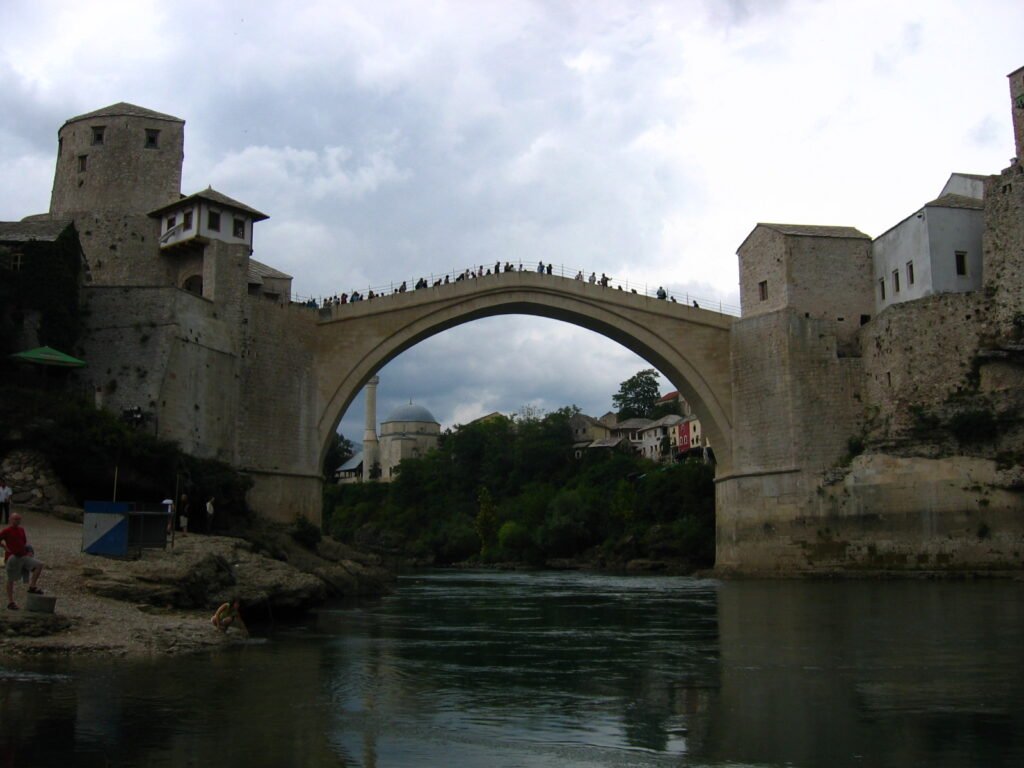
Mostar’s Old Bridge
Genuinely one of the most poignant reconstruction stories in modern European history, a bridge destroyed in war and painstakingly rebuilt stone by stone.
Stari Most (The Old Bridge)
Commissioned by Ottoman Sultan Suleiman the Magnificent and designed by architect Mimar Hayruddin, a student of the legendary Ottoman architect Mimar Sinan, the original Stari Most was constructed between 1557 and 1566, its elegant single stone arch spanning 29 meters across the Neretva River and connecting the two halves of what would become the city of Mostar, itself named after the “mostari,” or bridge keepers, who guarded the crossing during Ottoman rule. For over four centuries, the bridge stood as one of the most celebrated examples of Ottoman engineering in the Balkans, until Croatian forces destroyed it with artillery fire on November 9, 1993, during the height of the Bosnian War, an act of cultural destruction that came to symbolize the conflict’s broader devastation of shared community heritage. The bridge’s destruction was genuinely documented in real time and broadcast internationally, and the specific footage of its final collapse into the Neretva became one of the most widely recognized images of the entire Bosnian War, a single moment that crystallized the conflict’s human and cultural toll for global audiences watching from afar.
Following the war, an international coalition led by UNESCO and the World Bank undertook a genuinely painstaking reconstruction, engineers salvaged original stone blocks from the riverbed where they’d fallen and quarried new blocks from the same historic sources used in 1557, employing the same traditional construction techniques rather than modern shortcuts, a project completed in 2004 and recognized with UNESCO World Heritage status the following year. The reconstruction genuinely required specialists to relearn largely forgotten 16th-century stonemasonry techniques, since modern construction methods couldn’t replicate the specific interlocking stone technique, using iron clamps set into lead, that had allowed the original bridge to withstand centuries of flooding and use before finally succumbing to deliberate wartime destruction rather than natural decay.

Local young men continue a genuinely long-standing tradition of diving from the bridge’s highest point into the Neretva below, a test of courage practiced for generations and formalized into an annual diving competition held each summer since 1968, and the practice remains genuinely dangerous given the roughly 24-meter drop into cold water, meaning only trained, experienced local divers attempt the full jump rather than casual tourists, though visitors can pay these divers to perform the leap for photographs.
Mostar, Herzegovina, southern Bosnia. Free to view and cross; nearby museums charge separate admission. Best spring or fall for comfortable weather and the clearest views of the bridge’s reflection in the river.
Sarajevo’s Baščaršija & Tunnel of Hope
Genuinely a city whose old Ottoman quarter and recent wartime history sit within a short drive of each other, offering visitors two starkly different but equally essential windows into Bosnian history.
Baščaršija
Sarajevo’s historic old town, Baščaršija, takes its name from the Turkish for “main market,” and its winding streets, still centered on the ornate wooden Sebilj fountain built in 1891, remain genuinely lined with coppersmith workshops, Ottoman-era mosques, and traditional caravanserai buildings, a living, working continuation of the same commercial district established when the Ottomans first developed the city in the 15th century. The district’s genuine layering of Ottoman, Austro-Hungarian, and modern influences, visible in the architecture transitioning almost block by block as you walk east to west through the city center, has long made Sarajevo a genuinely significant symbol of cultural coexistence and exchange between East and West, a reputation that predates the 1990s conflict by centuries and has genuinely reasserted itself in the decades since the war’s end.
Gazi Husrev-beg Mosque, built in 1531 and among the most significant Ottoman-era structures in the entire Balkans, anchors the district’s religious architecture, while the nearby Sarajevo City Hall, a genuinely striking Moorish Revival building completed in 1896 under Austro-Hungarian rule and severely damaged by shelling during the 1990s siege, has since been carefully restored and now houses the National and University Library, its reconstruction genuinely symbolizing the city’s broader post-war recovery.
Sarajevo Old Town, central Bosnia. Free to explore. Best any season, though the district’s cafes and market stalls are genuinely at their liveliest during warmer months.
The Tunnel of Hope
During the Siege of Sarajevo, which lasted 1,425 days from April 1992 to February 1996, the longest siege of a capital city in modern warfare, the city found itself completely surrounded and cut off from the outside world, its only lifeline an 800-meter tunnel hand-dug beneath the UN-controlled airport runway using pickaxes and shovels, lit only by “war candles” made from cooking oil and string. Completed in July 1993 and connecting the Bosnian-held neighborhoods of Dobrinja and Butmir on either side of the airport, the tunnel genuinely allowed food, medicine, and humanitarian aid to reach the besieged population, and even included a small rail system to move supplies more efficiently through its narrow, barely one-meter-wide passage. Construction took more than six months of continuous digging by hand, a genuinely remarkable feat of improvised civil engineering carried out under constant threat of discovery and bombardment, and the tunnel’s narrow, low-ceilinged dimensions meant most of the roughly 20 tons of supplies moved through it daily had to be carried or pushed on small carts rather than transported by any larger vehicle.
Today, roughly 25 meters of the original tunnel, alongside additional restored sections opened to the public more recently, remain preserved as the Tunnel of Hope Museum, housed in the same private home that once concealed the tunnel’s entrance, and the museum’s photographs, artifacts, and documentary footage offer visitors a genuinely sobering, essential piece of context for understanding modern Sarajevo beyond its more picturesque historic quarter. Visitors specifically interested in the wider Siege of Sarajevo can genuinely combine the tunnel visit with a walk along the city’s infamous Sniper Alley and a stop at the Gallery 11/07/95, a museum specifically documenting the Srebrenica genocide, for a more complete, if genuinely difficult, understanding of the conflict’s full human cost.
Butmir, near Sarajevo International Airport. Entry fee applies. Best combined with a broader Siege of Sarajevo history tour, including Sniper Alley and the Gallery 11/07/95 museum, for fuller historical context.


Kravice Falls
Genuinely one of the most beautiful and least internationally known natural attractions in the entire Balkans, a wide, tiered waterfall considerably more accessible than its scale might suggest.
Kravice Falls
Located on the Trebižat River roughly 40 kilometers south of Mostar, Kravice Falls drop approximately 25 meters over a genuinely wide, tufa rock formation spanning some 120 meters across, creating a natural amphitheater that’s earned informal comparisons to a considerably smaller, more approachable version of South America’s Iguazu Falls. The falls form through a geological process specific to the region’s karst limestone landscape, calcium carbonate deposits building up gradually over centuries into the porous, terraced tufa rock that shapes the waterfall’s distinctive tiered appearance today, a genuinely ongoing geological process that continues slowly reshaping the falls’ exact contours even now.
The large natural pool at the base of the falls remains genuinely popular for swimming throughout the warmer months, the Trebižat’s consistently cool, clear water offering a refreshing contrast to Herzegovina’s often intensely hot summer weather, and the site’s forested, limestone-cliff surroundings give the whole area a genuinely lush, almost subtropical atmosphere unusual for this part of the Balkans. A small rope swing installed near one section of the falls adds a further, genuinely playful recreational element for visitors beyond simply swimming in the main pool, and boat rentals available on-site allow for a closer, water-level view of the falls’ full width from directly in front of the cascading water.
Despite its genuine natural beauty, Kravice remains considerably less visited than comparable waterfalls elsewhere in Europe, making it a genuinely worthwhile day trip for travelers based in Mostar or even visiting from nearby Dubrovnik across the Croatian border, roughly 130 kilometers away. The falls’ relative proximity to several other worthwhile Herzegovina attractions, including the pilgrimage town of Međugorje and the fortified hilltop village of Počitelj, means a well-planned day trip from Mostar can genuinely combine Kravice with additional regional sightseeing rather than treating the waterfall as a standalone destination.
Near Ljubuški, Herzegovina, roughly 40 km south of Mostar. Entry fee applies. Best summer for swimming, though the falls remain genuinely scenic and considerably less crowded in spring and fall.

Understanding Bosnia’s Modern History
The Bosnian War, fought between 1992 and 1995 following the breakup of Yugoslavia, resulted in genuinely staggering losses, an estimated 100,000 people killed and roughly two million displaced from their homes, making it the deadliest conflict in Europe since the Second World War. The war’s complex ethnic and religious dimensions, involving Bosniak, Croat, and Serb populations who had lived alongside each other for generations, produced some of the war’s most genuinely difficult chapters, including the 1995 Srebrenica massacre, recognized by international courts as an act of genocide, the single worst atrocity committed on European soil since 1945.

The Dayton Agreement, signed in December 1995, formally ended the war and established the country’s current, genuinely complex political structure, dividing Bosnia and Herzegovina into two main entities, the Federation of Bosnia and Herzegovina and Republika Srpska, a governance arrangement designed specifically to end the fighting rather than to produce the most efficient or straightforward political system, and one that remains a genuine subject of ongoing debate and reform discussion within the country today. Understanding this recent, complicated history genuinely matters for engaging thoughtfully with sites like Mostar’s bridge and Sarajevo’s tunnel, both represent not distant historical abstraction but events within the direct memory of the guides, shopkeepers, and residents visitors encounter throughout a typical trip.
Comparing the Destinations
| Destination | Character | Best For |
|---|---|---|
| Mostar’s Old Bridge | Rebuilt Ottoman-era landmark | Architecture, resilience, symbolism |
| Sarajevo | Ottoman old town, wartime history | Layered history, cultural depth |
| Kravice Falls | Wide tufa waterfall, natural pool | Nature, swimming, day trips |
Each destination genuinely offers a different, essential facet of Bosnia and Herzegovina’s complex modern identity. Mostar’s bridge represents both the country’s Ottoman architectural heritage and its genuine capacity for post-war healing and reconstruction, Sarajevo combines centuries of Ottoman and Austro-Hungarian coexistence with the more recent, deeply significant history of the 1990s siege, and Kravice Falls offers a genuinely lighter, purely natural counterpoint to the country’s historically weighty urban destinations. A traveler with limited time might reasonably prioritize Sarajevo and Mostar given their historical significance and easy connectivity, while Kravice offers a genuinely worthwhile, more relaxed addition for anyone extending their trip even slightly.
Planning Your Visit
Sarajevo and Mostar sit roughly two and a half hours apart by car or train, making them genuinely easy to combine within a single trip, and Kravice Falls, situated between Mostar and the Croatian border, pairs naturally as a day trip from Mostar or as a stop on a longer journey toward Dubrovnik. Bosnia and Herzegovina’s currency, the convertible mark (KM), remains pegged to the euro, and while English proficiency is genuinely strong among younger Bosnians and in the tourism industry, learning a few basic phrases genuinely helps when navigating more rural areas around Kravice.
Approaching Sarajevo’s wartime history sites, particularly the Tunnel of Hope, with genuine respect and openness matters considerably, these are recent historical events within living memory for many Bosnians, and engaging thoughtfully with that history, rather than treating these sites as simply another checklist attraction, genuinely enriches the visit for both traveler and the local guides who often share deeply personal connections to the events being described. Booking a guided tour specifically for the wartime history sites, rather than visiting independently, genuinely adds considerable context and personal perspective that self-guided visits often miss entirely.
Bosnian Food Worth Seeking Out
Ćevapi, small grilled minced meat sausages served in fresh somun flatbread with chopped onions, remains genuinely Bosnia’s most recognizable dish, and Sarajevo’s own specific version, prepared and served according to traditions passed down through generations of local restaurants in Baščaršija, is widely considered by many Bosnians and visiting food enthusiasts alike to be the definitive version found anywhere in the wider Balkan region. Burek, a savory pastry filled with minced meat and baked in a distinctive coiled spiral shape, represents another genuinely essential Bosnian staple, its Ottoman-derived preparation method and flaky pastry technique reflecting centuries of culinary influence that predates the country’s more recent political history by many generations.

Bosnian coffee, prepared in a distinctive copper pot called a džezva and served with a small cube of Turkish delight, remains genuinely central to Bosnian hospitality and social custom, the ritual of slowly sipping coffee together over unhurried conversation reflecting a deliberately slower pace of social life that visitors genuinely notice throughout their time in Sarajevo’s cafes. Rakija, a strong fruit brandy shared across much of the Balkans, and Bosnian wine from the Herzegovina region’s genuinely favorable Mediterranean-influenced climate, both offer worthwhile accompaniments to a proper Bosnian meal, and the region’s Žilavka white grape variety, native specifically to Herzegovina, produces a genuinely distinctive wine style considerably less internationally known than it perhaps deserves.
If this guide helped you plan a Bosnia trip, check out more travel videos from Worldly Traveler.
Whichever destination ends up on your itinerary, Bosnia and Herzegovina genuinely rewards travelers willing to engage honestly with a country whose relatively recent history remains inseparable from its considerably older cultural heritage. Mostar’s rebuilt bridge, Sarajevo’s living Ottoman quarter and sobering wartime tunnel, and Kravice Falls’ genuinely underrated natural beauty each tell a distinct part of a country that offers considerably more depth, and considerably more resilience, than its modest international tourism profile might initially suggest. From watching a local diver leap from the same bridge rebuilt stone by stone after wartime destruction, to walking through the very tunnel that kept an entire besieged city alive, to swimming in a waterfall pool most international visitors have never heard of, Bosnia and Herzegovina offers a genuinely unfiltered, deeply human travel experience found in relatively few other corners of Europe.
Bosnia’s Religious & Cultural Diversity
Bosnia and Herzegovina genuinely stands out among all European countries for its historic religious diversity, home to significant Muslim (Bosniak), Orthodox Christian (Serb), and Catholic (Croat) populations that have coexisted, with periods of genuine tension alongside long stretches of peaceful integration, for centuries under Ottoman, Austro-Hungarian, and Yugoslav rule. Sarajevo specifically has genuinely long been informally nicknamed the “Jerusalem of Europe” for this remarkable religious plurality, mosques, Orthodox churches, Catholic cathedrals, and a historic synagogue all still standing within walking distance of one another in the city center, a physical manifestation of centuries of multi-religious urban life that predates the modern nation-state entirely.

The Sarajevo Haggadah, a genuinely priceless illuminated Jewish manuscript dating to the 14th century and now housed in the National Museum of Bosnia and Herzegovina, offers a particularly striking symbol of this layered religious history, the manuscript was reportedly saved from destruction on at least two separate occasions, once during the Second World War by a Muslim museum curator who hid it from Nazi forces, and again during the 1990s siege when museum staff moved it to a bank vault for safekeeping amid the shelling of Sarajevo. That specific story, a Jewish religious artifact protected across decades by people of different faiths during two separate wartime crises, genuinely captures something essential about Bosnia’s complicated but often quietly heroic religious coexistence that the country’s more headline-grabbing conflicts can sometimes obscure.
Frequently Asked Questions
When was Mostar’s Old Bridge destroyed and rebuilt?
The Old Bridge (Stari Most) was destroyed by Croatian forces on November 9, 1993, during the Bosnian War, and was rebuilt using original construction techniques and salvaged stone between 2001 and 2004, reopening with UNESCO World Heritage status in 2005.
What was the Sarajevo Tunnel of Hope?
The Tunnel of Hope was an 800-meter hand-dug tunnel completed in July 1993 beneath Sarajevo Airport, serving as the besieged city’s only connection to the outside world during the 1,425-day Siege of Sarajevo, the longest siege of a capital city in modern warfare history.
What does Baščaršija mean?
Baščaršija derives from Turkish, roughly meaning “main market,” and refers to Sarajevo’s historic Ottoman-era old town, still lined with coppersmith workshops, mosques, and the iconic Sebilj wooden fountain built in 1891 at the district’s central square.
How tall are the Kravice Falls?
Kravice Falls drop approximately 25 meters and span roughly 120 meters wide, forming a natural amphitheater on the Trebižat River in Herzegovina, popular for swimming in the pool at its base during the warmer summer months.