
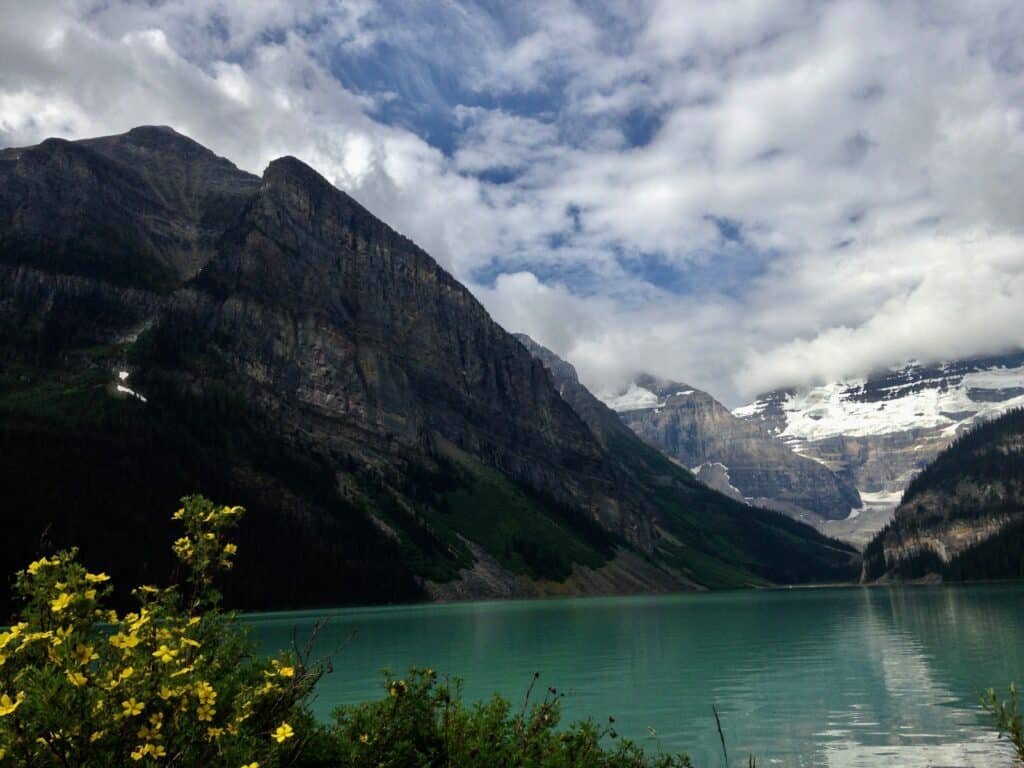
Established in 1885, Banff holds the genuine distinction of being Canada’s first national park, and its combination of glacier-fed lakes, towering peaks, and abundant wildlife has made it one of the most visited national parks in North America. This guide walks through Banff’s best regions, checked against real research into each location, connecting north to Jasper along one of the most celebrated scenic drives on Earth, with wildlife safety guidance woven throughout.
What makes the Canadian Rockies genuinely distinct from other major mountain ranges is the sheer concentration of glacially-fed turquoise lakes found here, a visual signature created by rock flour, fine sediment ground by glaciers and suspended in the meltwater that feeds the region’s lakes, scattering light in a way that produces colors many first-time visitors assume must be artificially enhanced in photographs. That glacial legacy runs throughout this entire region, from Lake Louise’s famous blue water to the Columbia Icefield, one of the largest accumulations of ice south of the Arctic Circle, feeding rivers that eventually reach three different oceans.
Banff’s status as Canada’s first national park genuinely carries real historical weight, its 1885 founding came just 13 years after Yellowstone became the world’s first national park, making Banff part of the very earliest wave of countries adopting the concept of large-scale protected wilderness for public benefit. That founding was itself tied directly to the completion of the Canadian Pacific Railway through the Rockies, the discovery of natural hot springs near present-day Banff townsite by railway workers led directly to the federal government setting aside the surrounding land, a genuine origin story that shaped how the entire park developed around accessible tourism infrastructure from its very earliest years.
The Banff Townsite
Lake Louise
The Icefields Parkway
Jasper
Wildlife Safety in the Rockies
Banff vs. Jasper
The Rockies’ Glacial Landscape Explained
Best Time to Visit Banff
Planning Your Banff Trip
FAQ
The Banff Townsite
Genuinely the gateway and main hub for exploring the surrounding national park, and a worthwhile stop in its own right rather than simply a base to sleep between longer excursions.
Banff Townsite
Home to roughly 8,000 year-round residents, Banff genuinely functions as both a working mountain town and the park’s primary visitor center, its main street lined with shops and restaurants set against a dramatic backdrop of Cascade Mountain. The Banff Gondola climbs Sulphur Mountain to a summit boardwalk offering genuinely sweeping views over the townsite and surrounding valleys, while the historic Banff Upper Hot Springs, developed following the park’s founding around natural thermal pools discovered in the 1880s, remain a genuinely relaxing way to soak in mountain scenery after a day of hiking. The Cave and Basin National Historic Site, marking the exact hot spring discovery that led to Banff’s founding, offers genuine insight into the park’s origin story for visitors curious about the history behind the scenery.
Banff townsite, central Banff National Park. Free to explore town; individual attraction fees vary. Best combined with the Banff Gondola for a comprehensive first day in the park.
.jpg)
Lake Louise
Genuinely one of the most photographed lakes in the world, its vivid color earning comparisons to a painted postcard rather than a natural landscape, a comparison that holds up even after seeing it in person.
Lake Louise
Fed by meltwater from the Victoria Glacier, Lake Louise’s striking turquoise color comes from rock flour, fine glacial sediment suspended in the water that reflects and scatters sunlight in a way ordinary lake water simply doesn’t produce. The historic Fairmont Chateau Lake Louise, built beginning in the 1890s by the Canadian Pacific Railway to draw tourists to the newly accessible region, remains perched directly on the lakeshore, and the Lake Agnes Tea House trail, climbing above the lake to a rustic teahouse built in 1901, offers one of the most rewarding short hikes in the entire park, its hand-baked goods and mountain-brewed tea served to hikers at an elevation few teahouses anywhere in the world can match. Moraine Lake, a short drive from Lake Louise itself, offers a genuinely comparable turquoise color set against the dramatic Valley of the Ten Peaks, and its image once appeared on the back of Canada’s old twenty-dollar bill, a testament to just how iconic this landscape has become nationally.
Lake Louise, western Banff National Park. Park entry fee; parking can fill early in peak season. Best arriving before 7am in summer, since parking lots regularly reach capacity by mid-morning.

The Icefields Parkway
Genuinely one of the most celebrated scenic drives in the world, connecting Lake Louise to Jasper through some of the most dramatic mountain scenery in North America, a route that regularly appears on international lists of the world’s greatest road trips.
The Icefields Parkway & Columbia Icefield
Stretching roughly 232 kilometers between Lake Louise and Jasper, the Icefields Parkway has been named one of the most scenic drives on Earth by multiple international travel publications, its route passing more than 100 visible glaciers along the way. The Columbia Icefield, the largest icefield in the Rocky Mountains, spans over 325 square kilometers with ice reaching depths up to 365 meters, taller than the Eiffel Tower, and specialized Ice Explorer vehicles allow visitors to drive directly onto the Athabasca Glacier, one of the icefield’s most accessible tongues, for a genuinely rare, up-close encounter with a body of ice this significant. The Columbia Icefield itself is genuinely significant hydrologically as well as visually, its meltwater feeds three separate ocean systems, the Pacific, Atlantic, and Arctic, via the Columbia, North Saskatchewan, and Athabasca Rivers respectively, a genuinely rare hydrological triple divide found in very few places on the planet.
Highway 93, between Lake Louise and Jasper. Park entry fee; Ice Explorer tours priced separately. Best allotting a full day for the drive, given the genuine number of worthwhile stops along the route.

Jasper
The largest national park in the Canadian Rockies, and genuinely a quieter, more remote counterpart to Banff’s busier tourist infrastructure, rewarding travelers willing to make the longer drive north.
Jasper National Park
Jasper’s genuinely significant dark skies, protected under an official Dark Sky Preserve designation, one of the largest in the world, make it a premier stargazing destination, and the town hosts an annual Dark Sky Festival celebrating that distinction each fall, drawing astronomers and casual stargazers alike to a region genuinely free of the light pollution that obscures the night sky across most of North America. Maligne Lake, the largest natural lake in the Canadian Rockies, and its famous Spirit Island viewpoint, accessible only by boat tour, offer scenery genuinely comparable to Lake Louise’s fame but with noticeably thinner crowds given Jasper’s more remote location.
Jasper National Park, north of the Icefields Parkway. Park entry fee. Best planning a stargazing evening if visiting during a new moon, when the park’s protected dark skies are at their most dramatic.

Wildlife Safety in the Rockies
The Canadian Rockies hold genuinely significant populations of black bears and grizzly bears, along with elk, moose, and mountain goats, and maintaining safe distances matters as much here as at any major wildlife destination in North America. Carrying bear spray on any hike away from developed trails is a genuinely serious recommendation, and making noise while hiking through dense brush or blind corners helps avoid startling a bear at close range, a genuine cause of the park’s rare but serious wildlife encounters. Elk, particularly during the fall rutting season, can become genuinely aggressive and should be given wide berth despite their familiar, deer-like appearance, and pulling over safely rather than stopping in an active traffic lane to view roadside wildlife remains a genuinely important courtesy and safety practice on the park’s busier roads. Grizzly bears specifically differ from black bears in genuinely important ways relevant to safety, larger, generally more aggressive when surprised, and identifiable by their distinctive shoulder hump, and knowing the difference matters for choosing the correct response if an encounter does occur.
Banff vs. Jasper
| Category | Banff | Jasper |
|---|---|---|
| Accessibility | Closer to Calgary, more developed | More remote, quieter |
| Crowds | Genuinely very busy in peak season | Noticeably thinner |
| Standout feature | Lake Louise, Banff townsite | Dark skies, Maligne Lake |
| Best for | First-time visitors, iconic sights | Solitude, stargazing, wilderness |
The choice between prioritizing Banff or Jasper genuinely comes down to how much you value convenience against solitude. Banff’s proximity to Calgary International Airport and its considerably more developed tourism infrastructure make it the genuinely easier choice for a first Canadian Rockies trip, while Jasper rewards travelers who’ve already experienced Banff’s headline sights and want a quieter, more contemplative version of the same mountain range. Many visitors combine both, connected by the Icefields Parkway itself, using Banff for iconic photo stops and Jasper for a genuinely different, wilder pace at the end of the drive.
Best Time to Visit Banff
June through September offers the best hiking conditions and full access to the Icefields Parkway, with most of the region’s higher-elevation trails remaining snow-covered well into early summer most years. July and August bring the warmest weather and the fullest bloom of wildflowers across the park’s alpine meadows, though this same window brings genuinely significant crowds to Lake Louise and other headline attractions, making early arrival or off-peak weekday visits genuinely worthwhile strategies. Fall brings golden larch trees to several of the park’s higher hiking trails, a brief but genuinely spectacular seasonal display drawing dedicated hikers each September, the Larch Valley trail near Moraine Lake becoming genuinely one of the most popular hikes in the entire park during this narrow window.
Winter transforms Banff into a significant ski destination, December through March drawing visitors to resorts like Lake Louise Ski Resort and Sunshine Village, while frozen Lake Louise and Lake Minnewanka offer a genuinely different, starkly beautiful version of the park’s famous glacial lakes, some visitors even ice skating directly on Lake Louise’s frozen surface, complete with a maintained rink and mountain backdrop found nowhere else in the world.
The Rockies’ Glacial Landscape Explained
Understanding why this specific stretch of the Rocky Mountains holds such a concentration of dramatic glacial lakes and ice fields genuinely comes down to a combination of elevation, latitude, and precipitation patterns unique to this part of the range, factors that combined over thousands of years to produce a landscape genuinely unlike anywhere else on the continent. The Canadian Rockies capture significant moisture off the Pacific, and at these elevations and this far north, that moisture falls and accumulates as snow rather than rain across much of the year, compressing over centuries into the glaciers and icefields that define the landscape today. The Columbia Icefield specifically formed over thousands of years as snowfall accumulated faster than it could melt, and while the icefield remains genuinely massive, its glaciers, including the Athabasca, have been measurably retreating for over a century, a visible, ongoing consequence of a warming climate that guides and interpretive signage along the parkway address directly with visitors, often pointing to marker posts showing exactly how far the ice has receded within living memory.
That retreat is worth knowing about specifically because it means the landscape covered in this guide is genuinely changing, sometimes within a single generation’s memory, older photographs of the Athabasca Glacier show ice extending considerably further down the valley than what visitors see today, a genuinely stark visual comparison available at several points along the parkway. Understanding that context adds real weight to an Icefields Parkway drive, this isn’t simply an admittedly spectacular but static landscape, it’s an active, visibly shifting one, worth experiencing with genuine attention rather than treating purely as scenic backdrop for a road trip.
Planning Your Banff Trip
Calgary International Airport, roughly a 90-minute drive from the Banff townsite, serves as the genuine gateway for most international visitors, and a rental car is essential for exploring the park thoroughly, since public transit within Banff, while improving in recent years with dedicated shuttle routes to Lake Louise, doesn’t cover the Icefields Parkway or Jasper, both of which genuinely require a car or a booked tour to reach comfortably. Given the genuine popularity of Lake Louise and Moraine Lake specifically, both now require either a Parks Canada shuttle reservation or arrival before roughly 6-7am during peak summer months, since parking lots at both sites regularly reach capacity within the first hour or two of daylight, a genuinely frustrating discovery for unprepared visitors arriving mid-morning. Booking accommodation well in advance, particularly for the Banff townsite and Lake Louise village during summer, genuinely matters given the region’s limited lodging capacity relative to its visitor numbers, some of the highest of any national park in North America, and rooms in both towns regularly sell out months ahead for the peak July and August weeks.
If this guide helped you plan your Banff trip, check out more travel videos from Worldly Traveler.
Whichever stretch of the Canadian Rockies ends up on your itinerary, this region genuinely rewards travelers willing to slow down between the headline stops. Lake Louise and the Columbia Icefield earn their fame honestly, but the quieter moments, a sunrise at a lesser-known viewpoint along the parkway, an evening spent watching the stars over Jasper’s protected dark skies, or simply pulling over to watch a glacier that’s been slowly reshaping this landscape for thousands of years, are genuinely what make the Canadian Rockies worth returning to again and again.
Frequently Asked Questions
Why is Lake Louise so blue?
Lake Louise’s vivid turquoise color comes from rock flour, fine sediment ground by the Victoria Glacier that feeds the lake, suspended in the water. The particles reflect and scatter light in a way that produces the lake’s distinctive blue-green color, a genuine natural phenomenon rather than any kind of enhancement.
Is Banff National Park Canada’s oldest national park?
Yes. Banff, established in 1885, is Canada’s first national park and one of the oldest national parks in the world, predated internationally only by Yellowstone, established just 13 years earlier in 1872.
How long is the Icefields Parkway?
The Icefields Parkway stretches roughly 232 kilometers (144 miles) between Lake Louise and the town of Jasper, and it has been named one of the most scenic drives in the world by multiple international travel publications.
Should I visit Banff or Jasper?
It genuinely depends on your priorities. Banff offers more developed tourist infrastructure and iconic, easily accessible sights like Lake Louise, while Jasper delivers a quieter, more remote wilderness experience with genuinely excellent stargazing.
What is the best time of year to visit Banff?
June through September offers the best hiking conditions and full access to the Icefields Parkway, while December through March draws visitors for skiing at Banff’s major resorts.