
Nice’s Promenade des Anglais and Cannes’ film festival glamour anchor most first-time trips to the south of France, and both genuinely earn their reputation — but Provence and the Côte d’Azur stretch across a genuinely varied landscape of lavender fields, perched hilltop villages, and dramatic limestone gorges that most coastal-focused itineraries never reach. This guide covers Provence and the Riviera’s best hidden gems, organized by sub-region so you can build a route through whichever part of the south genuinely calls to you.
The south of France’s genuine identity splits meaningfully between coast and interior in a way that first-time visitors often underestimate — the Riviera’s glamorous, internationally famous beach culture developed largely as a 19th- and 20th-century phenomenon, built around wealthy foreign visitors and later the film industry, while inland Provence’s villages, lavender fields, and olive groves reflect a genuinely older, more agrarian regional identity stretching back centuries further. Understanding that split helps explain why a Riviera-only trip and a Provence-only trip can feel like entirely different vacations, despite both technically falling under “the south of France.”
Nice, Cannes & Monaco: The Promenade des Anglais, the film festival red carpet, and Monte Carlo’s casino remain genuinely worthwhile for any first Riviera trip — this guide picks up where that standard coastal itinerary leaves off.
Gordes, Roussillon, Les Baux-de-Provence, and Saint-Paul-de-Vence are just a handful of the perched, postcard-perfect villages covered here — for even more of the country’s best-preserved historic villages, see our guide to 25 Hidden Medieval Villages in France.
The Luberon & Inland Provence
The Côte d’Azur
The Camargue
The Verdon Gorge
Lavender Season Basics
Provençal Food & Wine Worth Seeking Out
Best Time to Visit Provence & the Riviera
FAQ
The Luberon & Inland Provence
Away from the coast, Provence’s inland hills hold the region’s most photographed villages and its famous lavender fields.
Gordes
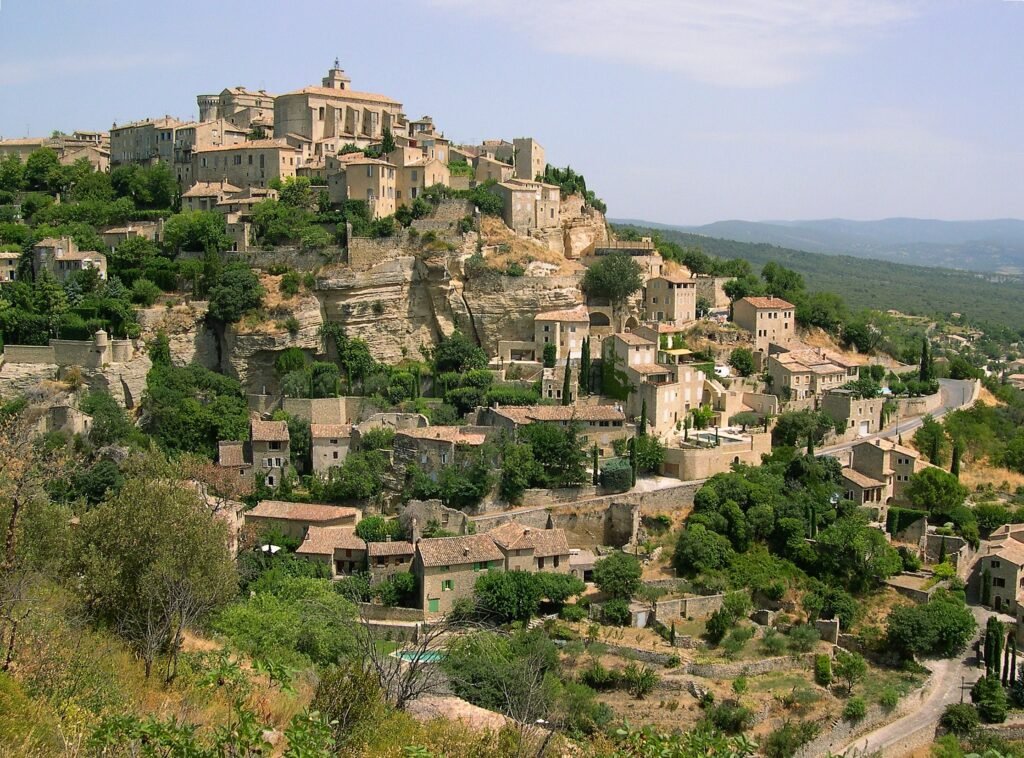
One of the most dramatically perched villages in all of Provence, its stone houses stacked in tiers directly against a rocky hillside overlooking the Luberon valley — a member of the official “Les Plus Beaux Villages de France” (The Most Beautiful Villages of France) association, its skyline anchored by both a medieval castle and centuries of dry-stone shepherd huts (bories) scattered across the surrounding countryside.
Vaucluse, Luberon region. Free to explore village. Best at sunset for the classic panoramic photograph of the village against the valley.
Abbaye Notre-Dame de Sénanque
A genuinely still-active 12th-century Cistercian abbey, its severe, unornamented Romanesque architecture reflecting the order’s ascetic values — the abbey’s real fame today comes from the vivid lavender fields planted directly in front of it, creating one of the single most photographed images in all of Provence each summer.
Near Gordes, Vaucluse. Free to view exterior; abbey tour fee. Best in early July for peak lavender bloom against the abbey.
Roussillon
A genuinely striking village built directly from and atop the largest ochre deposit in the world, its buildings painted in a rich palette of red, orange, and gold pigments quarried from the surrounding cliffs — a dedicated walking trail, the Sentier des Ocres, winds directly through the dramatic eroded ochre formations just outside town.
Vaucluse, Luberon region. Free to explore village; small fee for the Sentier des Ocres trail. Best at midday for the most vivid color contrast in the ochre cliffs.
.jpg)
Les Baux-de-Provence
A genuinely dramatic clifftop village built atop and around the ruins of a medieval fortress, its rocky perch offering sweeping views over the surrounding Alpilles hills — the village also sits near Carrières de Lumières, a former limestone quarry now transformed into an immersive digital art installation projecting monumental artwork across the cave’s vast interior walls.
Bouches-du-Rhône, Alpilles region. Village free to explore; castle ruins and Carrières de Lumières entry fees separate. Best combined with a Carrières de Lumières visit given the shared location.
L’Isle-sur-la-Sorgue
Genuinely nicknamed the “Venice of Provence,” this town’s historic center is built around the crystal-clear Sorgue River, its waterwheels — once used for silk and paper production — still turning today, and its Sunday antiques market considered one of the largest and most significant in all of France.
Vaucluse. Free to explore. Best on a Sunday for the town’s famous antiques and flea market.
The Côte d’Azur
Beyond Nice and Cannes’ famous promenades, the Riviera coast holds genuinely dramatic clifftop villages and quieter fishing towns.
Èze
A genuinely spectacular medieval village perched 1,400 feet above the Mediterranean, its narrow stone streets climbing to a hilltop cactus garden offering one of the most sweeping coastal panoramas anywhere on the Riviera — the village’s dramatic setting has drawn numerous perfume houses, including a Fragonard factory offering free tours of traditional perfume-making techniques.
Between Nice and Monaco. Free to explore village; exotic garden entry fee. Best at sunset for the coastal panorama from the hilltop garden.

Villefranche-sur-Mer
A genuinely well-preserved fishing port, its pastel harbor-front buildings and narrow medieval streets offering a quieter, more intimate Riviera experience than Nice’s larger, busier waterfront just minutes away — the town’s deep natural harbor has made it a favored anchorage for luxury yachts and, historically, naval fleets.
Between Nice and Monaco. Free to explore. Best combined with a Nice day trip given the short distance by train.
Saint-Paul-de-Vence
A genuinely well-preserved walled hilltop village that became a favored retreat for 20th-century artists including Matisse, Picasso, and Chagall, its cobblestone streets now lined with numerous art galleries — the nearby Fondation Maeght holds one of the most significant modern art collections in the south of France.
Near Nice. Free to explore village; Fondation Maeght entry fee. Best on a weekday to avoid the village’s significant weekend crowds.
Antibes & Cap d’Antibes
A genuinely charming walled port town, home to a significant Picasso Museum housed in the seaside Château Grimaldi where the artist once lived and worked, alongside the exclusive Cap d’Antibes peninsula, its coastal path offering some of the most dramatic, undeveloped Mediterranean scenery remaining on this stretch of coast.
Between Nice and Cannes. Free to explore town; museum entry fee. Best combined with a walk along the Cap d’Antibes coastal path.
The Camargue
Southwest of the main Riviera coast, the Camargue holds a genuinely unique wetland ecosystem found nowhere else in France.
Parc Naturel Régional de Camargue
A genuinely vast wetland delta where the Rhône River meets the Mediterranean, home to wild white horses and pink flamingos found in few other places in Europe — the region’s distinct cowboy culture (gardians) tends free-roaming black bulls across the marshland in a tradition genuinely comparable to the American West.
Bouches-du-Rhône, southwest of Arles. Free; guided tours and horseback excursions priced separately. Best in spring for peak flamingo populations and wildflower bloom across the marshland.

Saintes-Maries-de-la-Mer
A genuinely significant pilgrimage town at the heart of the Camargue, its fortified church holding relics venerated by both Catholic pilgrims and, notably, the Roma community, who gather here each May for a genuinely significant annual pilgrimage honoring their patron saint, Sara.
Camargue coast. Free to explore town; church crypt entry fee. Best in late May during the annual Roma pilgrimage, if timing allows and approached with genuine cultural respect.
The Verdon Gorge
Inland from the coast, the Verdon region holds continental Europe’s most dramatic canyon.
Gorges du Verdon
Genuinely nicknamed the “Grand Canyon of Europe,” this dramatic limestone gorge plunges up to 700 meters deep, its turquoise river carved over millions of years, offering some of the best canyoning, kayaking, and clifftop hiking in all of France.
Alpes-de-Haute-Provence/Var border. Free to view from overlooks; activity fees vary by operator. Best in late spring or early fall for comfortable hiking and paddling temperatures.

Moustiers-Sainte-Marie
A genuinely picturesque village at the entrance to the Verdon Gorge, its houses built into a dramatic rocky cleft, famous nationally for a distinctive faience (glazed ceramic) tradition dating back centuries — a golden star, suspended on a long chain between two cliffs above the village, commemorates a local legend involving a knight’s safe return from the Crusades.
Alpes-de-Haute-Provence, Verdon Gorge entrance. Free to explore village. Best combined with a broader Verdon Gorge scenic drive given the village’s position at the gorge’s edge.
Lavender Season Basics
Provence’s famous lavender fields typically bloom from mid-June through early August, with peak color generally falling in July, though exact timing shifts meaningfully year to year based on weather, elevation, and the specific lavender variety grown at a given farm. The Valensole Plateau, near the Verdon Gorge, and the fields directly surrounding the Sénanque Abbey both rank among the most photographed lavender locations in the region, though genuinely worthwhile fields extend across much of the Luberon and the broader Vaucluse department. Visiting on a weekday morning, before both the midday heat and the weekend crowds arrive, genuinely improves the experience at the most popular fields, and driving the region’s smaller back roads rather than sticking purely to the most Instagram-famous locations often turns up equally striking, far less crowded fields.
Provençal Food & Wine Worth Seeking Out
Provençal cuisine reflects the region’s Mediterranean climate and coastal proximity — ratatouille, socca (a chickpea flour flatbread genuinely native to Nice), and bouillabaisse (a rich fish stew with deep roots in Marseille’s fishing community) all showcase the region’s reliance on fresh vegetables, olive oil, and seafood rather than the butter and cream common further north. Herbes de Provence, a blend typically including thyme, rosemary, oregano, and marjoram, reflects the region’s abundant wild herb growth across its dry, sun-baked hillsides, and is worth seeking out fresh from a local market rather than a pre-packaged supermarket blend. Provence’s rosé wine tradition, centered particularly around the Bandol and Côtes de Provence appellations, produces genuinely serious, food-focused rosé wines meaningfully different in character from the sweeter, simpler rosé styles more commonly exported internationally. Nice’s socca, sold from dedicated street stalls and eaten hot with a dusting of black pepper, remains one of the most authentic, inexpensive local specialties worth seeking out specifically in the old town rather than a tourist-oriented restaurant.
Best Time to Visit Provence & the Riviera
May through June and September offer the most comfortable temperatures and noticeably thinner crowds than peak summer, when both heat and tourist volume climb significantly across the entire region, particularly along the coast. July and August bring lavender season to full bloom across Provence’s inland fields, though this same window represents the Riviera’s busiest, most expensive, and hottest peak tourist period, worth weighing against the appeal of the lavender itself. The Mistral, a genuinely strong, dry wind that periodically sweeps through Provence, can affect outdoor plans at any time of year, particularly in the exposed Rhône Valley and Luberon region, and is worth checking forecasts for during a visit. Winter remains genuinely mild by broader European standards along the coast, given the Mediterranean’s moderating effect, making the Riviera a viable, far less crowded destination even in the off-season, while inland Provence’s hilltop villages can feel considerably colder and quieter during the same months.
I cover the regional comparisons behind this guide in the video above. If this guide helped you plan your Provence or Riviera trip, subscribe to Worldly Traveler on YouTube for more travel guides from around the world.
Frequently Asked Questions
What are the best hidden gems in Provence and the French Riviera?
Some of the best hidden gems in Provence and the French Riviera include the perched village of Gordes, the Sénanque Abbey’s lavender fields, the Gorges du Verdon (France’s own Grand Canyon), the ochre cliffs of Roussillon, and the walled medieval town of Èze above the Mediterranean.
When is lavender season in Provence?
Provence’s lavender fields typically bloom from mid-June through early August, with peak bloom generally falling in July, though exact timing shifts year to year based on weather and elevation.
How many days do you need in Provence and the French Riviera?
10-14 days allows a well-paced trip combining the Riviera coast with inland Provence’s villages and lavender country. A shorter 5-7 day trip works well focused on just one sub-region.
What is the best time of year to visit Provence and the French Riviera?
May-June and September offer the most comfortable temperatures and manageable crowds. July-August brings lavender season and the Riviera’s busiest, hottest peak tourist period.
Do you need a car to explore Provence?
Yes, genuinely — while the Riviera’s coastal towns are well connected by train, most of inland Provence’s hilltop villages and lavender country require a rental car, since regional bus service is limited.