
Seville’s flamenco tradition and Granada’s Alhambra anchor most first-time trips to southern Spain, and both genuinely deserve their fame — but Andalucía spans eight provinces and a genuinely dramatic range of terrain, from whitewashed cliffside villages to surreal limestone rock fields to some of Europe’s best-preserved Roman ruins. This guide covers more than 15 Andalucía hidden gems, verified against a real video guide, organized by province so you can build a route through whichever part of southern Spain genuinely calls to you.
Seville, Granada & Córdoba’s Mezquita: The Alcázar, the Alhambra, and Córdoba’s Mosque-Cathedral remain genuinely essential for any first Andalucía trip — this guide picks up where that standard itinerary leaves off.
Andalucía’s genuine character was shaped by nearly 800 years of Moorish rule, from the early 8th century until the fall of Granada in 1492, a period that left the region with a genuinely distinct architectural and cultural imprint found nowhere else in Western Europe. That layered history — Roman, Moorish, and Christian, often visible within a single building or town — is exactly why Andalucía rewards exploration well beyond its three most famous cities. The white villages (pueblos blancos) scattered across the region’s interior mountains, in particular, developed largely in relative isolation, preserving a genuinely distinct architectural and social character shaped by centuries of remoteness from Spain’s larger urban centers.
That geographic isolation also produced Andalucía’s genuinely dramatic internal variety — within a single region roughly the size of Portugal, the landscape shifts from the Sierra Nevada’s snow-capped peaks, Spain’s highest mountains outside the Pyrenees, to continental Europe’s only true desert around Tabernas, to lush wetlands at Doñana National Park. Few regions in Europe pack in this much genuine ecological and cultural range within one administrative boundary, which is exactly why an Andalucía road trip built around its provinces, rather than purely its headline cities, rewards travelers with a far fuller picture of southern Spain.
Cádiz Province
Málaga Province
Córdoba Province
Granada Province
Almería Province
The White Villages Explained
Andalusian Food Worth Seeking Out
Best Time to Visit Andalucía
FAQ
Cádiz Province
Spain’s southernmost province holds some of Andalucía’s most striking white villages and genuinely significant Roman coastal ruins.
Setenil de las Bodegas
A genuinely astonishing village where entire streets and homes are built directly beneath a massive overhanging rock formation, the town’s name itself referencing “bodegas” (wine cellars), reflecting the natural caves’ historic use for wine storage before becoming full residences — the effect is unlike anywhere else in Spain, with restaurant terraces and living rooms alike tucked into the rock’s natural shadow.
Cádiz province. Free to explore. Best at midday when the overhanging rock provides genuine relief from the sun.

Playa de Bolonia
A genuinely pristine, largely undeveloped beach backed by massive shifting sand dunes, alongside the remarkably well-preserved ruins of Baelo Claudia, a Roman fishing town whose economy was built on garum, a fermented fish sauce once exported throughout the Roman Empire.
Cádiz province, near Tarifa. Free beach access; Baelo Claudia ruins entry fee. Best combined with a Baelo Claudia visit given the shared location.
Zahara de la Sierra
A genuinely dramatic white village perched above a turquoise reservoir, its hilltop Moorish castle ruins offering sweeping views over the Sierra de Grazalema — the reservoir itself, though man-made, has become one of the most photographed lake views in this part of Andalucía.
Cádiz province, Sierra de Grazalema Natural Park. Free to explore. Best at sunset for the reservoir’s most vivid turquoise color against the surrounding white houses.
Ronda’s Secret Baths
Beneath Ronda’s dramatic clifftop setting — the city itself split by a 100-meter gorge spanned by the iconic Puente Nuevo bridge — lie remarkably well-preserved 13th-century Arab baths, their star-shaped skylights and horseshoe arches offering a genuinely intimate glimpse of Moorish daily life largely overlooked by visitors focused purely on the famous bridge above.
Ronda, Málaga province (grouped here given proximity to Cádiz province destinations). Small entry fee. Best combined with a broader Ronda old town walk given the baths’ central location.

Málaga Province
Beyond the Costa del Sol’s beach resorts, Málaga province holds this region’s most thrilling hike and its most whimsical village transformation.
Caminito del Rey
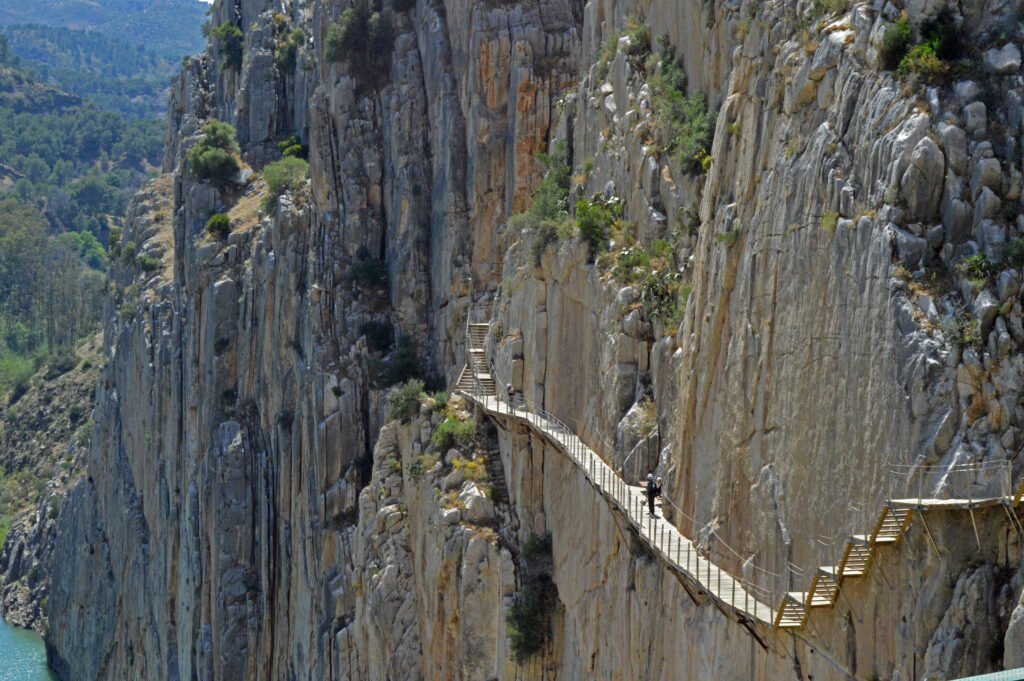
A dramatic 7.7-kilometer walkway pinned along the sheer walls of the El Chorro gorge, its wooden and steel boardwalk suspended up to 100 meters above the canyon floor — originally built in the early 1900s and left to decay for decades, the path earned a genuine reputation as “the world’s most dangerous walkway” following several fatalities in 1999-2000, before a complete four-year restoration reopened it as a fully secure trail in 2015.
Málaga province, near Ardales. Entry fee, advance booking required. Best booking well ahead given limited daily visitor capacity.
El Torcal de Antequera
One of the most impressive karst landscapes in Europe, its surreal stacked limestone formations shaped over roughly 150 million years, first as ancient seabed sediment and later carved by wind and rain into genuinely otherworldly stone towers and passages.
Málaga province, near Antequera. Small entry fee. Best in the late afternoon for dramatic shadows across the stacked rock formations.

Frigiliana
Widely voted Spain’s most beautiful village in a national competition, this dazzlingly whitewashed hill town’s steep, flower-draped streets retain a distinctly Moorish street plan largely unchanged since the medieval period, its cobblestones decorated with small ceramic plaques depicting scenes from the town’s history.
Málaga province, near Nerja. Free to explore. Best in spring when the town’s flowering balconies and window boxes are in full bloom.

Cueva de Nerja
A genuinely massive cave system, its main chamber so large it hosts an annual music and dance festival directly inside, holding what may be some of the oldest cave paintings discovered in Spain, including depictions of seals that researchers have dated to over 40,000 years old, among the oldest known cave art in the world.
Málaga province, near Nerja. Entry fee. Best booking tickets in advance during peak summer season.
Mijas Pueblo
A genuinely charming whitewashed hill village overlooking the Costa del Sol, its narrow streets home to a distinctive local tradition of “donkey taxis,” a quirky, tourist-friendly nod to the animals’ historic role as the village’s primary transportation before modern roads arrived.
Málaga province, above Fuengirola. Free to explore. Best combined with a Costa del Sol beach day given the short distance down to the coast.
Júzcar
A genuinely bizarre roadside curiosity — this entire white village was painted bright blue in 2011 as a promotional stunt for “The Smurfs” film, and after residents voted to keep the color following the promotion’s end, Júzcar remains, to this day, the only entirely blue village in Spain.
Málaga province, Serranía de Ronda. Free to explore. Best for travelers seeking a genuinely offbeat, only-in-Spain photo opportunity.
Córdoba Province
Beyond the Mezquita, Córdoba province holds a genuinely striking fortress and dramatic cliffside town.
Castillo de Almodóvar del Río
A genuinely fairy-tale-perfect medieval castle, its towers rising dramatically above the Guadalquivir River valley, having served as a filming location for “Game of Thrones” — the castle’s original structure dates to the 8th century, built atop even earlier Roman and Visigothic fortifications.
Córdoba province, near Almodóvar del Río. Entry fee. Best at sunset for the castle’s dramatic silhouette against the valley below.
Alhama de Granada
A genuinely dramatic town split by a deep gorge carved by the Alhama River, its name derived from the Arabic word for “hot spring,” referencing the town’s centuries-old thermal bath tradition, still active today at a working spa built directly atop the original Moorish-era baths.
Granada province, near the Córdoba border (grouped here for regional proximity). Free to explore town; spa entry fee. Best combined with a soak at the historic thermal baths.
Granada Province
Beyond the Alhambra, Granada province holds genuinely dramatic mountain villages and a startling clifftop church.
Las Alpujarras
A genuinely remote cluster of mountain villages on the southern slopes of the Sierra Nevada, their distinctive flat-roofed, whitewashed architecture directly inherited from the Berber builders of North Africa who settled here after fleeing the fall of Granada in 1492 — the villages of Trevélez, Capileira, and Bubión offer some of the best-preserved examples of this genuinely unique architectural tradition.
Granada province, Sierra Nevada foothills. Free to explore. Best in spring or fall for comfortable hiking temperatures between the villages.
Montefrío
A genuinely dramatic village whose 16th-century church, the Iglesia de la Encarnación, sits perched directly atop a rocky outcrop above the town — the writer and philosopher José Saramago once called the view of Montefrío “the best view in the world,” a bold claim that the town’s genuinely striking silhouette makes surprisingly credible.
Granada province. Free to explore. Best from the designated viewpoint just outside town for the classic photograph of the church atop its rock.
Almería Province
Spain’s driest region holds a genuinely surreal desert landscape and one of Europe’s most significant wetland preserves.
Tabernas Desert
Continental Europe’s only true desert, its arid, sun-baked terrain having doubled for the American Old West in numerous classic “Spaghetti Western” films throughout the 1960s and 70s, including several Clint Eastwood classics — several original film sets remain preserved today as western-themed tourist attractions.
Almería province. Free to view; film set attractions charge entry. Best in the cooler early morning or late afternoon, given the desert’s genuinely intense midday heat.
Doñana National Park
One of the most significant wetland ecosystems in Europe, straddling the border of Cádiz, Huelva, and Seville provinces, home to genuinely critical habitat for the endangered Iberian lynx and millions of migratory birds each year — a stark, wild contrast to Andalucía’s more developed coastal resort towns.
Huelva/Cádiz/Seville province border. Guided tour required for most areas. Best in spring for peak migratory bird activity.
The White Villages Explained
Andalucía’s pueblos blancos (white villages), scattered particularly across Cádiz and Málaga provinces, share their distinctive whitewashed appearance for genuinely practical reasons beyond simple aesthetics — the lime-based whitewash reflects intense summer sun, helping keep interiors cooler in a region where temperatures regularly exceed 40°C, while also carrying antibacterial properties historically valued for basic hygiene before modern sanitation. Many of these villages developed their current form during and after centuries of Moorish rule, with narrow, winding streets deliberately designed to create shade and channel cooling breezes through the settlement. A dedicated “Route of the White Villages” (Ruta de los Pueblos Blancos) connects many of Cádiz province’s best examples, including Arcos de la Frontera, Grazalema, and Zahara de la Sierra, making a multi-day village-hopping loop a genuinely rewarding way to experience this distinct regional architecture beyond any single town.
Andalusian Food Worth Seeking Out
Gazpacho and its thicker cousin salmorejo, both cold tomato-based soups, reflect Andalucía’s genuinely brutal summer heat, offering a refreshing, no-cook meal option during the region’s hottest months — salmorejo, topped traditionally with chopped hard-boiled egg and jamón, originated specifically in Córdoba and remains genuinely distinct from gazpacho in both texture and preparation. Jamón ibérico, particularly from acorn-fed pigs raised in the dehesa oak woodlands of western Andalucía, represents genuinely one of the finest cured meat traditions in the world, worth seeking out by its specific “de bellota” (acorn-fed) designation for the highest quality. Pescaíto frito, a variety of small fish lightly battered and fried, remains a genuine Andalusian coastal specialty, particularly in Málaga and Cádiz, best eaten fresh at a beachside chiringuito rather than further inland. Sherry, produced specifically in the “sherry triangle” around Jerez de la Frontera, Sanlúcar de Barrameda, and El Puerto de Santa María in Cádiz province, remains genuinely central to Andalusian food culture, worth exploring beyond the sweet, cream-style versions more commonly found internationally.
Best Time to Visit Andalucía
April through June and September through October offer the most comfortable temperatures, avoiding the region’s genuinely intense summer heat, which regularly exceeds 40°C (104°F) in inland areas like Córdoba and the Tabernas Desert — Seville and Córdoba in particular are widely considered among the hottest major cities in continental Europe during peak summer months. Spring brings Andalucía’s famous flower-decorated balconies into full bloom, particularly in villages like Frigiliana and Córdoba’s own patio festival, making it a genuinely rewarding season for garden and architecture-focused travel. Winter remains genuinely mild along the coast, given the Mediterranean’s moderating effect, though the Sierra Nevada mountains inland see real snow and support a functioning ski season, a striking contrast within the same region. Coastal areas of Málaga and Cádiz provinces stay noticeably cooler than the inland desert and city destinations year-round, worth factoring into planning for a summer trip specifically.
I cover all of these hidden gems in the video above. If this guide helped you plan your Andalucía trip, subscribe to Worldly Traveler on YouTube for more travel guides from around the world.
Frequently Asked Questions
What are the best hidden gems in Andalucía?
Some of the best hidden gems in Andalucía include Setenil de las Bodegas (a village built beneath overhanging rock), the Caminito del Rey cliffside walkway, the white village of Frigiliana, the surreal rock formations of El Torcal de Antequera, and the dramatic gorge-spanning town of Ronda.
Is the Caminito del Rey safe to walk?
Yes, since a full restoration completed in 2015 — the walkway was once considered one of the most dangerous hikes in the world before renovation, but it’s now a secure, well-maintained boardwalk requiring only a moderate level of comfort with heights.
How many days do you need to explore Andalucía’s hidden gems?
10-14 days allows a well-paced trip covering Cádiz and Málaga province’s villages, Córdoba, and a stretch of Granada or Almería province. A shorter 5-7 day trip works well focused on the white villages and Caminito del Rey region.
What is the best time of year to visit Andalucía?
April-June and September-October offer the most comfortable temperatures, avoiding the region’s genuinely intense summer heat, which can regularly exceed 40°C (104°F) in inland areas.
Do you need a car to explore Andalucía’s white villages?
Yes, genuinely — while Andalucía’s major cities are well connected by train, the region’s white villages (pueblos blancos) and most natural hidden gems require a rental car, since bus service between them is limited and infrequent.