
Lisbon and Porto get most of the attention when people plan a Portugal trip, and they earn it. But the rest of the country holds something genuinely stranger and older: villages built directly into house-sized boulders, stone circles that predate Stonehenge, and rock art carved into a river gorge fifteen thousand years before anyone thought to write anything down. This guide, checked against a real video tour, covers ten of Portugal’s best hidden gems, along with a few extras worth folding into the same trip.
What ties these places together is how little they’ve changed. Portugal’s rural interior never saw the same wave of development that reshaped its coastline, which means towns like Monsanto and Marvão still look close to how they did centuries ago, not because anyone preserved them on purpose, but because nobody got around to modernizing them. That’s part of what makes this list feel different from a typical “top attractions” roundup. These aren’t polished sites built for visitors. They’re places that happened to survive, and are only now getting discovered by people outside their own region.
Monsanto, the Village in the Boulders
Ancient Portugal: Ruins, Stones, and Rock Art
The Coast: Azenhas do Mar
More Hidden Gems Worth the Detour
Portuguese Food Worth Seeking Out
Best Time to Visit
FAQ
Monsanto, the Village in the Boulders
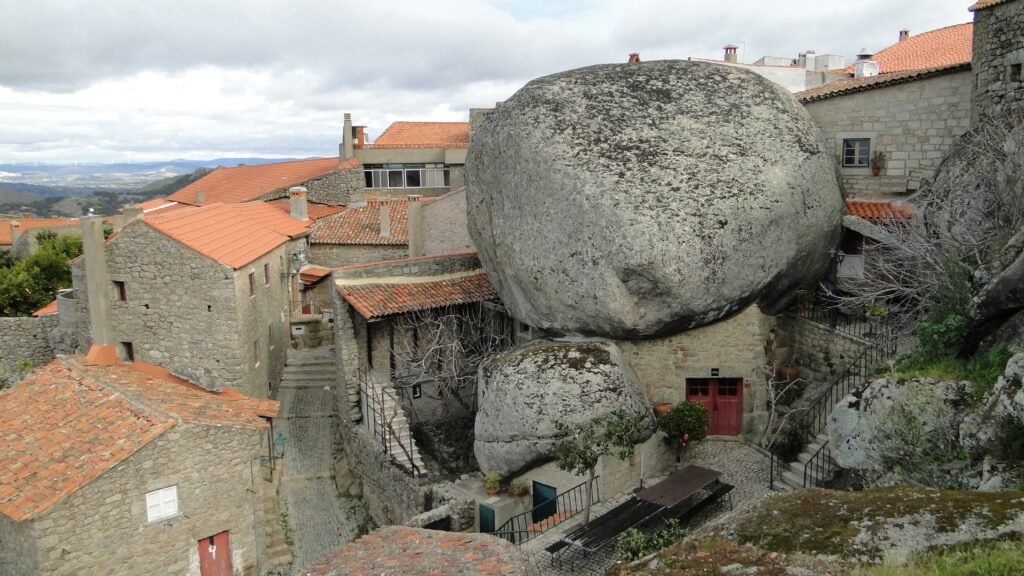
Some places are hard to describe until you’ve seen a photo of them. Monsanto is one of those places.
Monsanto
Built on a hillside scattered with enormous granite boulders, some the size of a two-story house, Monsanto didn’t clear the rocks to make room for buildings. It built around them instead, and in plenty of cases, right through them. Houses use a boulder as a wall, a roof, or sometimes the entire structure, with a door cut into the stone and little else added. In 1938, during a national contest, Monsanto was named the most Portuguese village in Portugal, which is a little ironic, since nothing else in the country looks quite like it. Walking the steep, narrow streets, you’ll pass doors that open directly into rock, roofs that are just the underside of a boulder, and homes still lived in today the same way they’ve been for generations.
Idanha-a-Nova municipality, central Portugal. Free to explore. Best in the late afternoon, when the light picks out the texture of the granite.
View from the Top
Above the village, a ruined Templar castle sits at the summit of the hill, and getting there means climbing between and sometimes under more of the same giant boulders. It’s worth the effort. The views stretch for miles across the surrounding countryside, all the way to the Serra da Estrela mountains on a clear day, and standing up there gives you a real sense of why this hilltop was considered such a valuable defensive position for so many centuries.
Above Monsanto village. Free. Best at sunset, when the surrounding plains catch the last light.
Ancient Portugal: Ruins, Stones, and Rock Art
Portugal’s interior holds some of the oldest human history in Europe, and most of it gets skipped entirely by visitors who never leave the coast.
Conímbriga, Roman Ruins of Portugal
One of the largest and best-preserved Roman settlements on the Iberian Peninsula, Conímbriga was a thriving town for centuries before it was abandoned following a series of barbarian invasions in the 5th century. Its mosaic floors are the real draw here, still holding their color and detail after more than fifteen hundred years underground.
Near Coimbra, central Portugal. Entry fee. Best combined with a visit to the on-site museum, which houses many of the smaller artifacts recovered during excavation.
The House of Fountains
Within the Conímbriga site, this Roman villa takes its name from an elaborate garden water system, its fountains and channels still functional enough that the site occasionally demonstrates the original hydraulics for visitors. The mosaic work here, depicting hunting scenes and mythological figures, ranks among the finest Roman mosaic art found anywhere in Portugal.
Conímbriga archaeological site. Included with general admission. Best with a guide, who can point out details in the mosaics easy to miss on your own.
Almendres Cromlech, Portugal’s Stonehenge
Predating Stonehenge by roughly two thousand years, this oval arrangement of nearly a hundred standing stones is one of the largest megalithic monuments anywhere in Europe, and one of the least crowded. You can walk right up to the stones, touch them, and wander freely among them, a level of access most ancient sites of this significance simply don’t allow anymore.
Near Évora, the Alentejo region. Free. Best in the early morning or at sunset, when the low light makes the stones’ carved surfaces easier to see.
Mysteries of the Stones
Nobody knows for certain what the Almendres Cromlech was actually for. Some archaeologists point to solar and lunar alignments, suggesting an early astronomical calendar. Others argue for a ceremonial or religious purpose. Several of the stones carry faint engravings, believed to be among the oldest surviving examples of Neolithic art in Europe, and their meaning remains genuinely unresolved.
Near Évora, the Alentejo region. Free. Best combined with a visit to the nearby Almendres Menhir, a single tall standing stone believed connected to the same ancient ceremonial complex.
Côa Valley, Ancient Rock Art
Carved into open-air rock faces along the Côa River, this collection of prehistoric engravings dates back as far as twenty-two thousand years, making it one of the largest and oldest sites of open-air Paleolithic art anywhere in the world. The site was nearly lost entirely in the 1990s to a planned hydroelectric dam, before public pressure and archaeological advocacy got the project canceled and the valley protected instead.
Vila Nova de Foz Côa, northern Portugal. Guided tour required, and booking in advance is genuinely necessary. Best on a clear day, since the engravings are easiest to see with natural light raking across the rock.
Reading the Rocks
The engravings here depict horses, aurochs, ibex, and other animals, carved by scratching through the rock’s outer surface to reveal a lighter layer underneath. Interpreting them takes real expertise, since some panels layer engravings from wildly different eras on top of each other, which is exactly why a guided visit is required rather than optional.
Côa Valley Archaeological Park. Included with the guided tour. Best asking your guide about the specific panels within walking distance of the visitor center, since some of the more remote sites require additional vehicle transport.
The Coast: Azenhas do Mar
Portugal’s Atlantic coastline holds plenty of dramatic scenery, and this cliffside village is one of its most striking, lesser-known corners.
Azenhas do Mar, Cliffside Coastal Village
Whitewashed houses cascade down a steep cliff face here, tumbling almost to the edge of the Atlantic itself. At the bottom, a natural seawater pool, formed by an old stone structure that traps the tide, offers swimming with genuinely spectacular ocean views. The village takes its name from old watermills, azenhas, that once used a local stream to grind grain before it reached the sea.
Sintra municipality, near Praia das Maçãs. Free to explore. Best at high tide, when the natural pool fills and the waves crash most dramatically against the cliffs below.
.jpg)
Taste of the Atlantic
The village’s small restaurants sit close enough to the water that sea spray reaches the outdoor tables on a windy day, and the seafood served here comes straight from the boats working this stretch of coast. It’s a genuinely good spot to try fresh grilled fish or percebes, the barnacles that Portugal’s Atlantic coast is known for among seafood lovers.
Azenhas do Mar. Prices vary by restaurant. Best at sunset, when the whitewashed cliffside houses catch the evening light.
More Hidden Gems Worth the Detour
A handful of other stops from this guide round out a fuller picture of rural Portugal.
Castelo de Marvão, the Eagle’s Nest
Perched on a granite outcrop near the Spanish border, Marvão’s hilltop castle looks out over such a wide stretch of countryside that it’s earned the nickname “the Eagle’s Nest.” The village below is nearly as striking as the castle itself, its whitewashed houses spilling down the rock in tight, walkable lanes.
Alentejo region, near the Spanish border. Free to explore village; small entry fee for the castle. Best at sunrise, when mist often settles in the valley below and leaves the village floating above the clouds.
Serra da Lousã, Hidden Mountain Villages
Scattered through this mountain range are a cluster of “schist villages,” built entirely from local slate-like stone, with roofs and walls that blend so completely into the hillside they’re easy to miss until you’re standing right in front of them. Hiking between them remains one of the best ways to see rural Portuguese life largely untouched by tourism.
Central Portugal, near Coimbra. Free to explore. Best in spring or fall, when the surrounding forest is at its most walkable.
Bussaco Palace
A genuinely over-the-top Neo-Manueline palace, built in the early 20th century as a royal hunting retreat, and looking every bit like something out of a fairy tale, all turrets, carved stonework, and elaborate detail. It sits inside the Bussaco Forest, a lush, centuries-old woodland once maintained by Carmelite monks specifically for its botanical variety.
Near Coimbra, Bussaco National Forest. Free to view exterior; hotel guests can tour more of the interior. Best combined with a walk through the surrounding forest.
Chapel of Bones (Capela dos Ossos)
Inside a church in Évora, the interior walls of this small chapel are lined, floor to ceiling, with the skulls and bones of an estimated five thousand people. It was built in the 16th century by Franciscan monks as a deliberate meditation on mortality, and an inscription above the entrance still greets visitors bluntly: “We bones that are here await yours.”
Évora, the Alentejo region. Entry fee. Best combined with the Almendres Cromlech, given the shared region.
Belmonte
A small town with an outsized history, Belmonte was home to one of Portugal’s last hidden Jewish communities, who practiced their faith in secret for nearly five centuries after forced conversions during the Inquisition, only reconnecting openly with mainstream Judaism in the 20th century. It’s also the birthplace of Pedro Álvares Cabral, the explorer credited with Portugal’s landing in Brazil.
Central Portugal, near Covilhã. Free to explore town; museum entry fees vary. Best combined with a visit to the Jewish Museum of Belmonte for the fuller story behind the town’s hidden community.
Portuguese Food Worth Seeking Out
Away from Lisbon’s tourist-heavy restaurants, rural Portugal cooks with a genuinely different rhythm. The Alentejo region, home to Almendres and Évora, is known for hearty, ingredient-driven dishes like açorda, a bread-based soup thickened with garlic, olive oil, and coriander, and migas, a similar bread dish often paired with pork. Percebes, the goose barnacles harvested along the wild Atlantic coast near places like Azenhas do Mar, are a genuine local delicacy, and dangerous to harvest, which is part of why they command such a high price. Queijo da Serra, a soft sheep’s milk cheese from the Serra da Estrela mountains, is worth seeking out specifically in that region, where it’s still made using traditional methods passed down through generations. And in a country full of strong regional wines, the Alentejo’s own wine tradition, built on grape varieties rarely exported abroad, is genuinely worth exploring at a small local producer rather than skipping straight to the more famous Douro Valley wines.
Best Time to Visit
April through June and September through October offer the most comfortable weather for exploring rural Portugal, avoiding both the sharp summer heat that settles over inland regions like the Alentejo and Côa Valley, and the colder, wetter stretches of winter. Spring brings wildflowers across the Alentejo’s plains, which makes for a genuinely beautiful backdrop at sites like Almendres. Summer remains workable if you plan around the heat, starting early and resting through the hottest midday hours, particularly at exposed sites like the Côa Valley rock art or the Almendres stone circle, where there’s little natural shade. Winter is quiet and cool, and while a few sites reduce their hours during the off-season, it’s genuinely a good time to see places like Monsanto and Marvão without any crowds at all.
I cover all of these hidden gems in the video above. If this guide helped you plan your Portugal trip, subscribe to Worldly Traveler on YouTube for more travel guides from around the world.
Frequently Asked Questions
What are the best hidden gems in Portugal?
Some of the best hidden gems in Portugal include Monsanto, a village built directly into giant granite boulders, the Almendres Cromlech stone circle, the ancient rock art of the Côa Valley, the cliffside village of Azenhas do Mar, and the Chapel of Bones in Évora.
What is the Almendres Cromlech?
The Almendres Cromlech is a large megalithic stone circle near Évora, made up of nearly 100 standing stones arranged in an oval formation. It predates Stonehenge by roughly 2,000 years and is one of the oldest and largest stone monuments in Europe.
How many days do you need to explore Portugal’s hidden gems?
10-14 days allows a well-paced trip covering central Portugal’s villages, the Alentejo’s megaliths, and the Côa Valley. A shorter 5-7 day trip can focus on just one or two regions.
What is the best time of year to visit rural Portugal?
April through June and September through October offer the most comfortable temperatures, avoiding the intense heat that settles over inland regions like the Alentejo during peak summer.
Do you need a car to see these hidden gems?
Yes, genuinely. Most of the places in this guide sit well outside Portugal’s train network, in small villages and rural areas that are only realistically reachable by car.