
Spain genuinely resists being seen in a single trip — its regions differ so significantly in culture, cuisine, and landscape that a 2-week itinerary is really an exercise in thoughtful selection rather than complete coverage. This day-by-day guide, verified against real video research on Spain’s top cities plus this site’s own in-depth regional guides, builds a genuinely well-paced 14-day route through the country’s essential stops and a meaningful stretch of Andalucía, without the rushed, one-night-per-city pace that leaves most multi-city itineraries feeling exhausting rather than rewarding.
This itinerary deliberately favors depth over breadth — rather than trying to touch every region mentioned in general “best cities in Spain” roundups, it builds a genuinely coherent route through Madrid, a highlight of Catalonia, the Basque Country’s food scene, and Andalucía’s Moorish architectural heritage, each explored with enough time to actually settle in rather than checking a box. Days are grouped into city bases with day-trip options built in, letting you adjust the pace up or down depending on how much time you genuinely want in each place.
Spain’s regional diversity is genuinely more pronounced than many first-time visitors expect — Madrid’s Castilian identity, Catalonia’s distinct language and culture centered on Barcelona, the Basque Country’s unique pre-Indo-European language and food obsession, and Andalucía’s centuries of Moorish influence each feel like meaningfully different countries stitched together under one national identity. That’s exactly why a well-paced itinerary, rather than an exhausting eight-city sprint, rewards travelers with a genuinely deeper understanding of what makes Spain such a layered, regionally distinct place to explore.
Days 1-4: Madrid & Toledo
Days 5-7: Barcelona
Days 8-9: San Sebastián
Days 10-14: Andalucía
Getting Around: Trains vs. Flights
Budget Basics
Best Time for This Itinerary
FAQ
Days 1-4: Madrid & Toledo
Arrive in Madrid and spend the afternoon orienting around the Plaza Mayor and the Puerta del Sol, Madrid’s genuine historic and geographic center — the zero-kilometer marker embedded in the pavement at Puerta del Sol marks the point from which all Spanish road distances are officially measured. Ease into the city with an evening walk through the Barrio de las Letras, the historic literary quarter, before a relaxed first dinner.
Spend the day at Madrid’s “Golden Triangle” of museums — the Prado, home to Velázquez’s “Las Meninas” and one of the world’s finest collections of Spanish and European classical painting; the Reina Sofía, home to Picasso’s “Guernica”; and the Thyssen-Bornemisza, a genuinely comprehensive private collection spanning centuries of Western art. Trying to see all three in a single day is genuinely exhausting — pick two, and save the third for a return trip if time allows.
Tour the Royal Palace, one of the largest functioning royal palaces in Europe by floor area, still used for state ceremonies despite the royal family’s actual residence elsewhere. Spend the afternoon in Retiro Park, Madrid’s genuine green lung, particularly around the Crystal Palace (Palacio de Cristal), a stunning 19th-century glass-and-iron structure originally built to house exotic plants from the Philippines.
Take the high-speed AVE train (roughly 30 minutes each way) to Toledo, genuinely nicknamed the “City of Three Cultures” for its layered Christian, Muslim, and Jewish heritage, all visible within its remarkably intact medieval walls perched dramatically above a bend in the Tagus River. The Cathedral of Toledo and the Monastery of San Juan de los Reyes both reward a visit, and the city’s steep, winding streets are genuinely best explored on foot without a rigid schedule.
Days 5-7: Barcelona
Take the AVE high-speed train from Madrid to Barcelona (roughly 2.5-3 hours). Spend the afternoon wandering the Gothic Quarter (Barri Gòtic), Barcelona’s medieval old town, before an evening stroll down Las Ramblas — genuinely worth doing once for its atmosphere, though the street itself is more a pedestrian promenade to experience briefly than a dining destination.
Dedicate a full day to Antoni Gaudí’s Barcelona — the Sagrada Família, still under construction since 1882 and genuinely one of the most ambitious unfinished buildings in the world, alongside Park Güell’s mosaic-covered terraces and either Casa Batlló or Casa Milà (La Pedrera), Gaudí’s two most significant residential works. Book Sagrada Família tickets well in advance, since same-day availability is genuinely unreliable during peak season.
Spend the morning at Barceloneta Beach and the surrounding seafront, then head up to Montjuïc hill in the afternoon for the Montjuïc Castle’s panoramic city views and, time permitting, the Joan Miró Foundation’s significant modern art collection. This site’s own in-depth Barcelona guide covers additional neighborhood-level hidden gems worth layering into this day if time allows.
Days 8-9: San Sebastián
Take a train or short flight to San Sebastián (roughly 6 hours by train via Madrid, or a more direct connection via Bilbao). Spend the afternoon at La Concha Beach, genuinely considered one of the most beautiful urban beaches in Europe, its perfect shell-shaped bay framed by two headlands.
Spend the day and evening working through San Sebastián’s Parte Vieja (Old Town), genuinely considered the birthplace of pintxos culture and home to more Michelin stars per capita than almost anywhere else on Earth — this site’s dedicated Basque Country and pintxos bar guides offer a genuinely detailed route through the neighborhood’s best specific stops, worth consulting directly for this day.
Days 10-14: Andalucía
Fly or take a longer train connection south to Seville (San Sebastián to Seville has no direct high-speed rail; flying via Madrid is generally more practical for this specific leg). Spend the evening wandering the Barrio de Santa Cruz, Seville’s atmospheric former Jewish quarter, and catch a flamenco performance at a genuine tablao rather than a purely tourist-oriented show.
Tour the Real Alcázar, a still-functioning royal palace whose Mudéjar architecture — built by Christian rulers using Moorish craftsmen and techniques after the Reconquista — makes it one of the most visually striking palaces in Spain, along with Seville Cathedral, the largest Gothic cathedral in the world, built atop a former mosque and holding Christopher Columbus’s tomb.
Take the high-speed AVE train (roughly 45 minutes) to Córdoba for the Mezquita, a genuinely staggering former mosque-turned-cathedral, its forest of over 850 candy-striped double arches representing one of the finest surviving works of Islamic architecture anywhere in the world. Return to Seville in the evening, or continue directly to Granada if reshuffling the itinerary for efficiency.

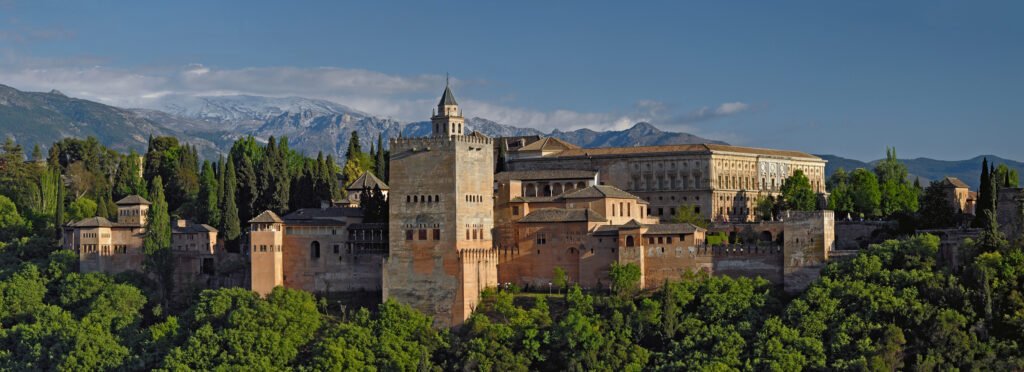
Travel to Granada (roughly 3 hours by train from Seville, or a shorter connection from Córdoba). Spend the afternoon in the Albaicín, Granada’s atmospheric former Moorish quarter, ending at the Mirador de San Nicolás for the classic sunset view directly across to the Alhambra.
Spend the morning touring the Alhambra itself — book Nasrid Palaces tickets weeks in advance, since same-day or even next-day availability is genuinely unreliable during peak season. Depart from Granada or take a short connecting flight/train back to Madrid for an international departure, closing out the two-week loop.
Getting Around: Trains vs. Flights
Spain’s high-speed AVE train network genuinely rivals or beats flying for most of this itinerary’s major city connections once airport transfer and security time are factored in — Madrid-Barcelona (2.5-3 hours), Madrid-Seville (2.5 hours), and Madrid-Córdoba (under 2 hours) are all genuinely comfortable, scenic, and city-center-to-city-center in a way flying simply can’t match, arriving directly into each city’s historic core rather than an airport requiring a further transfer. The San Sebastián-Seville leg in this itinerary is a genuine exception, where no direct high-speed rail connection exists, making a flight (typically routed through Madrid) the more practical option for that specific transition.
Booking AVE tickets in advance, rather than on the day of travel, genuinely secures meaningfully better pricing, and Spain’s Renfe rail booking system allows advance purchase up to several months ahead of a given travel date — prices on popular routes can rise substantially as the travel date approaches, similar to airline pricing dynamics. Within each city, walking and metro systems handle most day-to-day movement genuinely well, and this itinerary is built assuming minimal reliance on rental cars, since Spain’s major cities are dense, walkable, and well-served by public transit in a way that makes driving more hassle than benefit for a city-focused trip like this one.
Budget Basics
Spain remains genuinely one of the better-value major Western European destinations, with restaurant meals, mid-range hotels, and public transport all typically running noticeably less than comparable options in France, Italy, or the UK — a mid-range daily budget covering hotels, meals, and local transport (excluding intercity trains and major attraction tickets) is genuinely achievable without sacrificing quality, particularly outside the most heavily touristed pockets of Barcelona and Madrid’s city centers. Advance booking for headline attractions — the Alhambra, the Sagrada Família, the Prado — is worth doing regardless of budget level, since same-day tickets for these specific sites are genuinely unreliable during peak season and last-minute options, when available, often come at a meaningful premium over standard advance pricing.
Pintxos and tapas-style dining, a genuine cultural norm rather than a tourist gimmick in cities like San Sebastián and Seville, also offers a naturally lower-cost way to eat well compared to full sit-down restaurant meals at every stop — ordering a handful of pintxos with a glass of local wine at a bar counter genuinely costs a fraction of an equivalent multi-course restaurant meal while offering arguably a more authentic, locally embedded dining experience. Lunch, rather than dinner, is also typically the better-value meal across Spain, with many restaurants offering a genuinely substantial “menú del día” (menu of the day) at a fixed, budget-friendly price during weekday lunch hours.
Best Time for This Itinerary
April through June and September through October offer the most comfortable temperatures across this itinerary’s full geographic range, avoiding both Andalucía’s genuinely intense summer heat (which regularly exceeds 40°C/104°F in Seville and Córdoba during July-August) and any winter cold in Madrid and the Basque Country. Late spring specifically brings Seville’s Feria de Abril, a genuinely significant week-long spring festival, worth checking dates for if the timing happens to align with this itinerary — the festival transforms much of the city with flamenco dress, horse-drawn carriages, and traditional dance, though it also brings a genuine spike in hotel prices and crowds during that specific week.
Summer remains genuinely workable for the Madrid, Barcelona, and San Sebastián legs, though the Andalucía portion of this itinerary becomes considerably more physically demanding during peak summer heat, worth factoring into pacing if traveling in July or August specifically — building in more indoor time, siesta-hour breaks, and earlier starts to outdoor sightseeing genuinely helps manage the Andalusian heat during these months. Winter brings noticeably thinner crowds and lower prices across the entire itinerary, though several outdoor-heavy days (particularly Toledo and the Alhambra’s gardens) are genuinely less comfortable in the colder, shorter days of December through February.
This itinerary draws on this site’s dedicated guides to Madrid, Barcelona, the Basque Country, and Andalucía — check those out for a deeper dive into any single stop. If this guide helped you plan your Spain trip, subscribe to Worldly Traveler on YouTube for more travel guides from around the world.
Frequently Asked Questions
Is 2 weeks enough to see Spain?
2 weeks is genuinely enough to see a well-rounded cross-section of Spain — Madrid, Barcelona, and a stretch of Andalucía — though it isn’t enough to see the entire country in depth. Focusing on fewer regions with more time in each is generally more rewarding than rushing through everything.
Should I use trains or fly between cities in Spain?
Spain’s high-speed AVE train network genuinely rivals or beats flying for most major city connections once airport transfer and security time are factored in, particularly Madrid-Barcelona, Madrid-Seville, and Madrid-Córdoba, all under 3 hours by train.
How much does 2 weeks in Spain cost?
Costs vary considerably by travel style, but a mid-range budget covering trains, 3-star hotels, and restaurant meals typically runs noticeably less than comparable trips in France, Italy, or the UK, making Spain a genuinely good value for a multi-week itinerary.
What is the best time of year for a 2-week Spain trip?
April-June and September-October offer the most comfortable temperatures across the full itinerary, avoiding both Andalucía’s intense summer heat and any winter cold in Madrid and the north.
Do I need to book Alhambra tickets in advance?
Yes, genuinely essential — Alhambra tickets, particularly for the Nasrid Palaces, sell out days or weeks in advance during peak season, and arriving without a pre-booked ticket risks being unable to enter that day at all.