
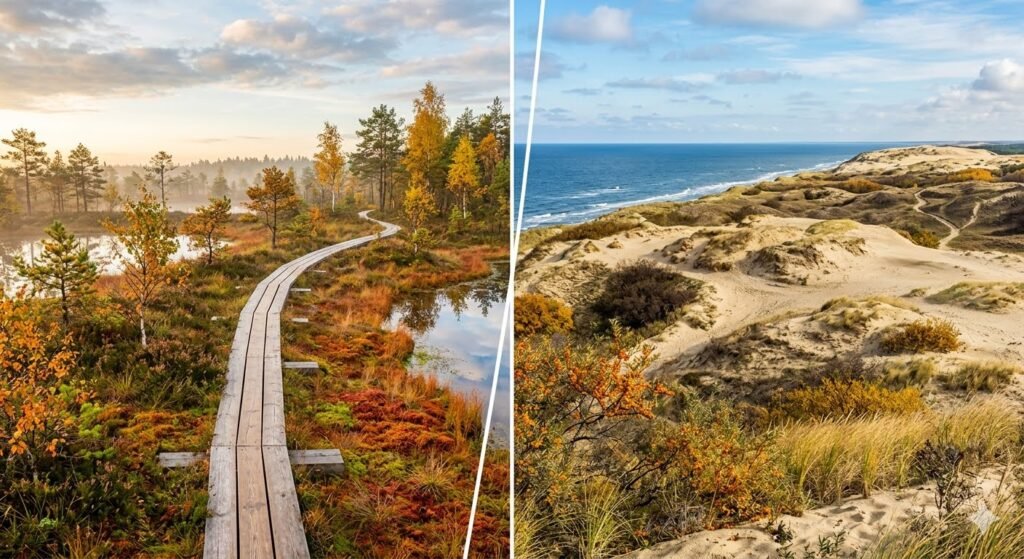
Medieval old towns, castles on islands, national song festivals, and one of Europe’s most striking coastlines — both Baltic countries have a strong case. This guide compares Estonia and Lithuania on cost, sights, food, nightlife, safety, and outdoor adventures, with 10 to 12 specific places to see in each. I walk through both countries in the video below.
Both countries share a region and a broadly similar recent history — Soviet occupation followed by independence in the early 1990s, EU and NATO membership soon after — but they feel genuinely different to visit. Estonian is a Finnic language unrelated to most of Europe’s, giving Tallinn a different cultural texture than its neighbors, while Lithuanian is one of the oldest living Indo-European languages.
Cost of Travel
10 Things to See in Estonia
12 Things to See in Lithuania
Food, Nightlife & Safety
Outdoor Adventures
FAQ
Cost of Travel
Estonia, especially Tallinn, runs noticeably more expensive than Lithuania. Expect roughly $70-$100 a day in Estonia against $50-$80 in Lithuania, with restaurant meals, hotel rooms, and hostel beds all landing lower in Lithuania. A mid-range hotel in Tallinn runs around $80 a night, while comparable comfort in Vilnius can be found for around $60. Public transport is similarly priced in both capitals, around $2 for a city bus ticket.
| Estonia | Lithuania | |
|---|---|---|
| Daily budget (mid-range) | $70-$100 | $50-$80 |
| Hostel bed | From ~$20 | From ~$15 |
| Restaurant meal | $15-$25 | Often under $18 |
| Signature nature site | Lahemaa & Soomaa National Parks | Curonian Spit (UNESCO) |
10 Things to See in Estonia
1. Tallinn Old Town
A UNESCO-listed medieval core of cobblestone streets, pastel merchant houses, and centuries-old city walls — one of the best-preserved old towns in Northern Europe.
Tallinn. Free to walk. Best explored on foot over a full day.

2. Toompea Castle
Perched on a limestone hill above the rest of Tallinn’s Old Town, this castle complex now houses Estonia’s parliament, with the pink Baroque facade being the most photographed angle.
Tallinn. Free to view exterior. Best combined with an Old Town walk.
3. Alexander Nevsky Cathedral
An Orthodox cathedral with distinctive onion domes, built in the late 19th century and visible across much of the Tallinn skyline.
Tallinn. Free to enter.
4. Town Hall Square
The historic center of Tallinn’s Old Town, ringed by merchant houses and home to one of the oldest continuously operating town halls in Northern Europe.
Tallinn. Free.
5. Lahemaa National Park
Estonia’s largest national park, roughly an hour from Tallinn, combining dense forest, coastal bog, and grand manor houses that hint at the region’s noble past.
About 1 hour from Tallinn. Free. Best as a day trip.
6. Viru Bog Boardwalk
A wooden trail through Lahemaa’s wetlands, a low-effort way to see Estonia’s distinctive bog landscape without a full hiking commitment.
Lahemaa National Park. Free.
7. Jägala Waterfall
Estonia’s widest waterfall, located within Lahemaa National Park and easily combined with a bog walk on the same day trip.
Lahemaa National Park. Free.
8. Soomaa National Park
Known locally for its “fifth season” — a period of unusual spring flooding that turns the park into a canoeing destination rather than a hiking one.
South-central Estonia. Free; guided canoe tours cost extra. Best in spring flood season.
9. Saaremaa & Hiiumaa Islands
Estonia’s largest islands, reached by ferry, offering windswept beaches, historic windmills, and a noticeably slower pace than the mainland.
Reached by ferry from the mainland. Ferry fee. Best for a multi-day visit.
10. Balti Jaam Turg Market
Tallinn’s central market, worth visiting for fresh produce, handmade goods, and a genuine slice of daily local life.
Tallinn. Free to browse.
12 Things to See in Lithuania
1. Vilnius Old Town
One of the largest and best-preserved old towns in Eastern Europe, a UNESCO World Heritage Site since 1994, characterized by Baroque churches, cobbled alleys, and hidden courtyards.
Vilnius. Free to walk.
2. Gediminas’ Tower
The remaining structure of Vilnius’s Upper Castle, first built in wood in the 14th century and rebuilt in brick in 1409. Its viewing platform overlooks the entire Old Town.
Vilnius. Small entry fee for the tower.
3. St. Anne’s Church
A Gothic brick church completed around 1500, considered one of the finest examples of Flamboyant Gothic architecture in the region and a defining feature of the Vilnius skyline.
Vilnius. Free to view exterior.

4. Cathedral Square
The civic and religious heart of Vilnius, anchored by Vilnius Cathedral and the bell tower, and the traditional starting point for exploring the Old Town.
Vilnius. Free.
5. Užupis
A bohemian district across the Vilnia River that humorously declared itself an independent republic, complete with its own constitution posted on a wall in dozens of languages.
Vilnius. Free to wander.
6. Trakai Castle
A red-brick island castle on Lake Galvė, a short trip from Vilnius, rebuilt in the 20th century on the foundations of a 14th- and 15th-century fortress.
About 30 minutes from Vilnius. Entry fee.

7. Hill of Crosses
Near Šiauliai in northern Lithuania, this pilgrimage site holds an estimated hundreds of thousands of crosses left by visitors over more than a century.
Near Šiauliai. Free. Continues to grow as visitors add new crosses.
8. Museum of Occupations and Freedom Fights
Housed in Vilnius’s former KGB headquarters, this museum documents the Soviet and Nazi occupations of Lithuania, including preserved prison cells and an execution chamber.
Vilnius. Entry fee.
9. Curonian Spit
A UNESCO World Heritage sand dune peninsula stretching along the Baltic coast, with the resort town of Nida as its best-known base for sandboarding, kite surfing, and hiking along the dune ridge.
Western Lithuania, reached via ferry from Klaipėda. Ferry fee. Best in summer.

10. Aukštaitija National Park
Lithuania’s oldest national park, built around hundreds of lakes and ancient woodland, popular for boating, kayaking, and cycling.
Northeast Lithuania. Free; boat and kayak rentals extra.
11. Žemaitija National Park
A quieter park in western Lithuania centered on peaceful rivers and wooden villages, with scenic hiking trails through the region’s traditional landscape.
Western Lithuania. Free.
12. Halės Market
Vilnius’s central market hall, a strong stop for smoked meats, cheeses, and pastries, and a good place to sample cepelinai or šaltibarščiai from a stall.
Vilnius. Free to browse.
Food, Nightlife & Safety
Food: Estonia’s cuisine leans Nordic, built around foraged mushrooms, rye bread, and smoked fish, with kama (a roasted grain blend with yogurt and berries) as a distinctive dessert. Lithuania’s food culture centers on hearty comfort dishes: cepelinai (potato dumplings stuffed with meat), šaltibarščiai (cold beetroot soup), and kugelis (a potato pudding).
Nightlife: Tallinn’s Old Town nightlife leans medieval-themed, with candlelit taverns alongside modern bars. Vilnius counters with cocktail bars, underground clubs, and a lively scene in Užupis, plus a growing craft beer culture.
Safety: Both countries are considered very safe for travelers, with low crime rates and visible police presence in city centers. Ordinary precautions — watching belongings in crowded areas — apply in both.
Outdoor Adventures
Estonia is the stronger pick for forest and island exploration — over half the country is wooded, with Lahemaa and Soomaa offering distinct bog and forest ecosystems, plus island-hopping to Saaremaa and Hiiumaa. Lithuania’s outdoor draw centers on the Curonian Spit’s dunes and lagoon, plus the lake-dense Aukštaitija and quieter Žemaitija national parks — better suited to kayaking and cycling than Estonia’s bog-heavy terrain.
Which Should You Visit First?
If budget is the deciding factor, Lithuania wins clearly. If medieval atmosphere and forest/island nature are the priority, Estonia has the edge. Both are compact enough, and close enough to each other by bus, that a two-week trip can realistically cover both.
I walk through both countries side by side in the video above. If this guide helped you plan your trip, subscribe to Worldly Traveler on YouTube for more travel comparisons from around the world.
Frequently Asked Questions
Is Estonia or Lithuania cheaper to visit?
Lithuania is noticeably cheaper across accommodation, food, and hostels, roughly $20-30 lower per day than Estonia.
Which country has better nature and outdoor activities?
Estonia for forests, bogs, and islands; Lithuania for the Curonian Spit and its lake-district national parks.
Can you visit both Estonia and Lithuania in one trip?
Yes, buses connect Tallinn and Vilnius in roughly 9-10 hours, making a two-week Baltic loop realistic.
Is English widely spoken in Estonia and Lithuania?
Yes in both capitals, especially among younger people; Estonia has a slight edge overall.
What is Lithuania’s Hill of Crosses?
A pilgrimage site near Šiauliai covered with hundreds of thousands of crosses, symbolizing faith and resistance.