
Tuscany’s rolling vineyards and famous hill towns draw the overwhelming majority of Central Italy’s international visitors, and just next door, Umbria — Italy’s only landlocked region without a coastline — offers a genuinely quieter, equally beautiful alternative that most travelers never make time for. This guide covers Umbria’s best hidden gems, organized by sub-region so you can build a route through whichever part of Italy’s “green heart” genuinely calls to you.
Umbria’s relative anonymity compared to Tuscany is genuinely more about historical circumstance than any lack of beauty — while Tuscany’s Renaissance city-states built enormous wealth and cultural influence that shaped how the rest of the world came to picture “Italy,” Umbria’s hill towns developed along a quieter, more spiritually oriented path, shaped profoundly by St. Francis of Assisi and St. Benedict of Norcia, two of the most significant figures in the entire history of Western Christianity. That difference in historical trajectory is exactly why Umbria today feels less like a curated postcard and more like a genuinely lived-in landscape — its hill towns are still primarily populated by actual Umbrians rather than restructured around tourism.
That lived-in quality extends genuinely into the region’s food, festivals, and daily rhythms, all of which remain notably less commercialized than their Tuscan counterparts. Umbria’s nickname, “the green heart of Italy,” reflects both its central geographic position on the peninsula and its genuinely dense forest cover, particularly across the Sibillini Mountains and Valnerina valley — a landscape defined as much by oak forest and mountain pasture as by the vineyard-covered hills most people picture when they think of Central Italy. Slow travel, in the genuine sense of lingering in one town rather than checklist-touring several in a day, rewards Umbria specifically well, since so much of the region’s character lives in details — a local festival, a truffle hunter’s stories, a quiet monastery — that a rushed itinerary would simply miss.
Perugia & the North
Assisi & the Sacred Valley
Orvieto & Southern Umbria
The Sibillini Mountains
Umbria vs. Tuscany
Umbrian Food & Wine Worth Seeking Out
Best Time to Visit Umbria
FAQ
Perugia & the North
Umbria’s regional capital and its surrounding northern hill towns hold significant Etruscan history alongside genuinely underrated small-town charm.
Perugia’s Underground City
Beneath Perugia’s modern streets lies the Rocca Paolina, a vast underground network of medieval streets and buildings, entombed intact when a 16th-century papal fortress was built directly on top of the existing neighborhood as a punishment following a local revolt — walking through this genuinely eerie preserved underground city offers a tangible sense of Renaissance-era Perugia frozen in place.
Perugia. Free to explore. Best combined with a broader Perugia historic center visit, since the underground entrance sits directly beneath the main square.
Perugia’s Chocolate Heritage
Home to Perugina, one of Italy’s most historically significant chocolate producers and creator of the famous Baci (“kisses”) chocolates, Perugia hosts Eurochocolate, one of the largest chocolate festivals in Europe, each October — a genuinely significant culinary claim to fame for a mid-sized Umbrian city.
Perugia. Free to explore town; festival and factory tour fees vary. Best in October during Eurochocolate, if timing allows.
Gubbio
A remarkably well-preserved medieval town built into a steep hillside, its stone streets rising in tiers connected by staircases and narrow passages, home to the Corsa dei Ceri, an intense annual footrace involving teams carrying massive wooden “candles” (ceri) up the mountainside — a tradition genuinely unchanged for over 900 years.
Northern Umbria. Free to explore. Best on May 15th if timing coincides with the Corsa dei Ceri.
Città di Castello
A genuinely underrated Renaissance town along the upper Tiber Valley, its historic center holding a significant collection of works by Renaissance master Luca Signorelli, alongside a modern art museum dedicated to sculptor Alberto Burri, a native son whose innovative use of industrial materials influenced 20th-century Italian art.
Northern Umbria, near the Tuscan border. Free to explore town; museum entry fees vary. Best combined with a broader upper Tiber Valley driving route.
Lake Trasimeno
The largest lake in Central Italy, its shores dotted with small towns and three inhabited islands, offering a genuinely peaceful alternative to Umbria’s hill-town circuit — the lake was also the site of a major Roman military disaster, Hannibal’s decisive 217 BC ambush of a Roman army, one of the most significant battles of the Second Punic War.
Western Umbria, near the Tuscan border. Free lake access; boat fares to islands. Best in summer for swimming and boat access to Isola Maggiore.
Assisi & the Sacred Valley
The valley surrounding Assisi holds the spiritual center of Umbria, alongside genuinely underrated neighboring hill towns.
Basilica di San Francesco
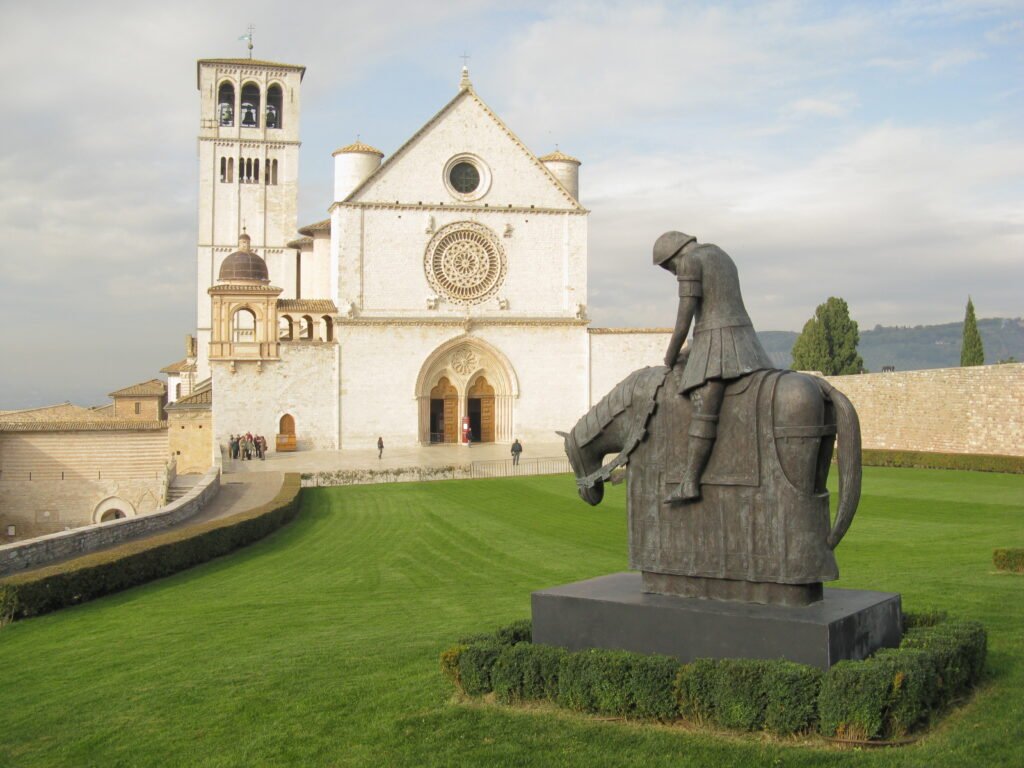
One of the most significant pilgrimage sites in the Christian world, this two-tiered basilica houses the tomb of St. Francis of Assisi alongside a genuinely extraordinary fresco cycle, including works long attributed to Giotto, whose innovative naturalistic style here helped launch the broader trajectory of Italian Renaissance painting.
Assisi. Free to enter (donations welcomed). Best in the early morning before the significant midday pilgrim and tour group crowds.
Eremo delle Carceri
A genuinely remote hermitage carved into the forested slopes of Mount Subasio above Assisi, where St. Francis and his early followers retreated for prayer and solitude — the site remains an active Franciscan hermitage today, its quiet forest setting offering a genuinely contemplative counterpoint to Assisi’s busier basilica.
Mount Subasio, above Assisi. Free (donations welcomed). Best combined with a hike up Mount Subasio, given the site’s forested, elevated location.
Spello
A genuinely gorgeous hill town, its stone streets overflowing each spring with the elaborate flower-petal “carpets” (infiorate) created for the Corpus Domini religious festival, a tradition so intricate that teams work through the entire preceding night to complete each design before dawn.
Near Assisi. Free to explore. Best in late May/early June for the Corpus Domini flower carpet festival, if timing allows.
Bevagna
A genuinely well-preserved medieval town, its Roman-era street grid still visible in the town’s layout, hosting an annual Mercato delle Gaite festival where residents recreate medieval crafts, trades, and daily life in astonishing, genuinely committed historical detail.
Near Foligno, central Umbria. Free to explore. Best in June during the Mercato delle Gaite festival, if timing allows.
Montefalco
Nicknamed the “Balcony of Umbria” for its sweeping panoramic views across the surrounding valley, this hill town is also the heart of Sagrantino wine production, home to a distinctive, powerfully tannic red grape variety found almost nowhere else in the world at this scale.
Central Umbria, near Spoleto. Free to explore town; wine tasting fees vary. Best combined with a Sagrantino wine tasting given the town’s central role in the appellation.
Spoleto
A genuinely significant Umbrian town, its dramatic Ponte delle Torri (Tower Bridge) spanning a deep gorge on ten massive stone arches, home each summer to the Festival dei Due Mondi, one of Italy’s most internationally significant performing arts festivals since its founding in 1958.
Central Umbria. Free to explore town; festival tickets priced separately. Best in June-July during the Festival dei Due Mondi, if timing allows.
Orvieto & Southern Umbria
Southern Umbria holds a genuinely dramatic clifftop city and Italy’s most significant Franciscan monastery beyond Assisi itself.
Orvieto’s Underground City
Beneath Orvieto’s dramatic clifftop setting lies a labyrinth of over 1,200 caves and tunnels, some dating back to Etruscan times roughly 2,500 years ago, later expanded for wine storage, dovecotes for raising pigeons, and, during WWII, air-raid shelters — a genuinely unique underground city rarely found beneath any other Italian hill town at this scale.
Orvieto. Guided tour fee (required for underground access). Best combined with an Orvieto Cathedral visit given the shared location.
%2013th%20century.JPG)
Orvieto Cathedral
A genuinely spectacular 13th-century Gothic cathedral, its striped marble facade and gilded mosaics among the most ornate in all of Italy, built to commemorate the Miracle of Bolsena, a Eucharistic miracle said to have occurred nearby in 1263 that helped establish the Catholic feast of Corpus Domini.
Orvieto. Entry fee. Best at sunset for the facade’s gold mosaic details catching the warm evening light.
Civita di Bagnoregio
Nicknamed “the dying town,” this genuinely astonishing hilltop settlement sits atop an eroding volcanic outcrop, accessible only via a long pedestrian bridge, its population reduced to a mere handful of year-round residents as centuries of erosion have gradually shrunk the plateau it sits upon.
Technically just across the border in Lazio, near Orvieto. Small entry fee. Best at sunset for the town’s dramatic silhouette against the surrounding valley.
Todi
A genuinely well-preserved hill town, once ranked in academic studies as one of the world’s most “sustainable” and livable small cities, its Piazza del Popolo considered one of the finest surviving medieval squares in Italy, ringed by a genuinely striking collection of civic and religious buildings.
Southern Umbria. Free to explore. Best combined with a broader southern Umbria driving route given its central location.
Norcia
The birthplace of St. Benedict, founder of Western monasticism, and genuinely one of Italy’s most significant food towns despite its small size, famous nationally for its cured meats (salumi) and black truffles — the town’s own name gave rise to “norcineria,” the Italian term for a pork butcher shop, a linguistic tribute to Norcia’s centuries-old mastery of the craft.
Southeastern Umbria, Sibillini foothills. Free to explore town; individual shop and restaurant costs vary. Best in autumn for peak black truffle season.
Cascata delle Marmore
One of the tallest man-made waterfalls in the world at 165 meters, originally engineered by the ancient Romans in 271 BC to drain a malaria-breeding marsh, its flow today controlled by a hydroelectric plant and released on a published schedule specifically for visitors.
Near Terni, southern Umbria. Entry fee. Best checking the current water-release schedule in advance, since the falls only run at full flow during specific announced hours.
The Sibillini Mountains
Umbria’s mountainous southeastern edge holds genuinely dramatic wilderness, largely overlooked even by visitors to the rest of the region.
Piano Grande di Castelluccio
A genuinely spectacular high-altitude plain, its floor transformed each late spring and early summer into a dazzling multicolored carpet of wildflowers and flowering lentils (la fiorita) — a natural spectacle that draws photographers from across Italy for its brief, intensely colorful blooming window.
Sibillini Mountains, near Norcia. Free. Best mid-June through early July for peak fiorita bloom, though exact timing shifts year to year based on weather.
Castelluccio di Norcia
A genuinely tiny mountaintop village overlooking the Piano Grande, largely rebuilt following devastating 2016 earthquakes that struck this region of central Italy, its resilient small community famous nationally for producing Italy’s prized Castelluccio lentils, grown on the surrounding high plain.
Sibillini Mountains. Free to explore. Best combined with a Piano Grande wildflower visit given the shared location.
Umbria vs. Tuscany
Umbria and Tuscany share genuine similarities — rolling hills, medieval hill towns, olive groves — that make comparison natural, but the two regions genuinely diverge in character once you look closer. Tuscany’s identity was shaped by Renaissance-era wealth and political power, particularly Florence’s outsized cultural influence, which produced a landscape optimized over centuries for aristocratic villas and, more recently, sophisticated tourism infrastructure. Umbria, lacking Tuscany’s coastal access and major historic banking wealth, developed along a quieter path centered more on spiritual pilgrimage (Assisi, Norcia) and agricultural self-sufficiency, resulting in a landscape that today feels genuinely less curated and more like ordinary Italian small-town life continuing largely undisturbed.
Practically speaking, this means Umbria offers noticeably thinner crowds, generally lower prices, and a food culture built more around truffles, lentils, and freshwater fish than Tuscany’s more internationally famous wine and beef traditions — differences worth knowing before assuming a “Tuscany trip” and an “Umbria trip” would deliver a similar experience. Many experienced Central Italy travelers genuinely recommend combining both regions in a single trip rather than choosing one over the other, given how close they sit geographically and how naturally each complements the other’s strengths — Tuscany’s polish and Umbria’s quieter authenticity.
Umbrian Food & Wine Worth Seeking Out
Umbria holds a genuinely serious claim to Italy’s finest black truffles, particularly around Norcia and the Valnerina valley, where dedicated truffle hunters and their trained dogs still forage the surrounding oak forests using techniques passed down through generations — a truffle-focused meal here is worth seeking out as a genuinely regional specialty rather than the luxury add-on it often becomes elsewhere. Norcia’s cured meat tradition, encompassing prosciutto, salami, and a wide range of pork specialties, reflects centuries of genuine mastery serious enough that “norcineria” became the standard Italian word for any pork butcher shop nationwide, regardless of location. Castelluccio lentils, grown on the high Piano Grande plain, are prized for their small size and thin skin, requiring no pre-soaking before cooking — a genuinely distinctive regional legume worth seeking out specifically by name on menus. Sagrantino di Montefalco, Umbria’s signature red wine, is made from a grape variety grown almost nowhere else in significant quantity, producing genuinely powerful, tannic wines that reward aging — a distinctly different wine experience from Tuscany’s more internationally familiar Sangiovese-based reds.
Best Time to Visit Umbria
April through June and September through October offer the most comfortable temperatures and the most manageable crowds, avoiding both summer’s heat (which can genuinely intensify in Umbria’s inland, non-coastal landscape) and any winter cold at higher elevations. Late May through early July brings the Piano Grande’s spectacular wildflower bloom, a genuinely narrow, weather-dependent window worth building a trip around if the fiorita is a priority. Autumn, particularly October and November, brings Umbria’s truffle season into full swing, along with genuinely excellent olive harvest activity across the region — a rewarding season for food-focused travelers despite the shorter days and cooler temperatures. Summer remains popular for major festivals like Spoleto’s Festival dei Due Mondi and Perugia’s Umbria Jazz Festival, though the heat and larger crowds at these specific events are worth factoring into planning around them.
I cover the culture, food, and travel style behind this guide in the video above. If this guide helped you plan your Umbria trip, subscribe to Worldly Traveler on YouTube for more travel guides from around the world.
Frequently Asked Questions
What are the best hidden gems in Umbria?
Some of the best hidden gems in Umbria include Assisi’s Basilica of St. Francis, Orvieto’s underground city, the hilltop town of Spello, Norcia’s truffle and salumi tradition, and the Cascata delle Marmore waterfall, all offering a genuinely authentic slice of Italy beyond the more crowded Tuscan hill towns.
How is Umbria different from Tuscany?
Umbria is Italy’s only landlocked region without a coastline, generally holds fewer visitors than Tuscany, and its hill towns and cuisine (truffles, lentils, freshwater fish) reflect a more inland, forested landscape than Tuscany’s vineyard-dominated countryside.
How many days do you need to explore Umbria’s hidden gems?
7-10 days allows a well-paced trip covering Perugia, Assisi, Orvieto, and a stretch of the Sibillini Mountains. A shorter 4-5 day trip works well focused on the Assisi-Perugia-Orvieto core.
What is the best time of year to visit Umbria?
April-June and September-October offer the most comfortable temperatures and manageable crowds. Late fall (October-November) also brings truffle season, a genuinely rewarding time for food-focused travelers.
Do you need a car to explore Umbria?
Yes, genuinely — while Perugia, Assisi, and Orvieto have train access, most of Umbria’s smaller hilltop villages and the Sibillini Mountains region require a rental car, since regional bus service is limited.