
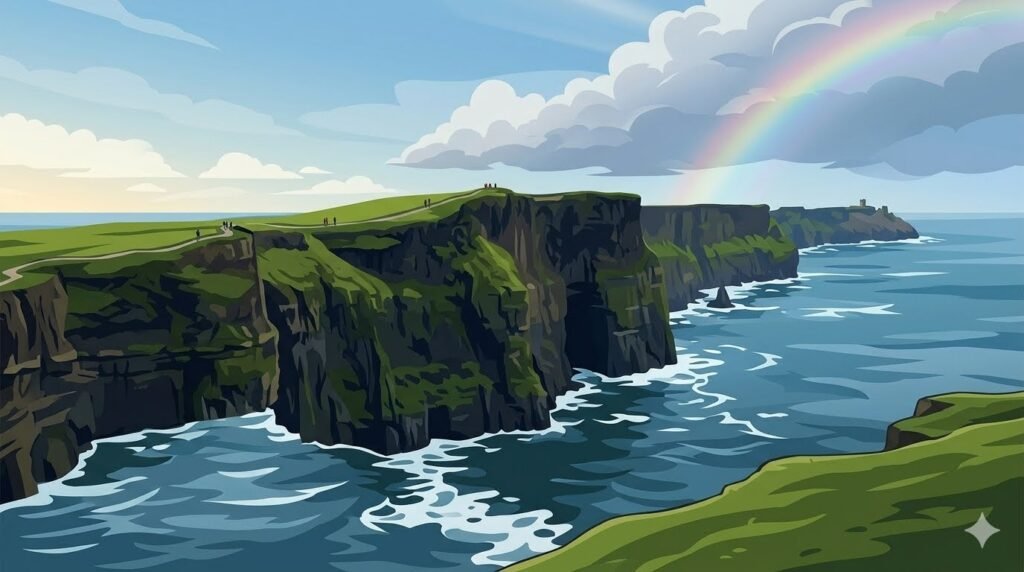
Most first-time visitors to Ireland spend their whole trip within an hour of Dublin. Ireland’s real character lives in its far corners — remote islands, glacial lakes reached only on foot, and gardens built around one of the strangest pieces of Victorian engineering in the country. This guide covers 25 hidden gems across Ireland, grouped by region, plus the planning details that make the difference between a wish list and an itinerary. I walk through all of these in the video below, so start there for a visual preview before you plan your route.
Trying to hit all 25 in one trip means a lot of driving across very different parts of the country, so this guide groups them into regional clusters — the southwest, the west coast and islands, the midlands and southeast, Dublin’s mountain doorstep, and Northern Ireland — so you can plan a route rather than crisscrossing the map.
The Southwest
The Midlands & Southeast
Dublin’s Mountain Doorstep
The West Coast & Islands
Northern Ireland
Planning Your Visit
FAQ
The Southwest (Kerry, Cork, Waterford)
1. Skellig Michael
A UNESCO World Heritage island 12 kilometers off the Kerry coast, home to a remarkably preserved 6th-century monastic settlement of stone beehive huts, along with dramatic cliffs and a puffin colony. It gained a wider audience as Luke Skywalker’s hideaway in the later Star Wars films.
Off County Kerry. Boat tour fee, permit-limited. Roughly mid-May through early October, weather-dependent.
2. Dunquin Pier
On the Dingle Peninsula, this pier’s zigzagging path drops dramatically down the cliffs to the Atlantic. It was historically the main departure point for boats to and from the Blasket Islands.
Dingle Peninsula, County Kerry. Free. Best on a clear day for Blasket Island views.
3. Mizen Head
At Ireland’s southwesternmost tip, a suspension bridge crosses high above crashing waves to reach a historic signal station that was once vital to transatlantic shipping communications. Seals and dolphins are regularly spotted from the bridge.
County Cork. Entry fee for the signal station and bridge. Best in calm weather.

4. Glenveagh Castle
Set within Glenveagh National Park on the shore of Lough Veagh in County Donegal, this late-19th-century castle was built in the Scottish baronial style and is known for its elaborate gardens. Its remote setting once drew high-profile guests, including actress Greta Garbo.
Glenveagh National Park, County Donegal. Park free; castle tour has a fee. Best in summer for the gardens.
5. Coumshingaun Lough
Reached via a challenging hike in County Waterford, this glacial lake sits inside a dramatic horseshoe of cliffs carved by ice thousands of years ago. Wildflowers line the shore in spring and summer.
County Waterford. Free. Best as a full-day hike, spring through early autumn.
6. Loop Head Peninsula
At the tip of County Clare, Loop Head Lighthouse has guided ships since 1854 from cliffs that plunge straight into the Atlantic. Dolphins are frequently spotted offshore.
County Clare. Small lighthouse tour fee. Best at sunset.
7. Slieve League
Rising nearly 2,000 feet above the Atlantic in County Donegal, Slieve League’s cliffs are roughly three times the height of the more famous Cliffs of Moher, yet see a fraction of the visitors.
County Donegal. Free. Best on a clear, low-wind day given the exposed cliff-edge paths.
8. Doolin Cave
Beneath the hills of County Clare, Doolin Cave holds the Great Stalactite, a single formation roughly 7.3 meters (about 24 feet) long, commonly cited as the longest free-hanging stalactite in the Northern Hemisphere.
County Clare. Guided tour fee. Good rainy-day option.
9. St. Finbarr’s Oratory, Gougane Barra
This small chapel sits on an island in Gougane Barra Lake, County Cork, on the site traditionally associated with a 6th-century monastery founded by St. Finbarr, patron saint of Cork.
County Cork. Free. Best in early morning for stillness on the lake.
10. Glencar Waterfall
A roughly 50-foot cascade in County Leitrim, best known for inspiring W.B. Yeats’s poem “The Stolen Child.” A wooden walkway leads visitors alongside the falls through moss-covered woodland.
County Leitrim. Free. Easy, short walk suitable for all ages.
11. Kinsale
This harbor town in County Cork is known for its brightly painted streets, strong seafood restaurant scene, and the historic Charles Fort overlooking the water.
County Cork. Town free; Charles Fort has entry fee. Best for a half-day visit combined with lunch.
The Midlands & Southeast
12. Cahir Castle
One of Ireland’s best-preserved medieval castles, built in the 13th century on a rock island in the River Suir in County Tipperary. Its intact walls and courtyards have made it a filming location for movies including Excalibur.
County Tipperary. Entry fee. Best combined with a walk along the River Suir.
13. Rock of Dunamase
These ruins in County Laois sit atop a limestone outcrop that’s been fortified since the early Christian era, with the current ruins dating to the 12th century.
County Laois. Free. Best at golden hour for photos.
14. Birr Castle Gardens
In County Offaly, these gardens are home to the “Leviathan of Parsonstown” — a giant telescope built in 1845 that was the largest in the world for over 70 years.
County Offaly. Entry fee. Best for a half-day visit including the science center.
15. The Vee
A zigzagging mountain drive through the Knockmealdown Mountains in County Waterford, named for the sharp V-shaped bend near its summit. It’s especially striking in late spring when rhododendrons bloom.
County Waterford/Tipperary border. Free. Best in late May-June for rhododendron blooms.
Dublin’s Mountain Doorstep (Wicklow)
16. Lough Tay
Nicknamed the “Guinness Lake” for its dark water and a strip of white sand at its northern shore, Lough Tay sits in the Wicklow Mountains and has appeared as a filming location for Vikings. It’s on private land but visible from the nearby Military Road.
County Wicklow. Free viewpoint. Best combined with a Sally Gap drive.
17. Powerscourt Waterfall
Ireland’s highest waterfall, dropping about 121 meters (nearly 400 feet) within the Powerscourt Estate in County Wicklow. The surrounding woodland is home to red squirrels and wild deer.
County Wicklow. Entry fee. Best after rain for full water flow.
18. Mount Usher Gardens
Spanning over 22 acres along the River Vartry in County Wicklow, these gardens follow an informal, naturalistic planting style with more than 5,000 plant species from around the world.
County Wicklow. Entry fee. Best in spring for peak bloom.
The West Coast & Islands
19. The Burren
A vast expanse of cracked limestone in County Clare, shaped by glaciers and home to more than 70% of Ireland’s native plant species. Ancient monuments, including the Poulnabrone Dolmen, rise from the stone.
County Clare. Free. Best in May for wildflower bloom.
20. Achill Island
Ireland’s largest island, off the coast of County Mayo, with some of Europe’s highest sea cliffs and the white-sand Keem Bay. It was a filming location for the Oscar-nominated The Banshees of Inisherin.
County Mayo, connected by bridge. Free. Best in summer for beach access.
21. Tory Island
Ireland’s most remote inhabited island, off County Donegal, known for electing its own “king” — a ceremonial figure who traditionally greets visitors. The island has helped keep the Irish language and traditional arts alive.
Off County Donegal. Ferry fee, weather-dependent. Best May-September.
22. Inisheer
The smallest of the Aran Islands, just 3 kilometers long, dotted with stone-walled fields and the ruins of O’Brien’s Castle. The MV Plassy, a cargo ship wrecked on the island’s rocky shore in 1960, remains a well-known landmark.
Aran Islands, off County Galway/Clare. Ferry fee. Best as a day trip from Doolin.
23. Kilkee Cliffs
A quieter alternative to the Cliffs of Moher along the County Clare coast, with a cliff walk offering similar dramatic views and a fraction of the crowds.
County Clare. Free. Best in late afternoon light.

24. Belmullet Peninsula
A remote stretch of County Mayo coastline with wide sandy beaches and strong Gaelic-speaking heritage, home to rare wildlife including corncrakes and popular with surfers for its Atlantic swells.
County Mayo. Free. Best for surfers and beach walks.
Northern Ireland
25. The Dark Hedges
An avenue of beech trees in County Antrim planted in the 18th century by the Stuart family to line the approach to their Georgian mansion. The trees have grown into an interlocking tunnel that became internationally recognized after appearing as the King’s Road in Game of Thrones.
County Antrim, Northern Ireland. Free. Bring a passport for the border crossing. Best at sunrise before tour buses arrive.

Temple Bar district, Dublin. Source: Wikimedia Commons
Planning Your Visit
Best time to visit: May, June, and September offer the best odds of dry weather without the peak-July crowds. Skellig Michael’s boat crossing only operates roughly mid-May through early October, so shoulder season is a genuine constraint if it’s a priority.
Getting around: A rental car is close to essential for this list — public transport to remote coastal sites and the Wicklow Mountains is limited. Ferries are required for Tory Island and Inisheer, both running reduced schedules outside summer.
How many days to allow: A one-week trip covers one region well, with the southwest loop being the densest cluster. Two to three weeks allows a fuller loop covering the west coast, midlands, and Northern Ireland.
Crossing into Northern Ireland: Bring a passport even though there are no formal border checkpoints, and confirm your rental car policy covers cross-border travel before you go.
I walk through all 25 of these locations in the video above, including Skellig Michael, the Dark Hedges, and the Burren. If this guide helped you plan your trip, subscribe to Worldly Traveler on YouTube for more hidden gems guides from around the world.
Frequently Asked Questions
How many days do you need to see all 25 gems?
Realistically two to three weeks. A one-week trip covers one region well, with the southwest loop being the densest cluster.
Do you need to book Skellig Michael in advance?
Yes, boat crossings are permit-limited, seasonal, and frequently weather-dependent, so book as early as possible.
Is it better to rent a car in Ireland?
Yes, for nearly all of these gems, since public transport to remote coastal sites is limited.
Do I need to cross into Northern Ireland separately?
For the Dark Hedges, yes, since it’s in County Antrim, Northern Ireland; bring a passport for the border crossing.
Are the Kilkee Cliffs as impressive as the Cliffs of Moher?
They’re lower but offer a similar cliff-walk experience with far fewer visitors.