
Beyond Brussels, Bruges, and Ghent, Belgium hides bluebell forests, underground boat tours, and a village so empty it’s become an open-air street art gallery. Belgium is small enough to cross in a few hours by train, which makes it one of the easiest countries in Europe to build a genuinely varied itinerary around. This guide covers 25 hidden gems across Belgium, organized by region. I walk through all of these in the video below.
The Ardennes & Meuse Valley
Flanders & the North
Brussels & Liège
Planning Your Visit
FAQ
The Ardennes & Meuse Valley
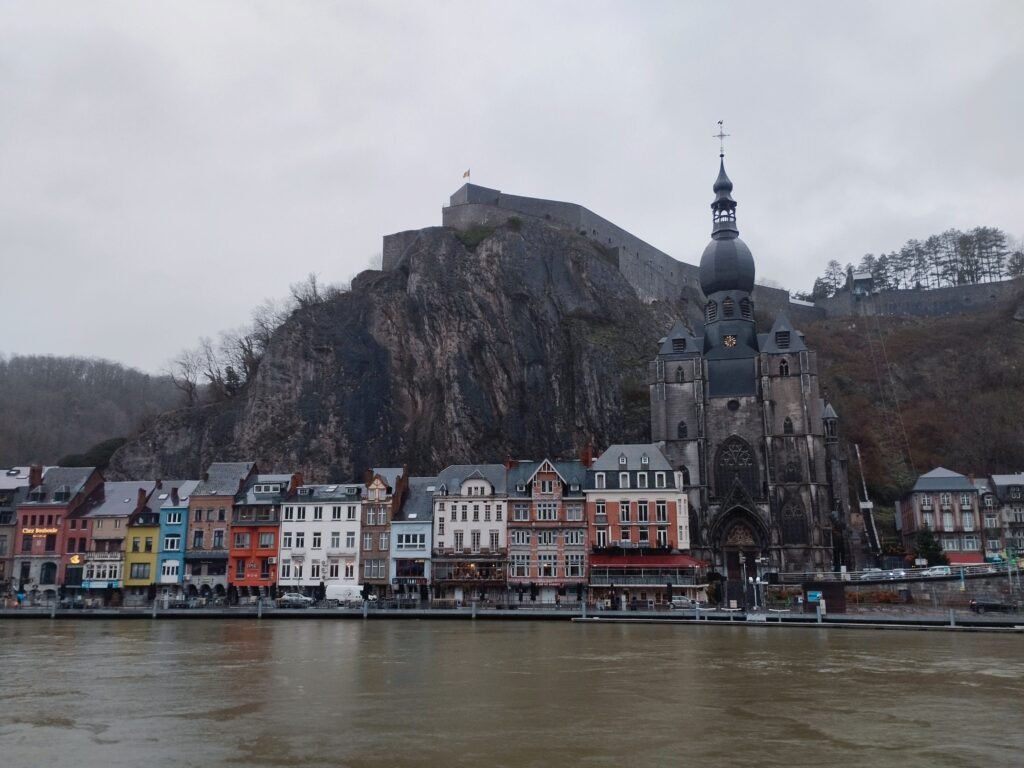
1. Citadel of Dinant
Perched above the Meuse River, the site was first fortified in 1051, though the current fort dates to 1815. Visitors can climb 408 steps or take a cable car to the top, where a terrace overlooks Dinant’s colorful old town.
Dinant. Entry fee for the citadel; cable car extra. Best combined with a walk through town.

2. Durbuy
Often marketed as the “world’s smallest city,” Durbuy has held official city status since 1331. Its cobblestone streets and medieval stone houses are compact enough to explore in a few hours.
Durbuy. Free to walk the town. Best for a half-day visit.
3. Caves of Han (Han-sur-Lesse)
These limestone caves, carved by the Lesse River, are reached via a vintage tram and explored partly on foot and partly by underground boat. The largest chamber spans roughly 150 meters with a vaulted ceiling reaching about 127 meters.
Han-sur-Lesse. Entry fee, includes tram and boat. Good rainy-day option.

4. Bokrijk Open Air Museum
More than 100 authentic historic buildings, relocated from across Belgium, recreate rural life from the 17th through 20th centuries, with costumed staff demonstrating traditional crafts.
Genk. Entry fee. Best as a half-day family visit.
5. Tombeau du Géant (Giant’s Tomb)
A viewpoint above a dramatic bend in the Semois River, named for a local legend about a giant who leapt to his death here. Several marked hiking trails lead to sweeping valley views.
Near Bouillon. Free. Best at sunset.
6. Villers-la-Ville Abbey Ruins
Founded in the 12th century by Cistercian monks, this monastery fell into ruin during the French Revolution. Its roofless Gothic arches and moss-covered cloisters are open to explore.
Villers-la-Ville. Entry fee. Occasional concerts and light shows held on site.
7. Castle of Vêves
A well-preserved 13th-century fortress with a distinctive pentagonal layout and pointed towers, furnished inside with period rooms and stained glass.
Near Dinant. Entry fee.
8. Semois Valley & Bouillon
The Semois River winds through forested hills in the southern Ardennes, popular for kayaking and hiking, with the town of Bouillon and its medieval castle as the valley’s best-known stop.
Southern Ardennes. Castle has entry fee; valley is free to explore.
9. Coo Waterfalls
Belgium’s most substantial waterfall drops roughly 15 meters into the Amblève River, with an amusement park and options for kayaking or ziplining nearby.
Coo, near Stavelot. Free to view; activities cost extra.
10. Meuse River Cruise
Boat cruises along the Meuse pass castles, limestone cliffs, and Dinant’s citadel, offering a different vantage point on several other gems on this list.
Departs from Dinant. Fee for cruise ticket.
11. Grotto of Remouchamps
Discovered in 1828, this cave system is known for a claimed distinction as Europe’s longest underground boat tour, gliding along a subterranean river through cathedral-like chambers.
Remouchamps. Entry fee.
12. Castle of Modave
Dating to the 13th century and remodeled into Baroque style in the 17th, this castle sits above the Hoyoux Valley. Its 1660s hydraulic water-pump system served as the working prototype for the Machine de Marly, which later supplied the fountains at Versailles.
Modave. Entry fee.
13. Maredsous Abbey
Founded in 1872 by Benedictine monks in Neo-Gothic style, Maredsous is known today as much for its monk-made products — Maredsous cheese and abbey beer — as for its architecture.
Near Denée. Grounds free; shop and cafe on site.
14. Château de Freÿr
A Renaissance chateau on the banks of the Meuse, with gardens inspired by Versailles, including hedge mazes and centuries-old orange trees.
Near Dinant. Entry fee. Seasonal opening, check ahead.
Flanders & the North
15. Hallerbos (Bluebell Forest)
For a few weeks each spring, typically mid-April to early May, this forest floor turns violet-blue with millions of blooming bluebells beneath a canopy of beech trees.
Halle, near Brussels. Free. Time-limited bloom window, check current reports before visiting.
16. Beguinage of Bruges
A UNESCO World Heritage site founded in the 13th century, this walled enclave once housed beguines — lay women who lived communally without taking formal religious vows.
Bruges. Free to enter the courtyard.

17. Doel
A once-inhabited village near the Port of Antwerp, largely emptied due to harbor expansion plans. Its abandoned buildings have since been covered in street art by international artists.
Near Antwerp. Free. Stick to public streets given nearby construction.
18. St. Peter’s Abbey, Ghent
Founded in the 7th century as a Benedictine monastery, the abbey’s gardens and exhibitions today cover Ghent’s history from medieval manuscripts to contemporary art.
Ghent. Entry fee for exhibitions; grounds partly free.
19. Lommel Sahara
A surreal landscape of sand dunes, a lake, and pine forest in northern Belgium, formed by historical sand mining and later reforestation.
Lommel. Free.
20. Gallo-Roman Museum, Tongeren
Located in Belgium’s oldest city, this museum displays Roman and pre-Roman artifacts alongside reconstructions of Roman armor and daily life.
Tongeren. Entry fee.
Brussels & Liège
21. Japanese Tower, Brussels
Built between 1900 and 1904 under King Leopold II and inspired by a pavilion at the Paris Exposition, this five-story tower is an unusual example of Japonisme architecture in Europe.
Brussels. Entry fee, limited opening hours — check ahead.
22. Folon Foundation
Just outside Brussels, this museum in La Hulpe park showcases the whimsical sculptures and illustrations of Belgian artist Jean-Michel Folon, with an outdoor sculpture garden.
La Hulpe. Entry fee for the museum; park is free.
23. Horta Museum
The former home and studio of Art Nouveau architect Victor Horta in Brussels, preserved with its sweeping curves, stained glass, and ornate ironwork intact.
Brussels. Entry fee, timed tickets recommended.
24. Montagne de Bueren, Liège
A 374-step monumental staircase built in the late 19th century to honor soldiers who defended Liège, rewarding the climb with panoramic views over the city.
Liège. Free.
25. Yser Tower (IJzertoren), Diksmuide
Note: our video’s on-screen location was misheard in the audio as “Ypres,” but the tower itself stands in Diksmuide, part of the wider Flanders Fields WWI region. Its 22 floors of exhibits climb toward panoramic views over the former battlefields, with “No More War” inscribed on its base in four languages.
Diksmuide. Entry fee. Often paired with a Flanders Fields WWI day trip.

Planning Your Visit
Best time to visit: Mid-April to early May if the Hallerbos bluebells are a priority — the flowering window lasts only a few weeks. Otherwise, May, June, and September offer the best balance of mild weather and manageable crowds.
Getting around: The Ardennes cluster is best explored with a car, since public transport thins out considerably outside the larger towns. Bruges, Ghent, and Brussels are all well connected by train and walkable once you arrive.
How many days to allow: Realistically ten days to two weeks to cover the Ardennes, Flanders, and Brussels clusters. A one-week trip covers one region well.
Language: French dominates in Wallonia (including the Ardennes cluster), Dutch (Flemish) in Flanders, with Brussels itself bilingual.

I walk through all 25 of these locations in the video above, including Dinant, the Caves of Han, and the Hallerbos bluebell forest. If this guide helped you plan your trip, subscribe to Worldly Traveler on YouTube for more hidden gems guides from around the world.
Frequently Asked Questions
How many days do you need to see all 25 gems?
Realistically ten days to two weeks. A one-week trip covers one region well.
When is the best time to see the Hallerbos bluebells?
Typically mid-April to early May, though the window shifts slightly year to year.
Do you need a car to see these gems?
For the Ardennes cluster, yes. The Flanders and Brussels clusters are reachable by train.
Is Doel safe to visit?
Yes, though it’s an abandoned village with some active construction nearby; stick to public streets.
Is the Yser Tower the same as the Menin Gate in Ypres?
No, the Menin Gate is in Ypres itself, while the Yser Tower is a separate peace monument in nearby Diksmuide.