
Fall foliage content overwhelmingly focuses on road trips: scenic byways, driving loops, and pull-off overlooks. Scenic train rides get comparatively little attention despite offering a genuinely different, and in several ways better-suited, way to experience the season. Watching a mountainside slowly change color while someone else handles the driving, from a vantage point that a parallel road often can’t match, is a real advantage a road trip simply doesn’t offer. This guide covers four of the country’s best fall foliage train routes and makes the case for the format itself.
Each of the railroads below has a genuine historical foundation that predates its current tourism identity, whether as a former logging line, a Southern Railway branch, or a resort-era passenger route, and that history is worth understanding as part of the experience, not just the scenery passing by the window.
Great Smoky Mountains Railroad
Cass Scenic Railroad
Adirondack Scenic Railroad
Conway Scenic Railroad
What Makes a Train Better Than a Road Trip
Timing Your Trip to Peak Foliage
Getting the Best Photos and What to Bring
Understanding Ticket Classes
FAQ
Great Smoky Mountains Railroad
A historic North Carolina railroad running through one of the most dramatic gorges in the Southern Appalachians.
The Nantahala Gorge Route
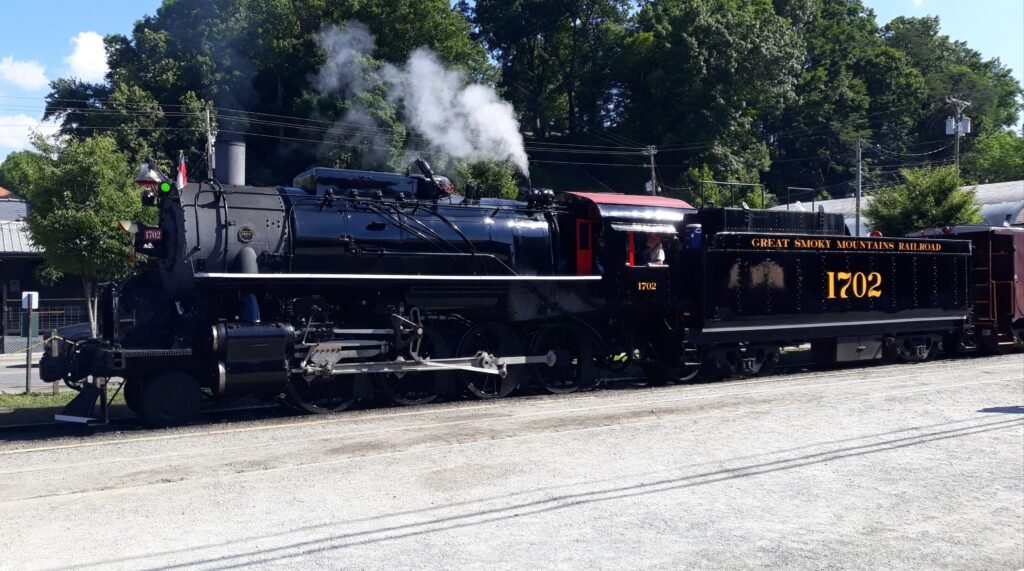
Operating on 53 miles of former Southern Railway track since 1988, the Great Smoky Mountains Railroad runs excursion trains through the scenic Nantahala Gorge, where the tracks run directly alongside the whitewater Nantahala River far below the gorge’s steep, densely forested walls. This specific stretch offers views genuinely inaccessible from the nearby parallel road, which runs at a different elevation and angle relative to the gorge, giving train passengers a distinct visual perspective on the same landscape. The railroad carries roughly 200,000 passengers annually, making it genuinely one of the most popular tourist railroads in the entire country, a reputation built specifically on routes like this one.
Bryson City, North Carolina, with routes departing toward Nantahala and Dillsboro. Ticket pricing varies by route and car class. Best in mid-October for peak Southern Appalachian foliage color.
Historic Rail Equipment
The railroad operates a mix of vintage diesel and occasionally steam-era equipment, some of which has appeared in film and television productions over the decades, adding a genuine sense of railroading history to the ride beyond the foliage views themselves. The restored passenger cars, some open-air for unobstructed photography, give visitors a choice between covered comfort and a fully immersive outdoor viewing experience, and several of the coaches date back to the mid-20th century, carefully maintained rather than replaced with modern equipment.
Bryson City, North Carolina. Open-air and climate-controlled car options typically available; check current offerings. Best for train enthusiasts wanting genuine historic equipment alongside the scenery.
Cass Scenic Railroad, West Virginia
A former logging railroad turned state park attraction, climbing genuinely steep mountain grades behind historic steam locomotives.
Steam Locomotives on Steep Grades
Cass Scenic Railroad State Park operates authentic geared steam locomotives, including several Shay-type engines originally designed for steep, curvy logging railroads rather than standard mainline track, giving the ride a genuinely different mechanical character from a typical scenic railroad. The park is genuinely home to the oldest operational Shay locomotive in existence, purchased in 1905 by the West Virginia Pulp and Paper Company, a piece of genuine working railroad history that predates the state park itself by over half a century. The entire complex, including the original historic company town of Cass, was added to the National Register of Historic Places in 1974, preserving not just the railroad itself but the surrounding logging community it once served.
Cass, West Virginia, in Pocahontas County. Ticket pricing varies by route length. Best in early-to-mid October for Allegheny Mountains foliage at the area’s higher elevations.
Allegheny Mountain Views
The railroad climbs to Bald Knob, one of the highest points in West Virginia, offering sweeping views over the Allegheny Mountains that most visitors driving through the region on nearby roads never see, since the summit itself is reachable only by the train or a considerably longer hike. The climb to Bald Knob is genuinely steep by railroad standards, which is precisely why the park still relies on the same geared Shay and Heisler locomotive designs originally built for exactly this kind of terrain, rather than switching to more conventional modern equipment.
Cass Scenic Railroad State Park, West Virginia. Longer routes to Bald Knob available seasonally; check current schedule. Best on the longer route specifically for the Bald Knob summit views.
Adirondack Scenic Railroad, New York
A volunteer-run heritage railway offering a genuinely quiet, lake-and-forest version of Adirondack Park fall foliage.
Through the Heart of Adirondack Park
Operated by the nonprofit Adirondack Railroad Preservation Society along former New York Central Railroad trackage, the Adirondack Scenic Railroad runs through Adirondack Park along a route roughly following the Moose River, passing through dense forest and past several lakes largely inaccessible by road from the train’s specific vantage point. The line’s history stretches back to the Mohawk and Malone Railway, later absorbed by the New York Central, and its 1980 revival for the Lake Placid Winter Olympics briefly gave the route a moment of genuine national attention before commercial service ultimately ended and the current heritage operation took over.
Utica to Thendara/Old Forge, New York, with seasonal extensions further north. Ticket pricing varies by route. Best in late September to early October, when Adirondack foliage tends to peak earlier than points further south.

A Genuine Volunteer-Run Operation
Unlike some larger commercial scenic railroads, the Adirondack Scenic Railroad is run largely by volunteers through a dedicated preservation society, giving the operation a genuinely community-driven character and a level of enthusiast knowledge among train crew that a more purely commercial operation sometimes lacks. Many volunteers have spent years or even decades restoring specific pieces of equipment, and conversations with crew members often reveal a depth of railroad history knowledge that goes well beyond a standard scripted tour narration.
Utica, New York area. Ticket pricing varies by route and season. Best for visitors who appreciate a more grassroots, less commercially polished rail experience.

Conway Scenic Railroad, New Hampshire
A well-established White Mountains route offering some of New England’s most reliable fall foliage color from the comfort of a restored train car.
The Notch Train Through Crawford Notch
The Conway Scenic Railroad’s Notch Train travels through Crawford Notch, a dramatic mountain pass in the White Mountains, crossing the historic Frankenstein Trestle and Willey Brook Bridge along a route originally built in the 1870s to serve the area’s booming grand-hotel tourism era. The trestle crossings in particular offer a genuinely vertigo-inducing perspective on the surrounding valley that most visitors driving the parallel highway through the notch never experience from quite the same angle. The Frankenstein Trestle itself, named for a local artist rather than the fictional monster, spans a deep ravine at a height that gives passengers an unusually direct view straight down into the forest canopy below.
North Conway, New Hampshire. Ticket pricing varies by route and car class. Best in early-to-mid October for peak White Mountains foliage.
A Historic Depot and Restored Equipment
The railroad’s North Conway station itself, a well-preserved Victorian-era depot, has been in continuous use since 1874, giving the departure point as much historical character as the ride itself. Restored vintage rail cars, some with dome-style windows for expanded overhead views of the surrounding mountains, are available on select routes for visitors wanting the fullest possible view of the foliage overhead as well as at eye level. The depot’s gingerbread-trimmed Victorian architecture has made it a popular photography subject in its own right, independent of the trains that still depart from its platform daily during the fall season.
North Conway, New Hampshire. Dome car and first-class options available at a premium; check current offerings. Best for visitors wanting the most expansive possible viewing angles.
What Makes a Train Better Than a Road Trip for Foliage
A train ride removes the fundamental tension of a foliage road trip entirely: someone always has to drive, and that person spends a meaningful portion of the trip watching the road rather than the scenery unfolding outside. On a train, every passenger gets the same uninterrupted view for the entire ride, a genuinely significant advantage for a foliage-focused trip specifically. Trains also access terrain a parallel road often simply can’t: gorges, narrow mountain grades, and lakeside stretches where a rail line was historically built along a route no road ever followed, since railroads and roads were frequently engineered to solve different problems even when covering similar ground.
Historic rail equipment adds a layer most road trips simply can’t replicate at all: a genuine, well-maintained steam or vintage diesel locomotive is itself a piece of history worth experiencing, turning the journey into an attraction in its own right rather than simply a means of reaching a scenic overlook. A road trip’s scenic value effectively ends the moment you arrive at an overlook and get back in the car; a train ride’s scenic value stays continuous for the entire duration, without the stop-and-go rhythm that defines most driving-based foliage tours.
There’s also a genuine accessibility advantage worth naming directly: train travel removes the physical demands of driving unfamiliar mountain roads, which can be a real concern for older travelers or anyone uncomfortable with winding, narrow routes, while still delivering comparable or superior scenery to the drive itself, all without the fatigue that a full day of mountain driving can bring.
Timing Your Trip to Peak Foliage
Foliage timing varies meaningfully by elevation and latitude across the routes in this guide. The Great Smoky Mountains Railroad and Cass Scenic Railroad, both at relatively similar Southern and Central Appalachian latitudes, tend to peak in mid-October, though higher-elevation sections of each route can turn slightly earlier than lower valley sections on the same line. The Conway Scenic Railroad in New Hampshire’s White Mountains generally peaks in a similar early-to-mid-October window, given its comparable elevation and latitude to the Appalachian routes further south. The Adirondack Scenic Railroad, given its more northern latitude, typically peaks earlier, often in the last week of September through the first week of October.
Each railroad typically publishes its own foliage tracking or seasonal advisory closer to the actual season, and checking that specific resource, rather than relying on a general regional foliage map not tailored to the exact route and elevation, gives a more accurate picture of when to book a specific date. Weekday rides, where schedules allow, also tend to offer a calmer, less crowded viewing experience than weekend departures during the height of peak color, when demand for these routes climbs sharply across all four railroads covered in this guide, sometimes filling entire cars weeks before the actual departure date.
If this guide helped you plan a fall trip, subscribe to Worldly Traveler on YouTube for more hidden gems guides from around the world.
Getting the Best Photos and What to Bring
Open-air or gondola-style cars offer the best photography opportunities, though seating on these cars is often limited and worth requesting or booking specifically in advance rather than assuming availability on arrival. A lens with at least a modest zoom range helps capture distant ridgelines and gorge walls that a standard smartphone camera can genuinely struggle to render with much depth or detail from a moving train, and a polarizing filter, for photographers using a dedicated camera, can meaningfully cut glare off wet leaves and river water on a bright fall day.
Dressing in genuine layers matters more on a scenic train than it might seem at first, since open-air cars and covered cars can differ significantly in temperature, and many routes climb noticeably in elevation over the course of the ride, meaning conditions at the destination or summit can be noticeably cooler than at the departure station. Packing a light jacket even on a mild fall day, and bringing along plenty of water and a snack for longer routes that run several hours round trip, rounds out a genuinely comfortable ride from start to finish.
Understanding Ticket Classes
Most scenic railroads offer several tiers of seating, typically ranging from standard coach seating to premium options like first-class cars with table service or open-air gondola cars with unobstructed views, and the specific mix of options varies meaningfully from one railroad to the next. The price difference between tiers is often quite modest relative to the overall trip cost, and for a foliage-focused ride specifically, upgrading to whichever tier offers the best sightlines is usually worth the extra cost, since the scenery itself is the entire point of the trip. Some railroads also offer combination packages that pair the train ride with a meal, a local attraction, or a return option via a different route, which can add genuine value for a full-day outing without requiring much additional planning effort on the traveler’s part.
Frequently Asked Questions
What is the best month for fall foliage train rides?
October is generally the strongest month across the routes in this guide, though exact peak timing varies by elevation and latitude: the Smokies and West Virginia and New Hampshire mountains typically peak in mid-October, while the Adirondacks often peak slightly earlier, in late September to early October.
Do these trains run in bad weather?
Most scenic railroads operate in light rain and normal fall weather, since covered or enclosed passenger cars are typically available, but severe weather can occasionally lead to delays or cancellations. Checking each railroad’s current weather policy before a trip, especially one built around open-air viewing, is worth doing in the days leading up to departure.
Are these rides suitable for young kids?
Yes, generally — scenic train rides are a low-effort, low-risk activity well suited to young children, since there’s no hiking or physical exertion involved, though the ride duration (several hours for some routes) is worth considering for children with shorter attention spans, and bringing a small activity or snack for the ride can help with longer routes.
How far in advance should you book fall foliage train tickets?
Peak foliage weekends, particularly in October, sell out weeks in advance at all of the railroads covered here, so booking as soon as a specific date is decided, rather than waiting until close to the trip, is strongly recommended, especially for open-air or dome car seating that tends to sell out first.
Which route has the most dramatic scenery?
The Great Smoky Mountains Railroad’s route through the Nantahala Gorge is often considered the most dramatic of the group, given the gorge’s steep walls and the railroad’s position directly alongside the whitewater river below, though the Cass Scenic Railroad’s steep mountain-grade climb and the Conway Scenic Railroad’s trestle crossings each offer their own genuinely striking, and quite different, perspectives.