
Sicily is genuinely its own world within Italy — a Mediterranean island shaped by Greek, Roman, Arab, Norman, and Spanish rule, layering millennia of architecture, food, and language onto a single dramatic landscape of volcanic mountains, white cliffs, and ancient ruins. This guide covers Sicily’s best hidden gems, drawing on a real video guide and independent research, organized by region so you can build a route through whichever corner of the island draws you.
Few places in the Mediterranean carry quite so many distinct civilizations in their visible architecture as Sicily does. Greek colonists built some of the largest temples in the ancient world here, later rulers included Carthaginians, Romans, Byzantines, Arabs, and Normans, and each left behind a genuinely tangible layer — Greek temples still standing at Agrigento and Segesta, Arab-influenced citrus groves and cuisine across the island, and Norman cathedrals in Palermo and Monreale covered in Byzantine gold mosaics. That density of layered history, combined with the island’s dramatic volcanic and coastal geography, is exactly why Sicily rewards slow, regionally organized exploration rather than a rushed highlight-reel visit.
Palermo & the Northwest
Taormina & the East Coast
Syracuse & the Southeast
Agrigento & the Valley of the Temples
The Aeolian Islands
Sicilian Food Worth Seeking Out
Getting Around Sicily
Best Time to Visit Sicily
FAQ
Palermo & the Northwest
Sicily’s capital region holds a genuinely dense concentration of Norman, Arab, and Baroque architecture, alongside dramatic protected coastline just outside the city.
Riserva Naturale dello Zingaro
Sicily’s first nature reserve, established in 1981 after a grassroots protest prevented a coastal road from being built through the area, preserving roughly seven kilometers of undeveloped coastline with turquoise coves accessible only by hiking trail — a genuinely rare stretch of pristine Sicilian coast.
Northwest coast, between San Vito Lo Capo and Scopello. Entry fee. Best in late spring or early autumn for comfortable hiking temperatures and swimmable coves.
Palermo’s Norman-Arab Architecture
Palermo’s historic center holds a UNESCO World Heritage collection of Norman-era buildings blending Byzantine, Islamic, and Latin architectural traditions, including the Palermo Cathedral and the Palatine Chapel, whose golden mosaic ceiling remains one of the most striking interiors in all of Sicily.
Palermo historic center. Entry fees vary by site. Best combined with a walk through the Ballarò or Vucciria street markets.
Mercato di Ballarò
One of Palermo’s oldest and most vibrant street markets, tracing its origins back over a thousand years to Arab-era trading, offering a genuinely immersive sensory introduction to Sicilian daily life, food, and dialect.
Palermo historic center. Free to browse. Best in the morning when the market is at its most active.
Monreale Cathedral
A Norman cathedral just outside Palermo, its interior covered almost entirely in shimmering gold Byzantine mosaics depicting biblical scenes across roughly 6,300 square meters — widely considered one of the greatest surviving examples of Norman architecture anywhere in the world.
Monreale, near Palermo. Entry fee. Best combined with a Palermo day trip, given the short distance.
Segesta
An extraordinarily well-preserved ancient Greek temple standing alone on a hillside, notable for having never been completed (its columns were never fluted, and no roof was ever built), offering a genuinely striking, almost ghostly silhouette against the surrounding countryside.
Near Calatafimi, western Sicily. Entry fee. Best combined with a visit to the site’s ancient theater, still used for performances today.
Taormina & the East Coast
Sicily’s east coast pairs dramatic clifftop towns with the island’s most iconic natural landmark — Mount Etna.
Savoca
A remarkably preserved medieval hill town in the Messina province, made internationally famous as a filming location for “The Godfather,” with the Bar Vitelli still operating as a genuine pilgrimage stop for film fans alongside the town’s own considerable medieval charm.
Messina province, near Taormina. Free to explore. Best combined with a Taormina day trip given the short drive.
Mount Etna
Europe’s tallest and most active volcano, still regularly erupting and reshaping its own summit, offering guided hikes across genuinely otherworldly lava fields alongside cable car access for visitors not attempting the full summit trek.
Near Catania and Taormina. Park entry fee; cable car and guided summit tours priced separately. Best checking current volcanic activity status before planning a summit attempt.

Taormina’s Ancient Theater
A stunningly positioned Greek (later Roman-rebuilt) theater with Mount Etna visible directly behind the stage, still hosting concerts and performances today — genuinely one of the most dramatically located ancient theaters anywhere in the Mediterranean.
Taormina. Entry fee. Best at sunset for the theater’s lighting and Etna backdrop.

Isola Bella
A small nature reserve island just off Taormina’s coast, connected to the mainland by a narrow sandy isthmus that appears and disappears with tidal and seasonal conditions, offering excellent snorkeling in the surrounding marine reserve.
Near Taormina. Reserve entry fee. Best at low tide for the fullest isthmus crossing.
Syracuse & the Southeast
Southeastern Sicily holds some of the island’s most significant ancient ruins alongside dramatic natural canyons.
Cava Grande del Cassibile
A dramatic limestone canyon carved by the Cassibile River, with a series of natural swimming pools reached by a genuinely demanding descent, offering some of the best wild swimming on the entire island away from any coastal crowds.
Near Avola, southeastern Sicily. Free; reserve entry may apply seasonally. Best in late spring for comfortable hiking temperatures before peak summer heat.

Noto Antica
The abandoned original site of the town of Noto, destroyed by a catastrophic 1693 earthquake that devastated much of southeastern Sicily — rather than rebuilding on the same spot, survivors relocated and built a new Noto nearby, leaving these atmospheric ruins largely reclaimed by forest.
Near Noto, southeastern Sicily. Free. Best combined with a visit to the rebuilt, Baroque “new” Noto, one of Sicily’s most celebrated post-earthquake towns.
Pantalica Necropolis
A UNESCO World Heritage archaeological site holding more than 5,000 rock-cut tombs carved into limestone cliffs, dating back roughly 3,000 years to the pre-Greek Sicilian civilizations that once inhabited the island, set within a dramatic river canyon.
Near Syracuse, southeastern Sicily. Free. Best combined with hiking trails through the surrounding Anapo Valley nature reserve.
Syracuse’s Ortigia Island
The historic core of ancient Syracuse, once one of the most powerful cities in the ancient Mediterranean world, packed onto a small island connected to the mainland by a short bridge, with a genuinely dense concentration of Greek, Roman, and Baroque architecture.
Syracuse. Free to explore; individual site entry fees vary. Best combined with the nearby Neapolis Archaeological Park, home to a massive Greek theater and the famous “Ear of Dionysius” cave.
Agrigento & the Valley of the Temples
Sicily’s southern coast holds both the island’s most important ancient Greek site and one of its most photographed natural formations.
Scala dei Turchi
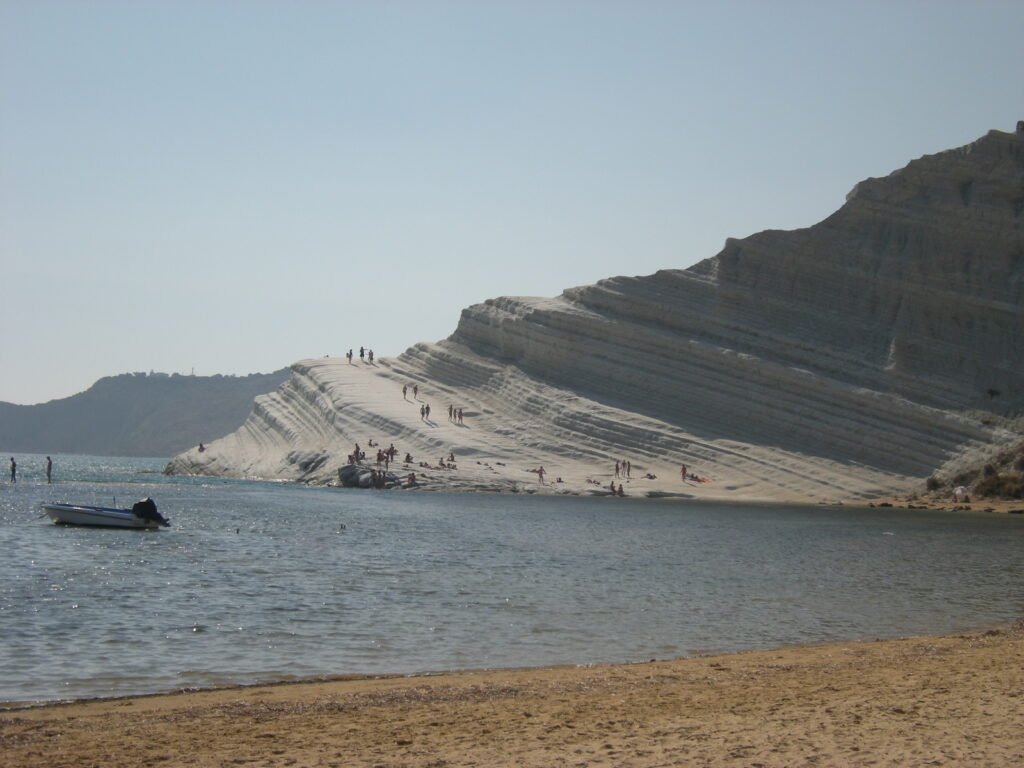
A dramatic staircase-like cliff formation of brilliant white marl (a soft sedimentary rock), its name (“Stairs of the Turks”) referencing historical Ottoman raids that once used the cove for landing — the smooth, layered white steps descending to turquoise water make it one of the most photographed natural sites in Sicily. The cliff’s soft rock erodes continuously, meaning its exact shape has visibly shifted even within living memory.
Realmonte, near Agrigento. Free. Best in the early morning or late afternoon to avoid both midday heat and peak crowds.
Valley of the Temples
A UNESCO World Heritage archaeological park holding the ruins of ancient Akragas, once one of the wealthiest cities in the ancient Greek world, with the Temple of Concordia standing as one of the best-preserved Doric temples anywhere on Earth thanks to its conversion into a Christian church during the Middle Ages, which spared it from the deliberate destruction and stone-scavenging that reduced many other ancient temples to rubble.
Agrigento. Entry fee. Best in the early morning or at sunset, both for lighting and to avoid the midday heat across the park’s largely shadeless grounds.

Castello di Donnafugata
A romantic 19th-century castle blending Venetian Gothic, Baroque, and Neo-Gothic architectural styles, surrounded by an elaborate garden featuring a genuine stone hedge maze — the castle also served as a filming location for the TV series “Inspector Montalbano.”
Near Ragusa, southeastern Sicily. Entry fee. Best combined with a Ragusa old town visit given regional proximity.
Montalbano Elicona
A striking medieval hill town crowned by a well-preserved Norman-Swabian castle, officially recognized as one of “Italy’s Most Beautiful Villages” (Borghi più belli d’Italia), with narrow stone streets that wind dramatically up the hillside.
Messina province, inland Sicily. Free to explore town; castle entry fee. Best combined with a broader inland Sicily driving loop.
Tindari
A dramatic clifftop sanctuary overlooking the Tyrrhenian Sea, home to a revered “Black Madonna” statue and offering sweeping views down to the Marinello Nature Reserve’s unusual, ever-shifting sand lagoons below.
Near Patti, northern Sicily coast. Free entry to the sanctuary. Best combined with a Marinello lagoons beach visit at the base of the cliff.
Grotta Mangiapane
A genuinely unique cave village built directly into a natural rock shelter, inhabited until the mid-20th century and now preserved as an open-air museum, complete with a small reconstructed chapel and traditional stone dwellings.
Custonaci, northwestern Sicily. Small entry fee. Best combined with a broader Custonaci/San Vito Lo Capo coastal day.
The Aeolian Islands
Just off Sicily’s northern coast, this volcanic archipelago offers some of the most dramatic scenery in the entire Mediterranean.
Stromboli
One of the most consistently active volcanoes on Earth, producing small, rhythmic eruptions visible from boats after dark — genuinely one of the few places in the world where witnessing live volcanic activity is a reliable, regularly bookable tourist experience.
Aeolian Islands. Guided hike or boat tour fees apply. Best on an evening boat tour for the clearest view of the nighttime eruptions.
.jpg)
Vulcano’s Mud Baths
A genuinely unusual island experience — natural sulfurous mud pools formed by volcanic activity, believed for centuries to have therapeutic properties, located a short walk from the island’s main port.
Vulcano, Aeolian Islands. Small entry fee. Best combined with a hike up the island’s active crater rim.
Lipari
The largest and most developed of the Aeolian Islands, serving as the archipelago’s main hub, with a well-preserved historic castle and a genuinely excellent archaeological museum documenting the islands’ millennia of volcanic and human history.
Aeolian Islands. Free to explore town; museum entry fee. Best as a base for exploring the other, smaller Aeolian Islands.
Sicilian Food Worth Seeking Out
Sicilian cuisine reflects the island’s layered history more than almost any other regional Italian food tradition — Arab-introduced ingredients like citrus, saffron, and sugar blend with Greek, Spanish, and mainland Italian influences into something genuinely distinct. Arancini, fried rice balls typically filled with ragù, cheese, or pistachio, remain the island’s essential street food, with genuine regional debate over the “correct” shape (round in Palermo, conical in Catania). Cannoli, filled fresh to order rather than pre-filled, taste meaningfully different from the mass-produced versions found elsewhere — seek out a genuine pasticceria rather than a tourist-facing café. Pasta alla Norma, combining eggplant, tomato, ricotta salata, and basil, originated in Catania and remains one of the island’s most beloved dishes. Sicilian granita, a semi-frozen dessert distinct from mainland Italian gelato, is traditionally eaten for breakfast alongside a soft brioche bun, especially in the summer heat.
Getting Around Sicily
Rental car: Genuinely recommended for exploring most of this guide’s hidden gems, since public transportation connects major cities reasonably well but rarely reaches smaller villages, nature reserves, or rural archaeological sites like Pantalica or Segesta.
Trains and buses: Trenitalia trains and regional bus networks connect Sicily’s major cities (Palermo, Catania, Syracuse, Messina) reasonably well, making a city-focused itinerary without a car genuinely feasible.
Ferries to the Aeolian Islands: Ferries and faster hydrofoils depart primarily from Milazzo on Sicily’s northern coast, with additional seasonal connections from Messina and even Naples on the mainland.
Driving conditions: Rural and mountain roads can be narrow and winding, particularly around Mount Etna and inland hill towns — comfortable, unhurried driving matters more here than in most of mainland Italy’s more developed road network.
Best Time to Visit Sicily
April through June and September through October offer the most comfortable temperatures and noticeably thinner crowds than peak July-August, when both heat and tourist numbers climb significantly, especially along the coast and at major sites like the Valley of the Temples and Taormina’s ancient theater. Summer remains the best window for the Aeolian Islands and swimming-focused stops like Cava Grande del Cassibile and Zingaro’s coves, despite the crowds, simply because water temperatures and ferry schedules are both at their best. Winter stays mild by broader European standards, and Mount Etna occasionally receives enough snow for a short local ski season, offering a genuinely different side of the island for off-season visitors.
I cover 10 real hidden gems from this guide in the video above, with additional research woven throughout. If this guide helped you plan your Sicily trip, subscribe to Worldly Traveler on YouTube for more travel guides from around the world.
Frequently Asked Questions
What are the best hidden gems in Sicily?
Some of the best hidden gems in Sicily include Scala dei Turchi’s white cliffs, the medieval village of Savoca, the Zingaro Nature Reserve, Cava Grande del Cassibile canyon, and the abandoned town of Noto Antica, all offering a side of the island beyond Palermo and Taormina.
How many days do you need in Sicily?
10-14 days allows a well-paced loop covering Palermo, Taormina and Mount Etna, Syracuse, and Agrigento’s Valley of the Temples. A shorter 7-day trip can focus on just the eastern or western half of the island.
What is the best time of year to visit Sicily?
April-June and September-October offer the most comfortable temperatures and thinner crowds than peak July-August, when heat and tourist numbers both climb significantly, especially along the coast.
Do you need a car to get around Sicily?
A rental car is genuinely recommended for exploring most of Sicily’s hidden gems, since public transportation connects major cities reasonably well but rarely reaches smaller villages, nature reserves, and rural archaeological sites.
How do you get to the Aeolian Islands from Sicily?
Ferries and hydrofoils to the Aeolian Islands depart primarily from Milazzo on Sicily’s northern coast, with additional seasonal connections from Messina and Naples.