
Rome, Florence, and Venice anchor most first-time Italy itineraries, and each genuinely deserves its fame — but Italy holds over 5,000 comuni (municipalities), the overwhelming majority of them small towns and villages that most international visitors never see. This guide covers more than 20 hidden medieval villages in Italy, verified against a real video guide, organized by region so you can build a route through whichever part of the country’s small-town landscape genuinely calls to you.
Italy’s village culture reflects a genuinely different scale of history than its famous cities — while Rome and Florence built empires and Renaissance dynasties, villages like the ones in this guide preserved something more intimate: centuries of continuous daily life largely undisturbed by the sweep of national history. Many of these towns predate Italian unification itself by nearly a thousand years, having developed their own distinct dialects, festivals, and architectural quirks in relative isolation before modern roads and railways connected them to the rest of the country. That isolation, once a genuine hardship, is exactly what preserved the atmosphere that now makes them worth seeking out.
Geography shaped this village-scale history as much as any single historical event — Italy’s mountainous spine, the Apennines, made overland travel between many of these communities genuinely difficult well into the 20th century, meaning towns just a few valleys apart could develop noticeably different dialects, festivals, and even culinary traditions. That fragmentation, visible today in the sheer regional diversity of Italian cuisine and local custom, is a big part of what makes village-hopping across different regions so rewarding: each stop genuinely feels like a distinct place rather than a variation on a single national theme.
Central Italy
Northern Italy
Southern Italy & the Islands
What Makes a Borgo?
Italian Village Food Worth Seeking Out
Best Time to Visit Italy’s Villages
FAQ
Central Italy
Beyond the Tuscany and Umbria hill towns already well documented, Central Italy holds genuinely lesser-known villages worth the detour.
Civita di Bagnoregio
Nicknamed “the dying town,” this astonishing hilltop settlement sits atop an eroding volcanic outcrop on the Umbria-Lazio border, accessible only via a long pedestrian bridge — covered in more depth in this site’s dedicated Umbria guide, given its proximity to Orvieto.
Lazio, near the Umbria border. Small entry fee. Best at sunset for the town’s dramatic silhouette.
Brisighella
A genuinely picturesque village built around three distinctive rock formations, each topped with its own landmark — a medieval fortress, a sanctuary, and a clock tower — with the town’s old street, the Via degli Asini, uniquely built as a covered elevated passage originally used by donkeys transporting local gypsum.
Emilia-Romagna. Free to explore. Best in late spring for comfortable walking temperatures along the elevated passage.
Dozza
A genuinely unique open-air art gallery of a town, its medieval walls and building facades entirely covered in murals painted by artists invited to the Muro Dipinto (“painted wall”) festival held here since 1960, transforming the entire village into a rotating, continuously updated art installation.
Emilia-Romagna. Free to explore. Best checking the current mural cycle, since works are periodically repainted during the biennial festival.
Montefioralle
A genuinely tiny, circular fortified village in the heart of Chianti wine country, its concentric medieval street plan still fully intact, offering a quiet, largely undiscovered alternative to the more heavily visited Chianti hill towns nearby.
Tuscany, Chianti region. Free to explore. Best combined with a broader Chianti wine tasting route given its central location.
Pienza & Pitigliano
Both covered in depth in this site’s dedicated Tuscany guide, these Renaissance and cliffside towns remain genuinely worth the visit — Pienza for its perfectly planned Renaissance “ideal city” design, Pitigliano for its dramatic tufa-cliff setting and centuries-old Jewish heritage.
Southern Tuscany. See the site’s Tuscany Hidden Gems guide for full details on both towns.
Santo Stefano di Sessanio
A genuinely remarkable stone village in the Abruzzo mountains, largely restored after being nearly abandoned in the late 20th century, its distinctive golden-stone architecture and slow-food tradition (particularly Sessanio lentils) drawing a small but genuine wave of renewed local interest and investment.
Abruzzo, Gran Sasso e Monti della Laga National Park. Free to explore. Best combined with a broader Gran Sasso mountain drive given the surrounding scenery.
Scanno
A genuinely atmospheric mountain village in Abruzzo, its labyrinthine medieval streets historically home to a distinctive traditional women’s costume still occasionally worn during local festivals, alongside a heart-shaped lake just outside town that draws its own dedicated visitors.
Abruzzo. Free to explore. Best combined with a Lago di Scanno visit given the short distance.
Sperlonga
A genuinely striking whitewashed coastal town on the Lazio coast, its narrow, sun-bleached streets tumbling down toward the sea, holding a significant Roman archaeological site — a grotto once used as Emperor Tiberius’s seaside villa, discovered to contain remarkable classical sculpture.
Lazio coast, south of Rome. Free to explore town; Roman villa/museum entry fee. Best in shoulder season for comfortable beach town exploration without peak summer crowds.
Corinaldo
A remarkably intact walled town in the Marche region, its complete circuit of medieval walls and towers among the best preserved in Central Italy, home to a genuinely unusual annual festival, the Contesa del Pozzo della Polenta, involving a competitive well-climbing race with historical roots.
Marche. Free to explore. Best in the summer months during the town’s various historical festivals.
San Leo
A genuinely dramatic fortress town in the Marche/Emilia-Romagna border region, its clifftop setting so striking it inspired Dante’s description of Purgatory — the imposing fortress here also once imprisoned the notorious 18th-century occultist and confidence man Alessandro Cagliostro until his death.
Marche/Emilia-Romagna border. Free to explore town; fortress entry fee. Best at sunset for the fortress’s dramatic silhouette against the surrounding valley.
Northern Italy
Northern Italy’s lakes and coastline hold genuinely romantic small towns beyond the well-trodden Lake Como circuit.
Varenna
A genuinely romantic Lake Como village, its pastel houses and narrow lakeside promenade offering a quieter, more intimate alternative to Como’s larger, more commercially developed towns, with a genuinely excellent direct train connection from Milan making it an easy day trip.
Lake Como, Lombardy. Free to explore. Best combined with a ferry ride across the lake to Bellagio given the short crossing.
Orta San Giulio
A genuinely dreamlike lakeside village on the shores of the lesser-known Lake Orta, its tiny namesake island, Isola San Giulio, home to a basilica and a monastery still following a vow of silence, reachable via a short, peaceful boat crossing.
Lake Orta, Piedmont. Free to explore; boat fare to island. Best at sunset for views back across the lake from the island.
Malcesine
A genuinely striking Lake Garda town, its medieval castle rising directly above the water, connected by cable car to Monte Baldo, whose summit offers panoramic views over the entire lake and, on the clearest days, toward the Dolomites in the distance.
Lake Garda, Veneto. Free to explore town; castle and cable car fees separate. Best combined with the Monte Baldo cable car for the fullest lake panorama.
Apricale
A genuinely artistic hill village near the French border, its medieval stone streets home to a working open-air theater and numerous small ateliers, having drawn a small but genuine community of resident artists and writers over recent decades.
Liguria, near the French border. Free to explore. Best on a summer evening when the village’s open-air theater hosts performances.
Cervo
A genuinely elegant Ligurian coastal village, its steep stone streets rising above the Riviera dei Fiori, home each summer to a well-regarded chamber music festival held in the town’s striking Baroque church square.
Liguria, Riviera dei Fiori. Free to explore. Best in July-August during the Cervo International Chamber Music Festival, if timing allows.
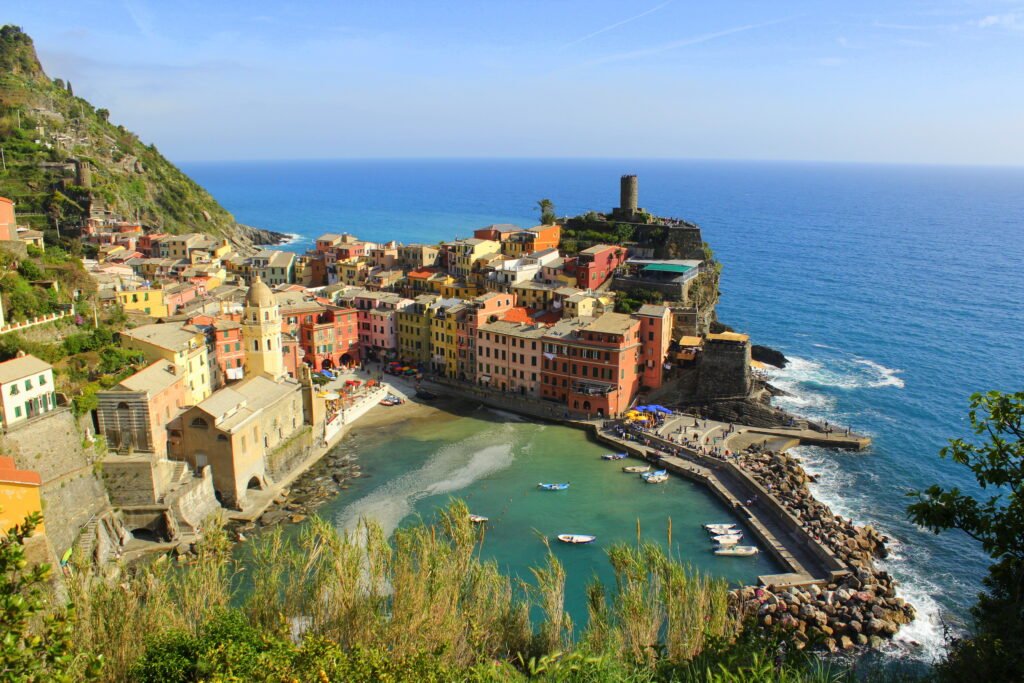
Vernazza
Widely considered the most photogenic of the five Cinque Terre villages, its small natural harbor and colorful tower houses climbing directly from the water offering the classic postcard image most associated with this entire stretch of Ligurian coastline.
Cinque Terre, Liguria. Free to explore; national park entry fee applies to trail access. Best hiking in from a neighboring village rather than arriving purely by train, for a fuller sense of the coastline.

Southern Italy & the Islands
Southern Italy holds this guide’s most dramatic mountain and coastal settings, largely overlooked by international visitors focused on Rome and the Amalfi Coast.
Castelmezzano
A genuinely astonishing village perched among the jagged rock spires of the Lucanian Dolomites, its buildings seeming to grow directly out of the mountainside — the town is also home to the “Volo dell’Angelo” (Flight of the Angel), a thrilling zipline strung across the valley to the neighboring village of Pietrapertosa, letting visitors fly at high speed between two mountaintop settlements.
Basilicata. Free to explore town; zipline fee separate. Best in good weather given the zipline’s genuine weather-dependent operation.
Locorotondo
A genuinely striking circular town in Puglia’s trulli country, its name literally meaning “round place,” referencing the concentric layout of its whitewashed historic center — the surrounding countryside holds numerous authentic trulli, the region’s distinctive conical-roofed limestone dwellings.
Puglia. Free to explore. Best combined with a broader Valle d’Itria trulli countryside drive.
Castiglione di Sicilia
A genuinely dramatic hill town on the slopes of Mount Etna, its position within Sicily’s most significant volcanic wine-growing region making it a genuine center for Etna DOC wine, produced from vines grown in mineral-rich volcanic soil found nowhere else in the world.
Sicily, Mount Etna region. Free to explore town; wine tasting fees vary. Best combined with an Etna wine tasting given the town’s central role in the appellation.
Bosa
A genuinely vivid Sardinian river town, its pastel-colored houses climbing a hillside above the Temo River, one of the few navigable rivers in Sardinia, with a well-preserved medieval castle overlooking the entire colorful settlement from above.
Sardinia. Free to explore. Best at golden hour for the pastel houses’ most vivid color against the evening light.
What Makes a Borgo?
Many of the villages in this guide carry the official designation “I Borghi più belli d’Italia” (“The most beautiful villages of Italy”), a certification founded in 2001 by the National Association of Italian Municipalities specifically to recognize and support small historic towns at genuine risk of depopulation and cultural loss. To earn the designation, a village must meet specific criteria around historical architectural integrity, harmonious urban planning, and a genuine commitment to preservation — essentially a formal quality mark distinguishing towns with authentically preserved historic character from those that have lost it to unchecked modern development. The association now includes several hundred certified borghi across the country, and the designation has become a genuinely reliable signal for travelers seeking villages with real, protected historic substance rather than a superficially “quaint” appearance. Several of this guide’s featured villages, including Castelmezzano, hold this official certification, a detail worth knowing when planning a broader borghi-focused Italy trip beyond this single guide.
Italian Village Food Worth Seeking Out
Italy’s village food culture remains genuinely regional in a way the country’s more internationalized city restaurants sometimes lose — Santo Stefano di Sessanio’s distinctive small lentils, Emilia-Romagna’s rich culinary tradition around Brisighella and Dozza, and Puglia’s orecchiette and burrata around Locorotondo each reflect centuries of hyper-local agricultural and culinary development specific to that exact microregion. Sicily’s Etna wine country around Castiglione di Sicilia produces genuinely distinctive volcanic-soil wines worth seeking out specifically by their Etna DOC designation, a meaningfully different style from wines grown elsewhere on the island. Sardinia’s Bosa is known regionally for Malvasia di Bosa, a distinctive sweet wine tradition specific to this small stretch of coastline, alongside genuinely excellent fresh seafood drawn from the nearby coast. Seeking out a village’s specific local specialty — rather than defaulting to generalized “Italian food” — genuinely rewards travelers willing to ask locals directly what the town itself is known for, since these hyper-regional specialties rarely travel far beyond their village of origin.
Best Time to Visit Italy’s Villages
April through June and September through October offer the most comfortable temperatures and noticeably thinner crowds across most of Italy’s hidden villages, avoiding both summer’s heat and the peak tourist season that concentrates around the country’s major cities and coastal destinations. Coastal villages like Vernazza, Cervo, and Sperlonga see their most reliable swimming and beach weather in summer, though this also brings the year’s largest crowds to these specific towns. Mountain villages including Castelmezzano, Santo Stefano di Sessanio, and Scanno genuinely benefit from cooler summer temperatures relative to the Italian lowlands, making them a worthwhile escape during the hottest months, while several also offer a genuinely distinct, quieter winter atmosphere for travelers willing to trade warmth for solitude. Many village festivals — Dozza’s painted wall festival, Corinaldo’s historical competitions, Cervo’s chamber music series — run on specific annual schedules worth checking before finalizing travel dates, since timing a visit around one of these events genuinely transforms the experience of an otherwise quiet village.
I cover all of these villages in the video above. If this guide helped you plan your Italy trip, subscribe to Worldly Traveler on YouTube for more travel guides from around the world.
Frequently Asked Questions
What are the best hidden medieval villages in Italy?
Some of the best hidden medieval villages in Italy include Castelmezzano (perched dramatically in the Lucanian Dolomites), Dozza (its every wall covered in murals), Orta San Giulio, Apricale, and Santo Stefano di Sessanio, each offering a genuinely distinct slice of Italian small-town life.
What does “Borghi più belli d’Italia” mean?
“I Borghi più belli d’Italia” (“The most beautiful villages of Italy”) is an official association founded in 2001 that certifies small Italian towns meeting specific historical, architectural, and preservation criteria, functioning as a genuine quality mark for village tourism across the country.
How many days do you need to visit Italy’s hidden villages?
2-3 weeks allows a genuinely thorough multi-region village-hopping trip. A shorter 7-10 day trip works well focused on villages within a single region or two adjacent regions.
What is the best time of year to visit Italy’s villages?
April-June and September-October offer the most comfortable temperatures and manageable crowds across most of Italy’s hidden villages, avoiding both summer’s heat and the more crowded peak tourist season.
Do you need a car to visit Italy’s hidden villages?
Yes, genuinely, for the majority of them — while a handful (Vernazza, Varenna) are well served by train, most of Italy’s smaller hilltop and mountain villages require a rental car, since regional bus service to these communities is often limited or infrequent.