
Florence’s headline sights genuinely deserve their fame, the Uffizi’s Renaissance masterpieces, Brunelleschi’s dome, Michelangelo’s David, these aren’t overrated tourist traps, they’re some of the most significant art and architecture on Earth. But Florence’s compact size means the crowds concentrate hard around a handful of streets, while a short walk in almost any direction reveals a quieter, equally rewarding version of the city. This guide walks through Florence’s best hidden gems, organized by area, checked against real research into each location, with a look at how the city compares to its more sprawling southern rival, Rome.
The Duomo, Uffizi & Ponte Vecchio: Florence’s cathedral, its premier art museum, and the medieval bridge lined with jewelers remain genuinely essential for any first visit, this guide picks up from there and heads into the quieter corners most itineraries skip.
What’s easy to forget, given how thoroughly Florence’s reputation rests on the Renaissance, is that the city’s historic center covers barely more than a square mile, meaning the crowds around the Duomo and the Uffizi can feel genuinely overwhelming during peak season, even as entire neighborhoods just a few minutes’ walk away stay comparatively calm. Crossing the Arno river alone changes the character of a visit substantially, from the dense, monument-heavy streets most visitors never leave, into a district that still functions as a genuine, lived-in neighborhood rather than an open-air museum.
Florence’s Renaissance flowering, roughly the 14th through 16th centuries, was genuinely concentrated in an area small enough to walk across in twenty minutes, a fact that helps explain both why the city’s art and architecture feel so densely packed and why the crowds concentrate so heavily in that same compact zone today. The Medici family’s patronage, funding artists and architects across generations, shaped nearly every corner of the historic center, but that patronage extended into the Oltrarno too, the Pitti Palace itself became a Medici residence in the 16th century, and the family’s influence over garden design, church commissions, and civic architecture reached well beyond the handful of streets most tour groups actually cover. Understanding that broader Medici footprint genuinely helps explain why so much worthwhile history sits quietly outside the city’s most photographed few blocks.
The Oltrarno District
San Miniato al Monte
The Boboli Gardens’ Quiet Corners
The Rose Garden
Florence’s Living Craft Tradition
Florence vs. Rome: Pacing Your Trip
Florence Food Worth Seeking Out
FAQ
The Oltrarno District
South of the Arno, Florentines themselves call this area the Diladdarno, and it holds a genuinely different character from the more monument-dense streets north of the river, one built around daily life rather than sightseeing.
Via Maggio & the Artisan Workshops
Genuinely one of the best streets in Florence for finding working craft studios, restorers, and antique dealers, Via Maggio and the surrounding lanes of San Frediano and Santo Spirito hold real, functioning ateliers, leatherworkers, frame-makers, furniture restorers, many still practicing techniques passed down for generations, a stark contrast to the mass-produced souvenirs sold closer to the Ponte Vecchio. This tradition of skilled craftsmanship stretches back centuries in the Oltrarno specifically, since the district historically housed the artisans and tradespeople who supported the wealthier families living in the grander palazzi across the river, a working-class counterpart to the more aristocratic north bank that still shapes the neighborhood’s character today.
Oltrarno district, south of the Arno. Free to explore. Best in the late morning, when workshops are open and genuinely active rather than closed for a midday break.
Piazza Santo Spirito
A genuinely local piazza, its unfinished, plain facade on the Basilica di Santo Spirito, a Brunelleschi-designed church, deliberately understated compared to Florence’s more famous churches, the square around it fills each evening with residents rather than tour groups, its cafés and small market stalls offering a rare, authentic slice of daily Florentine life. A modest morning market selling fresh produce and local goods sets up here several days a week, worth timing a visit around if you want to see the piazza at its most genuinely community-driven, before the evening aperitivo crowd takes over.
Santo Spirito, Oltrarno district. Free. Best in the early evening, when the piazza fills with locals for aperitivo.

San Niccolò
Genuinely one of the quietest historic quarters in central Florence, this small district hemmed between the hills around San Miniato and the river holds a church documented since 1184, and its narrow streets, historically home to lower-class workers, have become a genuinely appealing, low-key alternative to the busier Oltrarno neighborhoods nearby. The district’s proximity to the river has also meant a long history of flood damage, including the catastrophic 1966 Arno flood that devastated much of Florence, a history worth knowing given how much restoration work across the city, San Niccolò included, traces directly back to recovery efforts from that single disastrous event, one that also spurred a genuine international volunteer effort still remembered fondly by many Florentines today.
San Niccolò, Oltrarno district. Free to explore. Best combined with the walk up toward San Miniato al Monte, given the neighborhood’s position directly below the hill.
San Miniato al Monte
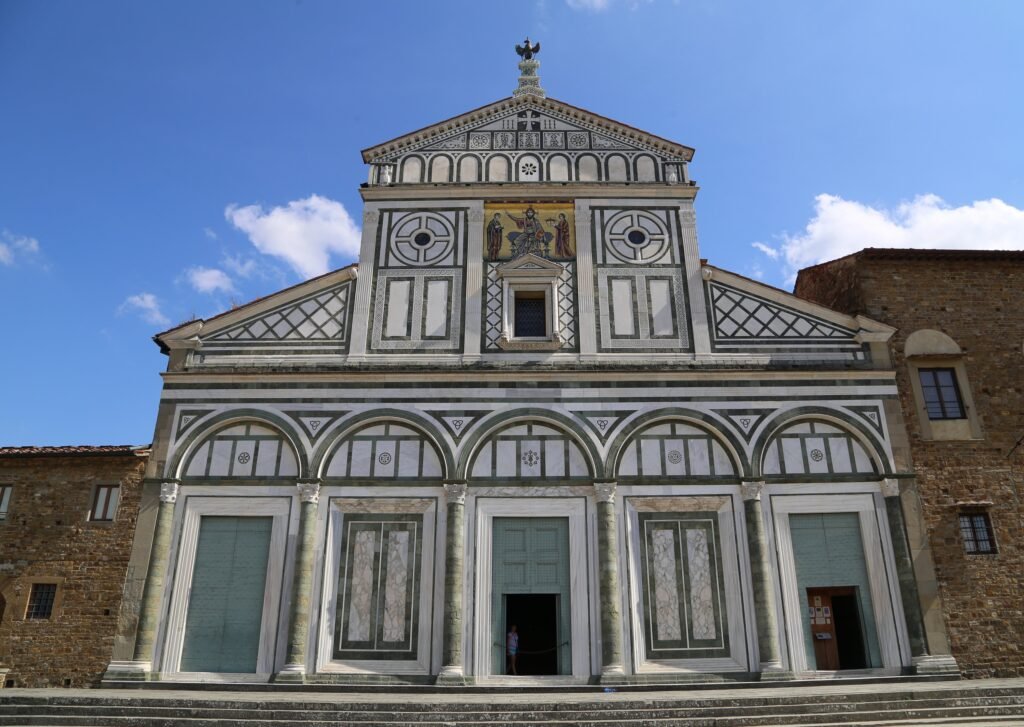
Perched on a hill above the city, this basilica genuinely predates the Duomo by centuries and offers one of Florence’s best panoramic views in the process.
San Miniato al Monte
Its current structure dating to 1013, San Miniato al Monte is genuinely one of the oldest surviving churches in Florence, its green-and-white marble facade and the sweeping city view from its hilltop terrace drawing a fraction of the crowds found at the Duomo despite arguably rivaling it for both architectural and historical significance. The church remains an active Benedictine monastery, and hearing the monks’ Gregorian chant during certain services offers a genuinely rare, contemplative experience most visitors to Florence never encounter. The basilica’s geometric marble facade, considered one of the finest surviving examples of Florentine Romanesque architecture, directly influenced the design of the Duomo’s own later facade, meaning a visit here genuinely helps explain the visual language of Florence’s most famous building, three centuries before that building even existed.
Above Piazzale Michelangelo, south of the Oltrarno. Free to enter. Best in the late afternoon, when the terrace view over Florence catches the day’s warmest light.
The Boboli Gardens’ Quiet Corners
Florence’s grand formal gardens behind the Pitti Palace hold sections most visitors never reach.
The Garden’s Outer Reaches
While the areas closest to the Pitti Palace entrance draw the bulk of Boboli’s visitors, the gardens’ outer sections, including quieter wooded paths and less-visited fountains further from the main entrance, offer a genuinely more peaceful version of the same 16th-century Medici garden design, with far fewer people to share it with. Laid out originally for Eleonora di Toledo, wife of Cosimo I de’ Medici, the gardens represent one of the earliest and most influential examples of the Italian formal garden style, a genuine template later copied by royal gardens across Europe, including at Versailles, a detail that adds real weight to what might otherwise seem like just a pleasant walk. The garden’s amphitheater, originally a quarry before its transformation into a genuine outdoor performance space, hosted early Medici court spectacles and remains one of the more overlooked architectural features within the wider grounds.
Behind the Pitti Palace, Oltrarno district. Entry fee (often combined with Pitti Palace admission). Best allotting extra time to walk toward the garden’s furthest sections, rather than turning back after the main fountains.
The Rose Garden
Just below the famous viewpoint at Piazzale Michelangelo, this smaller garden offers arguably the same view with a fraction of the crowds.
Giardino delle Rose
Created in 1865 by architect Giuseppe Poggi, the same designer responsible for Piazzale Michelangelo above it, this rose garden holds around 1,200 plants across roughly 400 varieties, along with a genuinely unexpected Japanese garden, a gift from Florence’s twin city, Kyoto, complete with a small Zen garden donated by the Kodai-ji temple. The garden’s creation coincided with a genuinely significant moment in Florence’s own history, 1865 was the year the city briefly became the capital of the newly unified Kingdom of Italy, and Poggi’s broader redesign of the city’s left bank, including this garden, was part of the urban improvements made to suit Florence’s short-lived status as a national capital, a role the city held for only about six years before Rome finally became Italy’s permanent capital. The combination of roses, sculpture, and a sweeping view over the city makes this one of Florence’s most underrated green spaces.
Below Piazzale Michelangelo, Oltrarno district. Free. Best in May or June, when the roses reach peak bloom.
Florence’s Living Craft Tradition
What genuinely sets the Oltrarno’s workshops apart from souvenir shops elsewhere in the city is the depth of skill still practiced there today. Florence’s guild system, dating back to the medieval period, organized craftspeople into powerful trade associations that shaped the city’s economy and, eventually, its politics, the Arte della Lana (wool guild) and Arte di Calimala (cloth merchants’ guild) among the most influential in funding the very buildings and art now considered essential Florence sightseeing. That guild tradition never fully disappeared, and many of the leather workers, gilders, and restorers still operating in the Oltrarno today trace their techniques directly back through generations of apprenticeship, a living connection to the same craft culture that made Renaissance Florence possible in the first place. Several workshops in the district genuinely welcome visitors to watch work in progress, a detail worth asking about directly rather than assuming a workshop is purely retail, and some even offer short hands-on classes for travelers who want to try a technique themselves rather than simply observe.
Florence vs. Rome: Pacing Your Trip
| Category | Rome | Florence |
|---|---|---|
| Scale | Sprawling, requires more transit | Compact, highly walkable |
| Historical focus | Ancient Roman & early Christian | Renaissance art & architecture |
| Pace | Faster, more overwhelming for first-timers | Slower, easier to see thoroughly |
| Best for | Ancient history, Vatican City | Art, architecture, day trips into Tuscany |
The choice between Rome and Florence genuinely comes down to pacing as much as content. Rome’s sheer scale, the Colosseum, the Forum, Vatican City, each demanding real time and often a full day on their own, makes for a faster, more physically demanding trip, especially for first-time visitors trying to see the essentials in a limited window. Florence’s much smaller historic center, by contrast, lets visitors cover the major sights at a genuinely relaxed pace within a few days, with energy left over for exactly the kind of hidden-gem wandering covered in this guide.
Budget also genuinely shifts between the two cities, Rome’s larger size means more transit costs and a wider range of accommodation prices depending on neighborhood, while Florence’s compact core means most visitors can walk everywhere, cutting transportation costs but concentrating hotel demand (and prices) into a smaller area during peak season. Many itineraries combine both cities, connected by a fast train of under 90 minutes, using Rome for ancient history and Florence for a slower, more concentrated dose of Renaissance art, a combination that plays to each city’s genuine strengths rather than asking one city to deliver an experience it isn’t really built for.
Florence Food Worth Seeking Out
Bistecca alla Fiorentina, a thick-cut, bone-in T-bone steak traditionally grilled rare over an open flame, is genuinely Florence’s signature dish, worth seeking out at a proper Tuscan trattoria rather than a tourist-oriented restaurant near the Duomo, where quality and authenticity can vary considerably, and the dish is traditionally sold by weight and meant to be shared between two people given its genuine size. Lampredotto, a traditional Florentine street food made from the fourth stomach of a cow, slow-cooked and served in a bread roll, remains a genuinely beloved local specialty, sold from small stands (trippai) throughout the city and worth trying despite, or perhaps because of, how unfamiliar it might sound to first-time visitors, it’s a dish genuinely woven into the city’s working-class food history rather than a modern novelty.
Ribollita, a hearty Tuscan bread and vegetable soup, reflects the region’s genuine tradition of resourceful, ingredient-driven peasant cooking, its name literally meaning “reboiled,” a reference to its origins as a way of using up leftover bread and vegetables, and it’s worth seeking out specifically in winter, when it’s traditionally served. And Chianti, produced in the hills just south of the city, is worth tasting directly at a small Oltrarno wine bar (an enoteca) rather than only the bottled versions found in supermarkets abroad, since the range of quality and style within the Chianti region genuinely rewards closer comparison, from everyday table wines to the more prestigious Chianti Classico designation, marked by its black rooster symbol.
I reference this Rome vs. Florence comparison in the video above. If this guide helped you plan your Florence trip, check out more travel videos from Worldly Traveler.
Whichever combination of sights you choose, the real lesson of Florence’s hidden gems is that the city rewards a genuinely slower pace than the average two-day itinerary allows. Crossing the Arno alone, walking up to San Miniato, or simply sitting in Piazza Santo Spirito for an hour with a coffee, none of these require an entrance fee or advance booking, just the willingness to step away from the handful of streets that appear on every top-ten list. That’s really the throughline connecting every place in this guide, Florence’s most rewarding corners are almost never hidden in the sense of being hard to find, they’re hidden mainly because most visitors never have the time, or the inclination, to look for them.
Frequently Asked Questions
What are the best hidden gems in Florence?
Some of the best hidden gems in Florence include the Oltrarno district’s artisan workshops, San Miniato al Monte (a hilltop basilica older than the Duomo), the Rose Garden below Piazzale Michelangelo, and the quieter corners of the Boboli Gardens.
What is the Oltrarno district?
The Oltrarno, meaning “beyond the Arno,” is the district of Florence south of the river, locally nicknamed the Diladdarno. It holds the Pitti Palace and Boboli Gardens alongside a genuinely more local, artisan-focused character than the more heavily touristed streets north of the river.
Should I visit Rome or Florence?
It genuinely depends on your priorities. Rome offers ancient history on a massive scale, the Colosseum, the Forum, Vatican City, while Florence delivers a more concentrated, walkable dose of Renaissance art and architecture within a much smaller historic center.
How many days do you need in Florence?
3-4 days gives you enough time to see the major sights, explore the Oltrarno at a relaxed pace, and take a day trip into the surrounding Tuscan countryside.
Is San Miniato al Monte older than the Duomo?
Yes. San Miniato al Monte’s current structure dates to 1013, roughly three centuries before construction began on Florence’s cathedral in 1296, making it one of the oldest surviving churches in the city.