
Berlin’s history and Munich’s beer halls anchor most first-time trips to Germany, and both cities genuinely earn their reputation. But Germany is a big, geographically varied country, sixteen states, four coastlines and mountain ranges, and centuries of fragmented regional history that left behind more castles than any single guidebook could reasonably cover. This guide, checked against a real video tour, walks through more than 20 hidden gems, organized by region so you can build a trip around whichever corner of the country genuinely calls to you.
Berlin, Munich & Neuschwanstein: The Brandenburg Gate, Oktoberfest, and Germany’s most famous fairytale castle remain worth building a first trip around. This guide picks up from there.
What’s easy to forget about Germany, coming at it as a single modern country, is that it wasn’t unified until 1871, and even after that, it stayed a patchwork of kingdoms, duchies, and free cities in cultural memory long after the political map changed. That fragmented history is exactly why the country holds such an enormous density of castles, walled towns, and distinct regional identities. Bavaria still feels meaningfully different from Saxony, which feels different again from the Rhineland, and a lot of what makes this country rewarding to explore slowly is watching those differences show up in the architecture, the food, and even the dialect as you move from one region to the next.
That regional variety also means Germany rewards a road trip more than almost any other travel style. Unlike a country built around one or two dominant cities, Germany’s most memorable stops are often small towns, forest trails, and river valleys that never appear on a typical two-city itinerary. Renting a car and threading together a handful of these hidden gems, rather than sticking to a rail pass between major stations, genuinely changes the character of a trip here, turning it into something closer to a slow unfolding of the country’s older, stranger corners than a checklist of capital cities.
Bavaria Beyond Munich
The Romantic Road & Black Forest
The Rhine & Mosel Valleys
Eastern Germany
Germany’s Castle Country
Comparing Germany’s Castle Regions
German Food & Beer Worth Seeking Out
Best Time to Visit Germany
FAQ
Bavaria Beyond Munich
Germany’s largest state holds far more than Munich’s beer gardens, stretching south into genuinely dramatic alpine terrain right up against the Austrian border.
Königssee
Often called Germany’s most beautiful lake, Königssee sits inside Berchtesgaden National Park, its water so still and clear it takes on a deep emerald color on a calm day. Boat tours run silently, powered by electric motors rather than engines, to protect the surrounding acoustics, and partway across, a trumpeter traditionally plays a note toward the cliffs to demonstrate the lake’s genuinely remarkable echo. The small pilgrimage church of St. Bartholomä, with its distinctive onion domes, sits on a peninsula only reachable by boat.
Berchtesgadener Land, Bavaria, near the Austrian border. Free lake access; boat tour fee. Best in the early morning, when the water is calmest and the echo demonstration carries furthest.

Berchtesgaden Salt Mine
Salt has been mined in this valley since 1517, and the historic mine remains active as a tourist attraction, visitors ride a small train deep into the mountain, then slide down wooden miners’ chutes to reach an underground salt lake, crossed by raft, before finding their way back to the surface. It’s a genuinely playful way to spend an afternoon that also happens to be five centuries of real industrial history.
Berchtesgaden, Bavaria. Entry fee, includes the full underground tour. Best combined with a Königssee visit, given the short distance between the two.
Partnach Gorge
A narrow limestone gorge near Garmisch-Partenkirchen, its walkway carved directly into the rock face just above a rushing mountain stream, with waterfalls crashing down from above at several points along the route. In winter, the gorge partially freezes, creating a genuinely different, ice-draped version of the same walk.
Garmisch-Partenkirchen, Bavaria. Small entry fee. Best in late spring, when snowmelt keeps the waterfalls running at full force.
Mittenwald
A genuinely picturesque Alpine town known for its centuries-old violin-making tradition, its main street lined with painted facades depicting religious and folk scenes, a Bavarian decorative style called Lüftlmalerei found across this part of the Alps but rarely displayed this densely in one place.
Bavaria, near the Austrian border. Free to explore. Best in summer, when the surrounding mountain trails are fully accessible for day hikes out of town.
Mainau Island
Known genuinely as the “Flower Island,” this small island in Lake Constance was transformed by generations of the Bernadotte family, a branch of the Swedish royal line, into an elaborate botanical showcase, its rose gardens, palm house, and butterfly conservatory drawing garden enthusiasts from across the country each summer.
Lake Constance, Baden-Württemberg. Entry fee. Best in June, when the island’s roses reach peak bloom.
The Devil’s Table (Teufelstisch)
A striking sandstone rock formation in the Palatinate Forest, its wide, table-like cap balanced improbably atop a narrow eroded stem, shaped over millions of years by wind and water into a form that looks genuinely engineered rather than natural.
Hinterweidenthal, Rhineland-Palatinate. Free, reached via a moderate forest hike. Best combined with a broader Palatinate Forest hiking day, given the trailhead’s rural location.
The Romantic Road & Black Forest
Stretching across southern and western Germany, this stretch holds the country’s densest concentration of walled medieval towns and dark, storybook forest.
Rothenburg ob der Tauber’s Secret Gardens
Rothenburg’s walled old town is well known as one of the best-preserved medieval towns in Germany, but its quieter garden terraces, tucked along the town walls and overlooking the Tauber valley below, draw a fraction of the crowds that pack the main market square.
Bavaria, on the Romantic Road. Free to explore. Best in the early morning or evening, when the main square’s day-trip crowds have thinned.
Hohenzollern Castle
Perched on a steep hilltop and visible for miles across the surrounding countryside, this 19th-century castle was built as the ancestral seat of the Hohenzollern dynasty, the family that would go on to rule Prussia and, eventually, a unified German Empire.
Baden-Württemberg. Entry fee. Best on a clear day for the sweeping views from the castle terraces.
Triberg Waterfalls
Among the highest waterfalls in Germany, tumbling roughly 500 feet down through the Black Forest in a series of dramatic cascades, reached via a well-marked forest trail that makes the full descent manageable for most fitness levels.
Triberg im Schwarzwald, Baden-Württemberg. Small entry fee. Best in spring, when snowmelt from higher elevations keeps the falls running strongest.
Oberammergau
A genuinely storybook Bavarian village, its buildings covered in the same Lüftlmalerei painted facades found in Mittenwald, though Oberammergau is most famous for its Passion Play, a religious performance staged only once every ten years by the town’s own residents, a tradition dating back to 1634.
Bavaria. Free to explore. Best checking the Passion Play schedule if timing a visit around the decade-long tradition specifically.
The Rhine & Mosel Valleys
Germany’s most storied rivers cut through steep, vineyard-covered hills, past castles that inspired centuries of Romantic-era art and legend.
Eltz Castle
Hidden in a forested valley above the Mosel River, Eltz is one of the only castles in the Eifel region never destroyed by war or siege, and it’s still owned by the same family that has held it since the 12th century. Its cluster of turrets, built up over generations by different branches of the same family sharing the property, gives it a genuinely fairy-tale silhouette that’s drawn photographers for well over a century.
Wierschem, Rhineland-Palatinate. Entry fee for the interior tour; free to view exterior via the forest trail. Best arriving via the roughly 20-minute forest walk from the parking area, since it approaches the castle from its most photogenic angle.

The German Wine Route’s Secret Cellars
Germany’s oldest wine route, running roughly 53 miles through the Palatinate region, connects small family-run wineries and cellars that have produced Riesling here for centuries, many still using cave-like cellars carved directly into the region’s soft sandstone hillsides.
Rhineland-Palatinate, along the Deutsche Weinstraße. Tasting fees vary by producer. Best in September or October, during the harvest.
Regensburg’s Old Stone Bridge
Completed in 1146, this bridge across the Danube was, for centuries, considered one of the great engineering achievements of medieval Europe, and it’s still standing largely intact today, connecting Regensburg’s remarkably well-preserved medieval old town to the far bank.
Regensburg, Bavaria. Free to walk. Best combined with a walk through Regensburg’s old town, a UNESCO World Heritage Site in its own right.
Monschau
Tucked into a narrow, steep-sided valley near the Belgian border, Monschau’s half-timbered houses climb the hillside above the Rur River in a way that makes the whole town feel genuinely frozen somewhere in the 18th century, when its wealth came from a once-thriving cloth-making industry.
North Rhine-Westphalia, near the Belgian border. Free to explore. Best in the late afternoon, when the light picks out the town’s steep, colorful rooftops.
Eastern Germany
The formerly divided east holds genuinely underrated medieval towns and one of the country’s strangest natural formations.
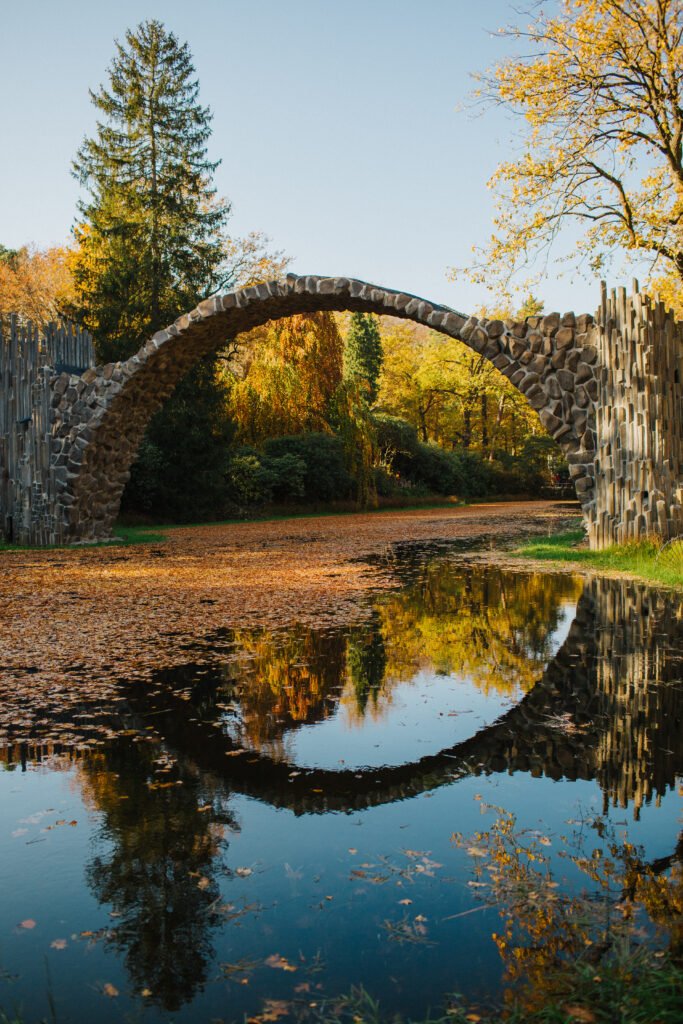
Rakotzbrücke, the Devil’s Bridge
Built in the 1860s inside a private estate’s landscaped park, this delicate stone arch was never meant for practical crossing, it was designed purely so that, when reflected in the still water of the lake below, it would appear to form a perfect circle. That precision, combined with the bridge’s genuinely improbable, spindly construction, gave rise to the local legend that only the devil could have built it.
Kromlauer Park, near Gablenz, Saxony. Small parking fee; park entry free. Best on a windless morning, when the water is calm enough for the full circular reflection to appear.
Quedlinburg
A UNESCO World Heritage town holding more than 1,300 timber-framed buildings, spanning six centuries of German architectural styles within a single old town, largely untouched by the bombing that destroyed so many other historic German city centers during the Second World War.
Saxony-Anhalt. Free to explore. Best allotting a full day, given how much of the town rewards slow, unhurried wandering.

Wernigerode Castle
Rising above the timber-framed town of Wernigerode, this castle’s current romantic, turreted appearance is largely the result of a 19th-century renovation, transforming a much older fortress into the fairy-tale silhouette that draws visitors to the Harz Mountains region today.
Wernigerode, Saxony-Anhalt. Entry fee. Best combined with a walk through Wernigerode’s own well-preserved timber-framed old town below.
The Fairy Grottoes of Saalfeld
A former alum slate mine, abandoned in the 19th century and later flooded, whose walls developed a genuinely unusual mineral coating over subsequent decades, creating a cave interior of vivid, almost unnatural color that earned it recognition in the Guinness World Records for the most colorful cave on Earth.
Saalfeld, Thuringia. Entry fee, guided tour only. Best booking ahead during peak summer season, since tour group sizes are limited.
Externsteine
A striking formation of tall sandstone pillars rising from the Teutoburg Forest, believed to have held religious significance for pre-Christian Germanic peoples and later adapted for Christian use, a genuinely mysterious site whose exact original purpose remains debated among historians.
Horn-Bad Meinberg, North Rhine-Westphalia. Small entry fee. Best at sunset, when the rock formations catch the day’s last light.
Spreewald
A UNESCO biosphere reserve built around a network of small canals branching off the Spree River, traditionally navigated by flat-bottomed punt boats, its distinctive Sorbian culture (a Slavic minority with its own language and traditions) still visible in the region’s food, most notably its genuinely famous pickles.
Brandenburg, southeast of Berlin. Free to explore; punt boat tours priced separately. Best by boat, since much of the region’s charm is only accessible via its waterways.
Sylt
Germany’s northernmost island, its windswept dunes and long, sandy beaches genuinely feel more like a piece of Scandinavia than typical German coastline, a favored escape for wealthy Hamburg and Berlin residents since the early 20th century, when the island’s dramatic cliffs and thatched-roof houses first drew a wave of artists and vacationers.
Schleswig-Holstein, North Sea. Free beach access; a car train (since no road bridge exists) is required to reach the island. Best in late summer for the most reliable beach weather this far north.
Germany’s Castle Country
Germany holds somewhere between 20,000 and 25,000 castles and palaces, depending on how loosely the term is defined, a genuinely staggering number that reflects centuries of political fragmentation into small, competing territories, each with its own ruling family eager to build a fortress or a residence to match its rivals. That density means castle-hopping is a genuinely realistic way to structure an entire German road trip, and different regions developed distinct architectural personalities depending on when and why their castles were built.
Comparing Germany’s Castle Regions
Not every castle region offers the same experience, and knowing the general character of each area genuinely helps with planning a route.
| Region | Castle Style | Standout Example | Best For |
|---|---|---|---|
| Mosel Valley | Medieval hilltop fortresses, largely original | Eltz Castle | Travelers who want genuinely old, unrestored medieval architecture |
| Bavaria | 19th-century Romantic reconstructions | Neuschwanstein, Hohenzollern | Travelers drawn to the fairy-tale, storybook aesthetic |
| Harz Mountains | Renovated medieval castles above timber-framed towns | Wernigerode Castle | Combining castle visits with well-preserved old towns |
| Rhine Gorge | Riverside fortresses, dense concentration | Marksburg, Rheinstein | A castle-hopping river cruise or driving route |
German Food & Beer Worth Seeking Out
Germany’s food culture shifts noticeably by region, and Bavaria’s hearty, pork-and-potato-based cooking, pretzels, weisswurst, schnitzel, is really only one regional slice of a much broader picture. The Rhineland and Mosel region leans into its wine tradition, with Riesling produced along steep river-valley vineyards considered among the finest in the world, worth tasting directly at a small family cellar rather than a supermarket bottle. Eastern Germany’s food culture carries genuine Slavic and Central European influence, particularly in Spreewald’s pickle tradition and Saxony’s Stollen, a dense, fruit-and-marzipan Christmas bread with roots tracing back to the 15th century.
German beer, protected since 1516 by the Reinheitsgebot purity law limiting ingredients to water, barley, and hops, genuinely varies by region too, Bavaria’s wheat beers, Cologne’s light Kölsch, and Berlin’s tart Berliner Weisse are different enough to feel like separate traditions rather than variations on one national drink. Along the northern coast near Sylt, expect a genuinely different culinary focus entirely, fresh herring, crab, and other North Sea seafood prepared far more simply than the heavier southern German cooking most visitors expect. And regional sausage traditions alone could fill a guide of their own, Nuremberg’s small, finger-length bratwurst is a genuinely different product from Thuringia’s longer grilled version, and locals in each region will happily explain, at length, why theirs is the superior one.
Best Time to Visit Germany
May through September offers the most comfortable temperatures and full access to hiking trails, gorges, and mountain routes, with July and August representing the busiest, most crowded stretch of the year at the country’s most famous sites. Spring brings comfortable temperatures for exploring the Rhine and Mosel valleys, along with the start of the wine region’s growing season. Late November through December transforms towns across the country with Christmas markets, a genuinely significant seasonal tradition worth planning a trip around if the timing allows, particularly in well-known market towns like Nuremberg and Dresden. Winter outside the Christmas market season brings a quieter, colder version of the country, and while many outdoor attractions reduce their hours, cities and museums remain fully open and considerably less crowded.
I cover all of these hidden gems in the video above. If this guide helped you plan your Germany trip, subscribe to Worldly Traveler on YouTube for more travel guides from around the world.
Frequently Asked Questions
What are the best hidden gems in Germany?
Some of the best hidden gems in Germany include Rakotzbrücke (the Devil’s Bridge, which forms a perfect circle in the water), Eltz Castle, Königssee, the timber-framed town of Quedlinburg, and the Partnach Gorge near Garmisch-Partenkirchen.
Why is Rakotzbrücke called the Devil’s Bridge?
Built in the 1860s purely for aesthetic effect rather than practical crossing, the bridge’s arch was so delicate and its symmetry so precise that local folklore attributed its construction to the devil, a legend attached to several similarly dramatic bridges across Europe.
How many days do you need to explore Germany’s hidden gems?
2-3 weeks allows a well-paced trip covering Bavaria, the Rhine and Mosel valleys, and a stretch of Eastern Germany. A shorter 7-10 day trip works well focused on just Bavaria and the Romantic Road.
What is the best time of year to visit Germany?
May through September offers the most comfortable temperatures and full access to hiking trails and gorges, while late November and December bring Germany’s famous Christmas markets to towns across the country.
Do you need a car to explore Germany’s hidden gems?
A car genuinely helps for most of the destinations in this guide, though Germany’s rail network is excellent and connects many larger towns, making a mixed approach of trains for cities and a rental car for rural stretches often the most practical.